Italian Concerto In F Major, BWV 971 Sheet Music Preview

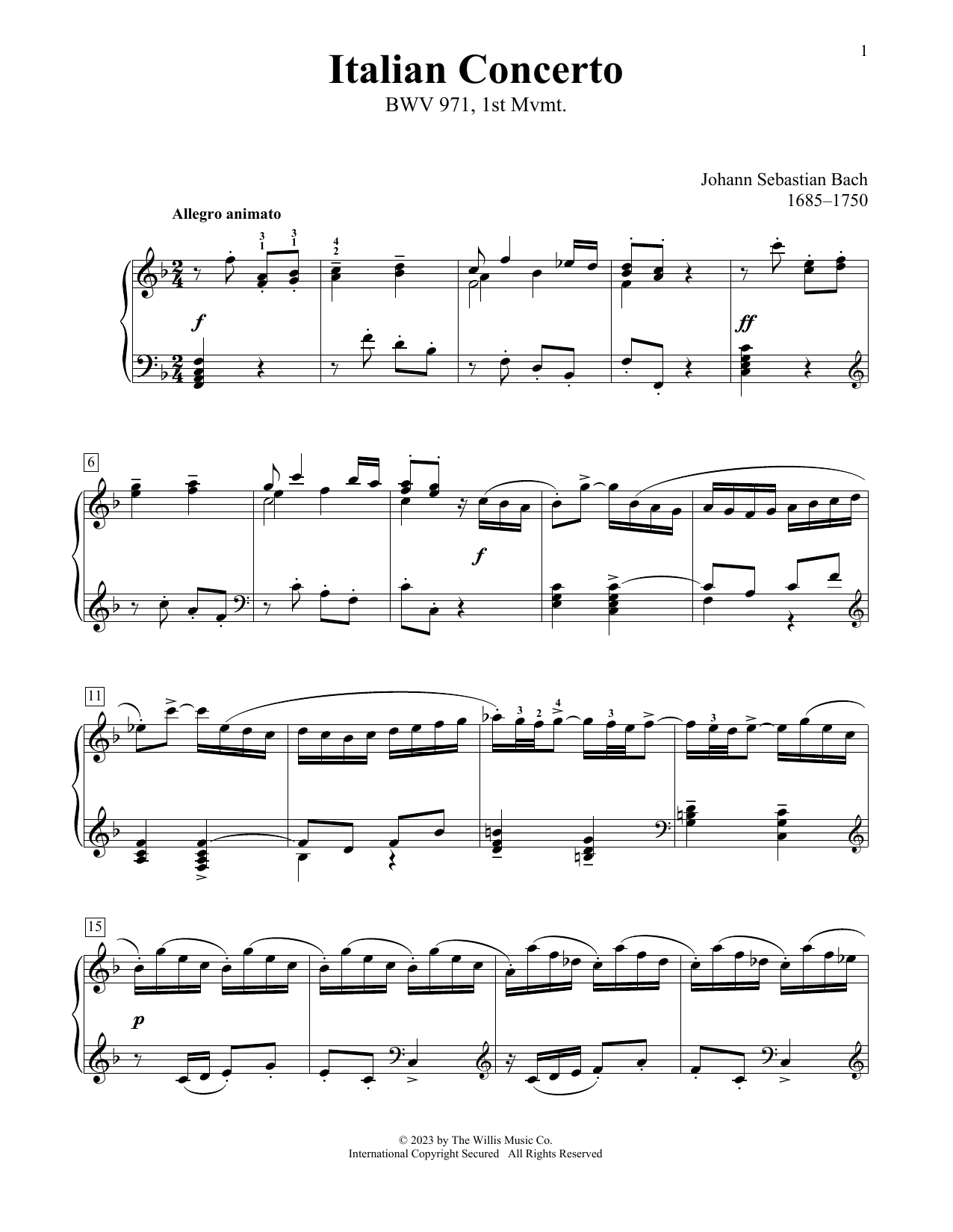
Italian Concerto In F Major, BWV 971: Educational Piano

Edited by Charmaine Siagian / Edited by Sonya Schumann

Item: 35-DS01340334

Digital Download
$4.99
One moment…
Description

Discover MakeMusic Cloud: thousands of interactive titles your students can play along with today.

Sample Audio
No sample audio found.
Sample Video
Additional Details
Publisher: Hal Leonard
Page Count: 10
SKU: 35-DS01340334

More about this title

About the Creator: Johann Sebastian Bach

Johann Sebastian Bach composed the Italian Concerto in F Major, BWV 971, during his years in Köthen, a period when he was deeply engaged with keyboard music and instrumental forms influenced by Italian composers. The work represents Bach's synthesis of Italian concerto style with German keyboard writing, demonstrating his ability to absorb and transform musical idioms from across Europe.

This two-keyboard concerto was originally conceived for harpsichord, though Bach's writing translates beautifully to the modern piano. The piece showcases his mastery of contrast between two distinct musical voices, with rapid figuration trading places against slower, singing lines in a structure that mirrors the fast-slow-fast design of Italian instrumental concertos.

Why we love this

This edition strips away unnecessary complications and lets the architecture of Bach's writing emerge clearly on the page. Students encounter genuine dialogue between two independent voices without the textural density of some other Bach keyboard works, making it an ideal gateway into his contrapuntal thinking while remaining genuinely rewarding to perform.

What to expect

Bright and energetic in the outer movements, with rapid figuration that sparkles across the keyboard while maintaining a sense of formal architecture and purposeful design. The middle section offers a moment of genuine lyricism, a singing cantabile that provides welcome contrast before the final return to brilliance and motion.

Who it's for

Intermediate to early advanced pianists ready to engage with Bach's keyboard style without the complexity of the Goldberg Variations or the French Suites. This edition works equally well for students tackling Baroque counterpoint for the first time and for those preparing for music theory or performance competitions that frequently feature BWV 971.

How to get the most out of it

  • Articulate the rapid passagework with clarity and precision. Each sixteenth-note figure should speak distinctly rather than blur together, which means imagining these runs as sequences of individual notes rather than as connected scalar lines.
  • Shape the slower middle section with long-line phrasing. Resist the urge to stop at every bar line; instead, allow the melody to breathe and sing across the full arc of each phrase.
  • Listen for the concerto element embedded in the writing. The two hands often function as independent instrumental voices presenting and responding to material, so think orchestrationally rather than pianistically when considering balance and independence.
  • Maintain even rhythmic control throughout the fast sections. The intricate interplay between hands demands absolute steadiness of pulse, particularly when passages in one hand continue while the other articulates shorter figures.

How to use it

Feature this as a solo piano offering on a recital devoted to Baroque keyboard works, or program it alongside Italian Concerto movements by Vivaldi or Marcello to illustrate Bach's engagement with Italian instrumental forms. It also serves as an excellent capstone repertoire piece for intermediate piano students completing a Baroque unit in their studies.

Skills your students will build

  • Reading and executing two-voice counterpoint with independent hand coordination
  • Managing rapid sixteenth-note passagework at a controlled tempo
  • Distinguishing between linear melodic phrasing and accompanying figuration
  • Balancing articulation and legato across different musical layers
  • Interpreting Baroque ornamentation and the relationship between structural harmony and decorative figuration

You May Also Like