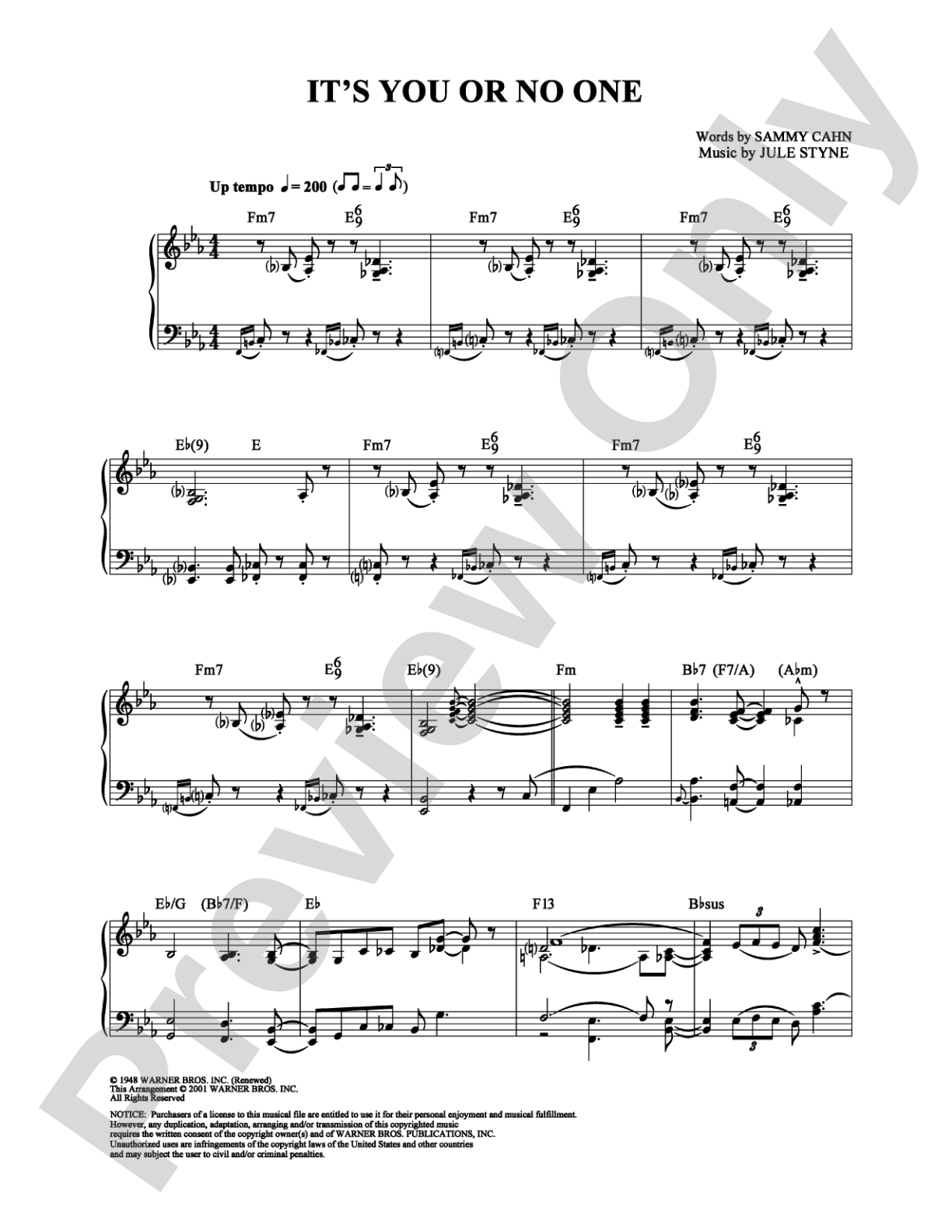
It's You or No One: Piano Digital Sheet Music

It's You or No One: Piano Digital Sheet Music

Jule Styne, George Shearing

Item: 00-PS-0002062

Digital Download
$3.99
Description

It's You or No One: Piano Digital Sheet Music isn't in MakeMusic Cloud just yet...but it could be. Let us know you'd like to see it, and you'll help shape what comes next. In the meantime, start a free trial and dive into thousands of interactive titles your students can play along with today.

Sample Audio
No sample audio found.
Sample Video
Additional Details
SKU: 00-PS-0002062

More about this title

About the Artist: George Shearing

George Shearing (1919-2011) was a British jazz pianist whose harmonic sophistication and touch redefined small-group jazz in the 1950s. Blind from birth, Shearing developed an instantly recognizable sound built on locked-hands voicings and a gift for melody that made him one of the most commercially successful jazz artists of his era. His interpretations of standards became models for jazz pianists studying voice leading and comping technique.

Why we love this

Shearing's approach to this standard rewards close listening to his harmonic choices and reharmonization work. The piece demonstrates how a master improviser interprets a familiar melody while maintaining clarity and swing, making it valuable study material for jazz students learning to balance respect for a tune with personal voice.

What to expect

Elegant and conversational, with a touch of wistfulness. The melody unfolds with unhurried grace while the accompaniment locks in with a gentle but unmistakable swing. There's refinement without pretense, warmth without sentimentality.

Who it's for

Jazz pianists studying standard interpretation, reharmonization, and swing feel will find a clear model in Shearing's approach. This works equally well for pianists developing their listening library of great jazz recordings or building repertoire for jazz recitals and ensemble playing.

How to get the most out of it

  • Study the voicings Shearing uses in the head; they're teaching moments in themselves, showing how to voice chords with independence and color rather than default shapes.
  • Lock into his rhythmic feel by listening closely to how he sits with the beat rather than pushing ahead. The apparent simplicity of his touch masks careful attention to placement.
  • Work the left hand ostinato or comping pattern separately until it feels like accompaniment to your right hand, not two independent parts fighting for attention.
  • Resist rushing the phrases; Shearing's phrasing often sits just behind the beat in ways that create space and sophistication.

How to use it

Include this in a jazz standards recital to show range beyond up-tempo swingers, or use it as a study piece when teaching students how to reharmonize and personalize familiar material. It pairs well with other ballad-tempo standards in a student listening and analysis unit.

Skills your students will build

  • Analyzing and voicing jazz harmony using extended and altered chords
  • Interpreting swing feel at slower tempos
  • Comping and accompaniment techniques in left hand while solo melody is in right
  • Reharmonization and melodic interpretation of standard repertoire
  • Listening for phrasing subtlety and rhythmic placement

You May Also Like