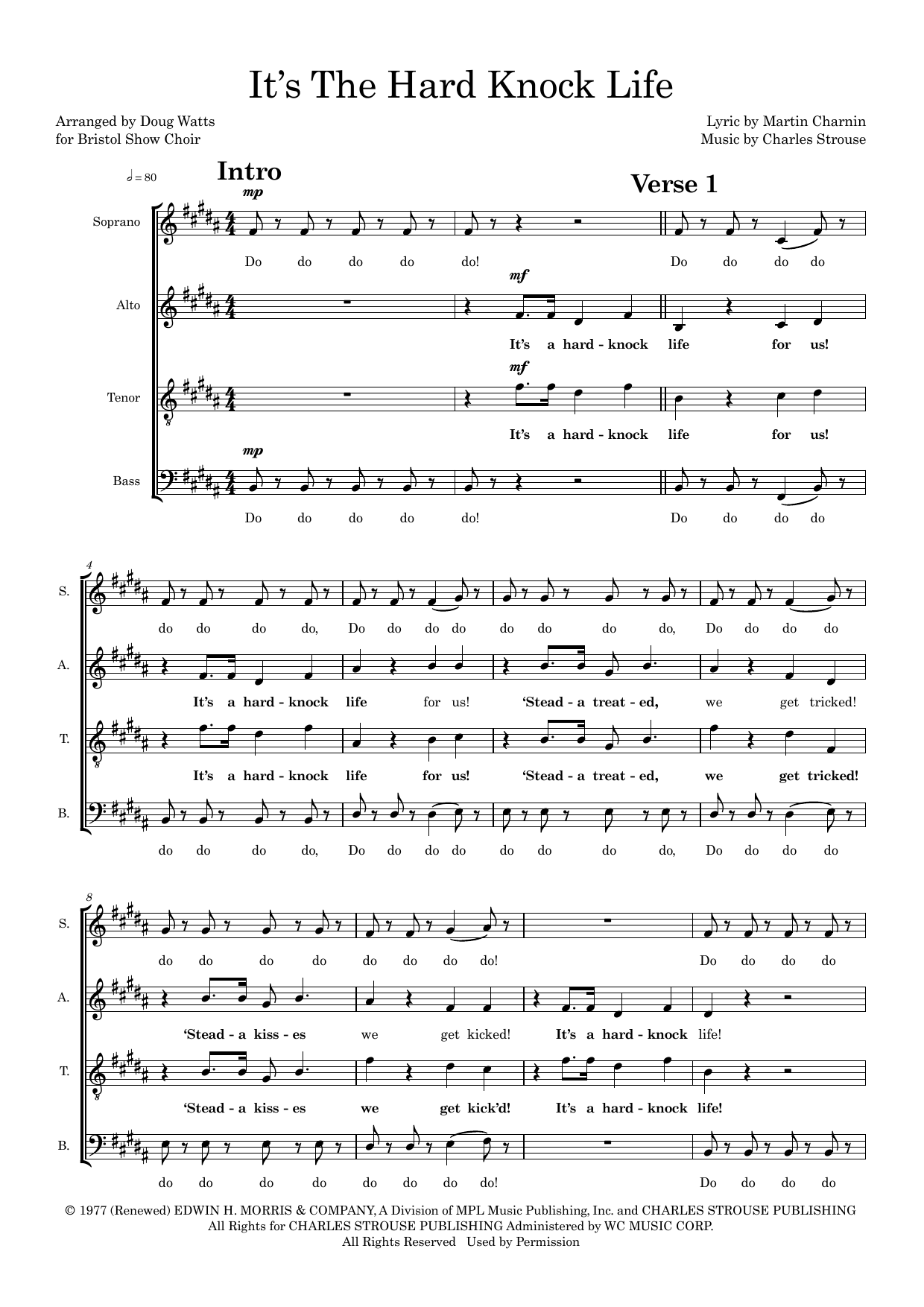
It's The Hard Knock Life (arr. Doug Watts) Sheet Music Preview

It's The Hard Knock Life (arr. Doug Watts): SATB Choral Octavo

As performed by Charles Strouse Martin Charnin / Arranged by Doug Watts

Item: 35-DS01397489

Digital Download
$1.99
Description

It's The Hard Knock Life (arr. Doug Watts): SATB Choral Octavo isn't in MakeMusic Cloud just yet...but it could be. Let us know you'd like to see it, and you'll help shape what comes next. In the meantime, start a free trial and dive into thousands of interactive titles your students can play along with today.

Sample Audio
No sample audio found.
Sample Video
Additional Details
Publisher: Hal Leonard
Page Count: 10
SKU: 35-DS01397489

More about this title

About the Artist: Charles Strouse Martin Charnin

Charles Strouse composed the music for Annie, the 1977 Broadway phenomenon that became a cultural landmark. His gift for memorable melody and theatrical storytelling made him one of the most successful composers in American musical theater, with a career spanning decades and multiple Tony Award wins. Strouse's ability to write songs that resonate with both children and adults changed the landscape of family-oriented musical theater.

Martin Charnin, the lyricist behind Annie, crafted words that matched Strouse's melodies with wit, heart, and accessibility. His lyrics for the show became instantly recognizable and have been sung by countless performers across generations. Charnin's contribution to American musical theater extends well beyond Annie, but this collaboration represents one of the most enduring partnerships in the genre.

Why we love this

Doug Watts has captured the infectious energy and defiant optimism of this showstopper in an SATB arrangement that feels both respectful to the original and genuinely singable for school choirs. The voicing lets you balance accessibility with musical substance, giving every section a moment to shine while maintaining that propulsive groove that makes the song so irresistible. Programming this offers an instant connection with your audience, especially younger singers who grow up with Annie's legacy.

What to expect

Scrappy, resilient, and unapologetically upbeat. The arrangement captures the street-smart optimism of the original song, with moments that feel almost conversational before lifting into fuller, more expansive sections. There's an underlying current of infectious joy beneath the sass, making it feel earned rather than forced.

Who it's for

School choirs looking for a contemporary pop arrangement with real musical substance and undeniable audience appeal. This works equally well for mixed groups of intermediate skill and above who want to explore musical theater repertoire with style and purpose.

How to get the most out of it

  • Lock in the rhythmic pulse early in rehearsal. The forward momentum of this arrangement depends on precision in the rhythmic figures, particularly where voices overlap or enter staggered.
  • Shape the dynamic trajectory carefully. Resist the urge to start loud; build from a grounded, confident beginning toward the payoff moments so the piece has room to land with impact.
  • Balance the text delivery with the musical lines. The lyrics carry attitude and specificity, so encourage singers to inhabit the character and intention behind the words rather than simply executing notes.
  • Use the divisi sections strategically. When the arrangement splits voices, ensure each part has enough independence in rehearsal that blend happens naturally rather than through over-singing.

How to use it

This belongs on a concert celebrating American musical theater or a program exploring songs of resilience and hope. It also works beautifully as a closer for informal settings or pops concerts where audience engagement matters. The piece has enough musicality to stand alone but also pairs naturally with other theatrical selections from the same era.

Skills your students will build

  • Maintaining rhythmic precision in syncopated pop-style writing
  • Blending and balancing voices within divisi passages
  • Interpreting character and intention through text and phrasing
  • Managing dynamic contrast and building structural momentum
  • Navigating the intersection of theatrical style and choral technique

You May Also Like