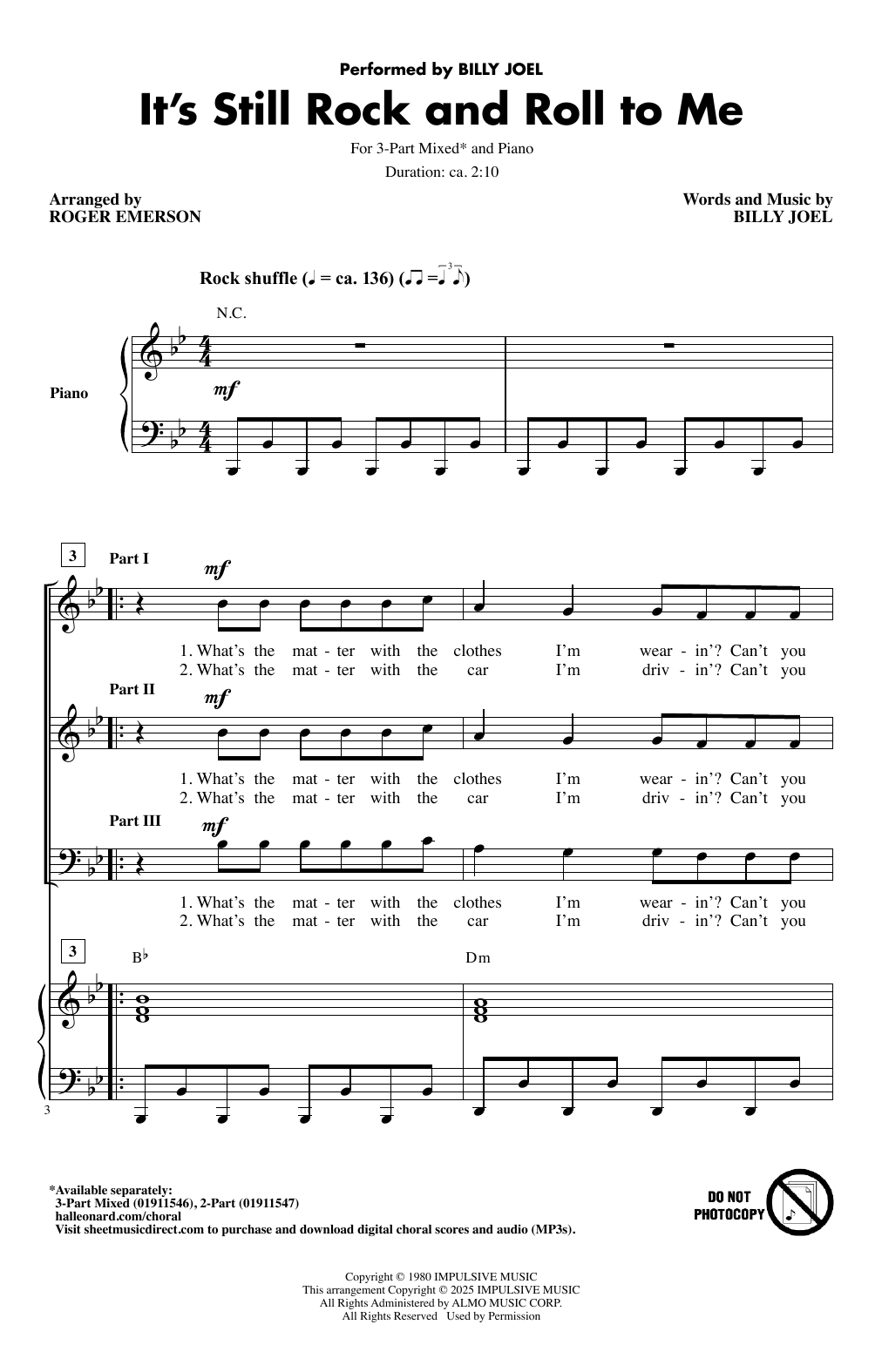
Billy Joel stands as one of the most successful singer-songwriters in popular music history, with a catalog spanning five decades. His gift for crafting memorable melodies and incisive lyrics about everyday life earned him a devoted global audience and numerous Grammy Awards. In music education settings, his work demonstrates how strong harmonic writing and storytelling can thrive within rock and pop idioms.
Why we love this
Roger Emerson's arrangement captures the conversational wit and rhythmic momentum of Joel's original without losing the song's essential humor. The 3-part mixed voicing sits comfortably for most ensembles while maintaining genuine harmonic interest, and the pop sensibility feels current rather than dated. Directors find this piece energizes singers and audiences alike, making it a genuine crowd-pleaser that doesn't require apology.
What to expect
The track bounces with the irreverent energy of 1980s pop radio, full of self-aware commentary and rhythmic lift. Singers feel the satisfaction of executing tight ensemble work while delivering a song that genuinely makes people smile. It's the musical equivalent of a knowing wink, delivered with precision and joy.
Who it's for
Mixed choirs at the middle school through community level will find this piece accessible and immediately gratifying. It works particularly well for ensembles seeking contemporary repertoire that engages both singers and listeners without requiring extensive vocal maturity.
How to get the most out of it
Nail the rhythmic precision of the vocal lines; the syncopation and staggered entries give the piece its personality, so rehearse the parts separately before combining them.
Lean into the conversational delivery of the text. This song thrives on attitude and specificity, so encourage singers to understand what they're singing about rather than treating it as pure melody.
Balance the inner parts carefully. The arrangement likely weaves supporting harmonies that need clarity; resist the urge to let them disappear beneath a strong melody line.
Use the recorded accompaniment as a reference, but make sure your own ensemble's tempo feels natural and propulsive rather than metronomic.
How to use it
Drop this into spring concerts or lighter programming moments where you want to shift energy and remind your audience that choral music lives well beyond art songs and show tunes. It pairs naturally with other contemporary pop arrangements or serves as an accessible finale that leaves everyone in a good mood. Consider it a gateway piece for singers hesitant about their vocal abilities.
Skills your students will build
Rhythmic precision in syncopated pop idioms
Part independence in 3-part mixed voicing
Text interpretation and conversational delivery
Ensemble balance with multiple simultaneous melodic lines
Confidence singing contemporary arranged material
You May Also Like
Scan to Complete Your Purchase
Use your phone's camera to scan the code below
You'll log in on your phone and the order will be added to your account