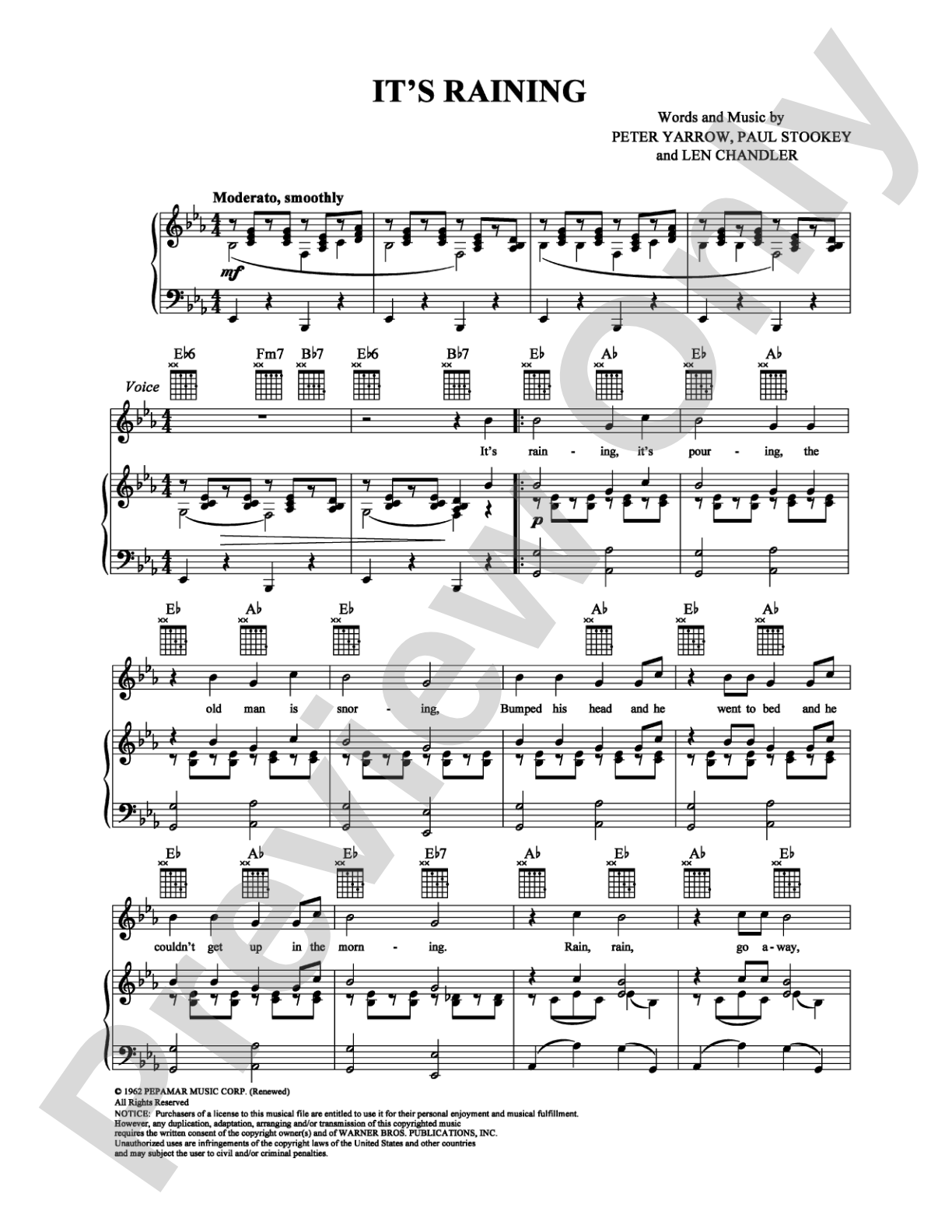
It's Raining: Piano/Vocal/Chords Digital Sheet Music

It's Raining: Piano/Vocal/Chords Digital Sheet Music

Peter Yarrow, Paul Stookey, Peter Paul & Mary, Len Chandler

Item: 00-PS-0002271

Digital Download
$3.99
Description

It's Raining: Piano/Vocal/Chords Digital Sheet Music isn't in MakeMusic Cloud just yet...but it could be. Let us know you'd like to see it, and you'll help shape what comes next. In the meantime, start a free trial and dive into thousands of interactive titles your students can play along with today.

Sample Audio
No sample audio found.
Sample Video
Additional Details
SKU: 00-PS-0002271

More about this title

About the Artist: Peter Paul & Mary

Peter, Paul and Mary emerged from the American folk revival of the early 1960s to become one of the era's most influential vocal groups. Their blend of acoustic guitar, tight three-part harmony, and socially conscious songwriting made them champions of both folk tradition and contemporary social issues. The trio's ability to arrange traditional and original songs for accessible vocal performance established them as essential voices in American popular music education.

Beyond their studio recordings, Peter, Paul and Mary demonstrated remarkable skill in vocal arrangement and ensemble singing. Their interpretations of folk material showed how traditional songs could resonate with modern audiences, a principle that continues to shape music education repertoire today. Teachers and students alike turn to their work as models for thoughtful vocal blend, clear diction, and meaningful musical communication.

Why we love this

This arrangement captures the accessible warmth that made Peter, Paul and Mary essential to American musical literacy. The piano/vocal/chords format invites singers to explore how three-part harmony sits within a supportive harmonic framework, making it ideal for teaching voice leading and ensemble blend in an intimate setting.

What to expect

Gentle and reflective, with the easy intimacy of voices gathered around an acoustic instrument. The piece carries the quiet optimism characteristic of the folk idiom, where simple melodies and accessible harmonies create space for singers to connect emotionally with the text rather than struggle with technical demands.

Who it's for

Singers seeking accessible repertoire with genuine folk roots and strong three-part harmony will find this arrangement welcoming and musically rewarding. Community choirs, school ensembles, and adult singers returning to music education benefit from material that combines singable melodies with meaningful lyrics. Accompanists working in folk or contemporary styles will appreciate the straightforward chord progression and lyric-driven arrangement.

How to get the most out of it

  • Pay attention to vowel consistency across the three vocal lines. The folk idiom depends on natural, unforced blend rather than classical technique; singers should maintain warm, centered vowels without oversinging.
  • Use the chord symbols as a foundation for accompaniment choices. Whether playing simple block chords or adding light comping, keep the piano texture transparent enough that the lyrics remain the emotional center.
  • Shape phrases by listening to how the melody and harmony interact. Folk arrangements often benefit from subtle dynamic shaping that follows the natural speech rhythm of the text rather than rigid metric phrasing.
  • Balance the three vocal parts so no single line dominates. In unison or octave passages, ensure the group sounds unified; in three-part sections, let each line be heard without forcing projection.

How to use it

This works beautifully in a concert celebrating American folk heritage or pairing established classics with contemporary covers and arrangements. It can anchor a set of three-part songs suitable for community or educational ensembles, or serve as a bridge between traditional folk repertoire and singer-songwriter material that appeals to adult learners.

Skills your students will build

  • Reading and balancing three-part vocal harmony
  • Interpreting chord symbols in a folk or contemporary style
  • Shaping phrases through text and harmonic movement rather than metric accent
  • Blending voices while maintaining clear individual line identity
  • Understanding how accompaniment supports rather than overshadows a vocal line

You May Also Like