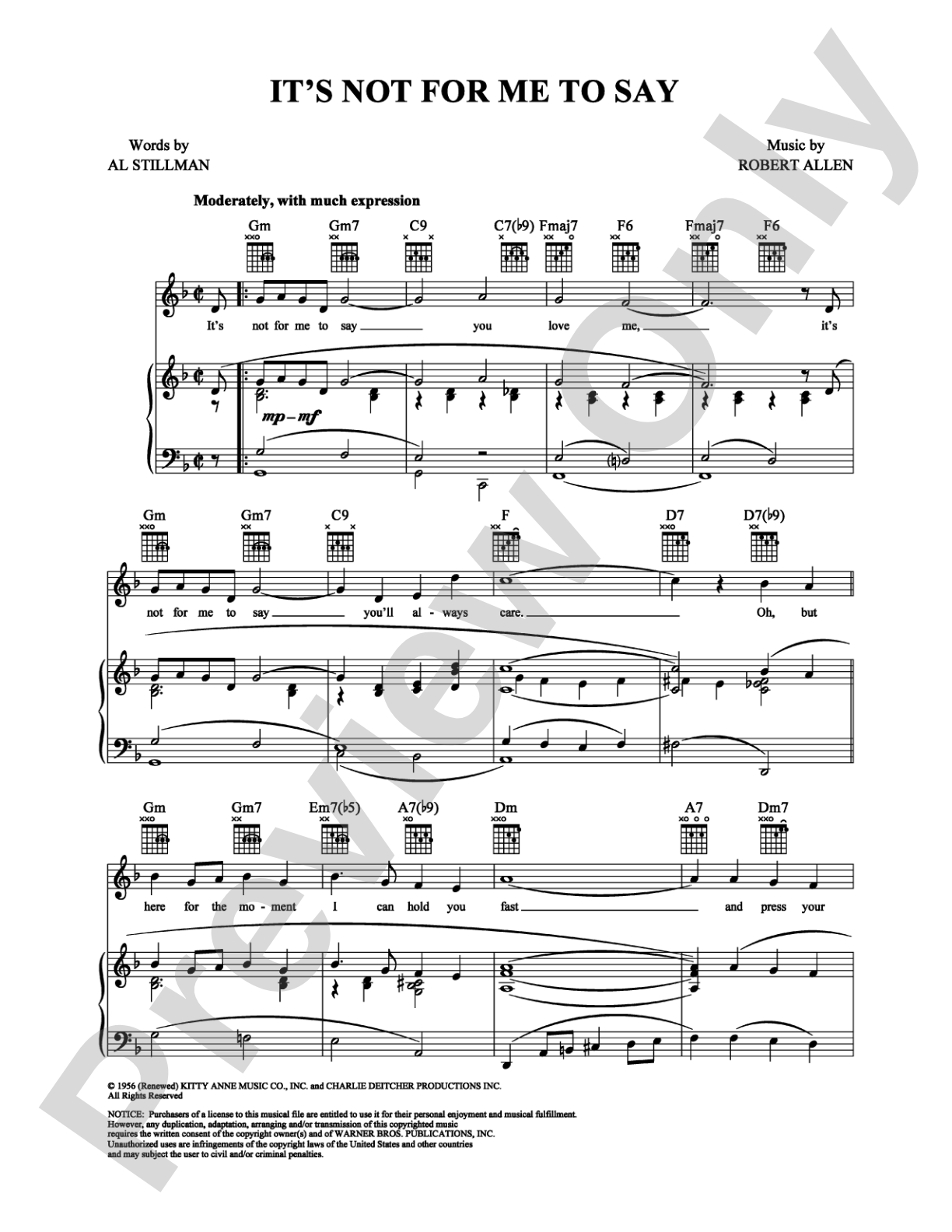
It's Not for Me to Say: Piano/Vocal/Chords Digital Sheet Music

It's Not for Me to Say: Piano/Vocal/Chords Digital Sheet Music

Johnny Mathis, Robert Allen

Item: 00-PS-0003212

Digital Download
$2.95
Description

It's Not for Me to Say: Piano/Vocal/Chords Digital Sheet Music isn't in MakeMusic Cloud just yet...but it could be. Let us know you'd like to see it, and you'll help shape what comes next. In the meantime, start a free trial and dive into thousands of interactive titles your students can play along with today.

Sample Audio
No sample audio found.
Sample Video
Additional Details
SKU: 00-PS-0003212

More about this title

About the Artist: Johnny Mathis

Johnny Mathis has been one of the most recognized voices in American popular music since the 1950s, known for his smooth baritone and interpretive depth across jazz standards, pop ballads, and easy listening repertoire. His recording career spans decades and has influenced generations of singers through his mastery of phrasing, breath control, and emotional restraint.

Why we love this

This standard gives singers a masterclass in interpretive restraint and phrasing. The piano-vocal-chord arrangement lets accompanists and singers collaborate on tempo flexibility and rubato, making it ideal for teaching how to shape a melodic line without over-singing.

What to expect

A tender, introspective ballad that feels like a quiet confession. The song breathes in spaces between phrases, inviting the singer to inhabit the lyric rather than perform it.

Who it's for

Singers developing their interpretive range in jazz standards and classic popular songs, and pianists strengthening their ability to accompany and respond to a vocalist's choices. Voice teachers building repertoire that teaches phrasing and emotional clarity will find this a valuable addition.

How to get the most out of it

  • Balance vocal expression with harmonic support by letting the pianist breathe with the singer rather than driving a steady pulse.
  • Shape the melody through legit vowels and connected phrasing; resist the urge to add stylistic embellishments that obscure the song's inherent elegance.
  • Pay attention to how chord changes support the lyrical content, using them as guideposts for subtle dynamic shifts rather than harmonic anchors.

How to use it

Pair this with other classic standards to create a recital set exploring the American songbook, or use it as a vehicle for teaching jazz-inflected interpretation in a voice studio setting.

Skills your students will build

  • Rubato and flexible phrasing over steady harmonic accompaniment
  • Harmonic analysis and functional chord reading from lead sheets
  • Vocalist-pianist communication and collaborative listening
  • Interpretive choices in classic popular song repertoire

You May Also Like