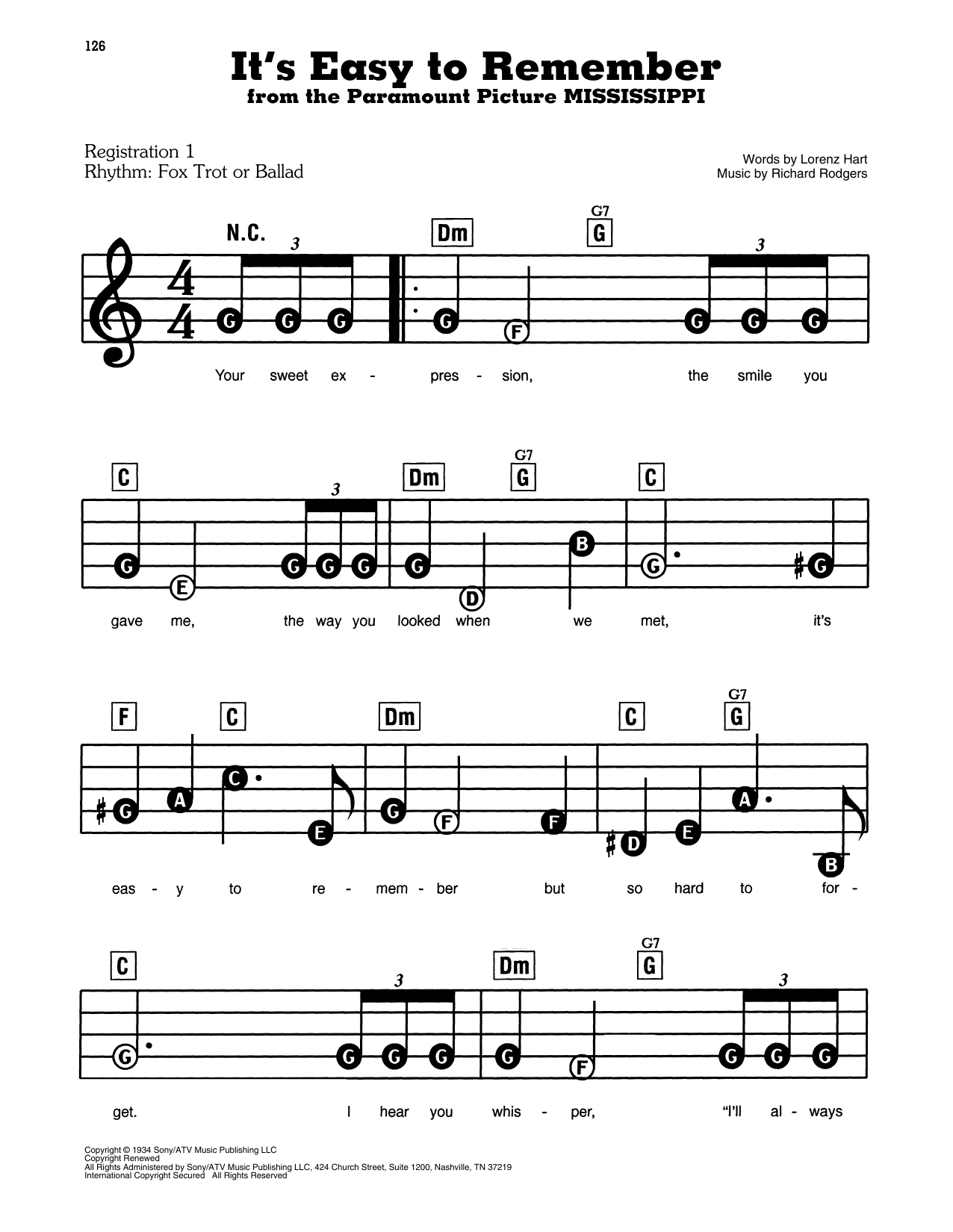
It's Easy To Remember (from Mississippi) Sheet Music Preview

It's Easy To Remember (from Mississippi): E-Z Play Today

Item: 35-DS00456510

Digital Download
$4.99
Description

It's Easy To Remember (from Mississippi): E-Z Play Today isn't in MakeMusic Cloud just yet...but it could be. Let us know you'd like to see it, and you'll help shape what comes next. In the meantime, start a free trial and dive into thousands of interactive titles your students can play along with today.

Sample Audio
No sample audio found.
Sample Video
Additional Details
Publisher: Hal Leonard
Page Count: 3
SKU: 35-DS00456510

More about this title

About the Creator

Richard Rodgers and Lorenz Hart created some of the most enduring songs in the American songbook during their partnership in the 1920s and 1930s. Hart's witty, conversational lyrics paired with Rodgers' sophisticated harmonic language produced standards that remain central to jazz and popular music repertoire. Their work for film and stage demonstrates how melody and lyric can work together to create something instantly memorable yet harmonically complex.

Why we love this

This standard sits in that sweet spot where intermediate pianists encounter real jazz harmony and rubato without needing years of experience. The three-page length makes it accessible for repertoire building, and the song's inherent charm carries even when the performance is straightforward.

What to expect

Wistful and conversational, with a melody that sits naturally under the fingers. The harmonic language carries sophisticated color without demanding technical pyrotechnics, creating a piece that feels like a real song rather than an exercise.

Who it's for

Pianists moving into standard repertoire will find this immediately playable while still offering harmonic depth worth exploring. It works for anyone building a jazz or popular music foundation at the intermediate level.

How to get the most out of it

  • Allow the melody to breathe. This isn't a piece that demands strict tempo; the title itself invites you to find ease in the phrasing.
  • Voice the left hand chords to support the harmonic color. Rodgers wrote with intention here, and small adjustments to which notes land on the beat can deepen the standard's sophistication.
  • Explore the relationship between the melody notes and the harmony underneath. Where does the tune sit above the chords, and where does it land within them?

How to use it

Slot this into a recital exploring American standards, or use it as a bridge between classical and jazz repertoire. It's compact enough to pair with other short pieces and substantial enough to stand alone as an interlude or solo feature.

Skills your students will build

  • Voicing jazz changes smoothly through chord substitutions
  • Reading and interpreting rubato in a melodic context
  • Understanding harmonic function in popular song structures
  • Balancing melody and accompaniment in solo piano settings

You May Also Like