It's All Right with Me: 2nd B-flat Tenor Saxophone Sheet Music Preview

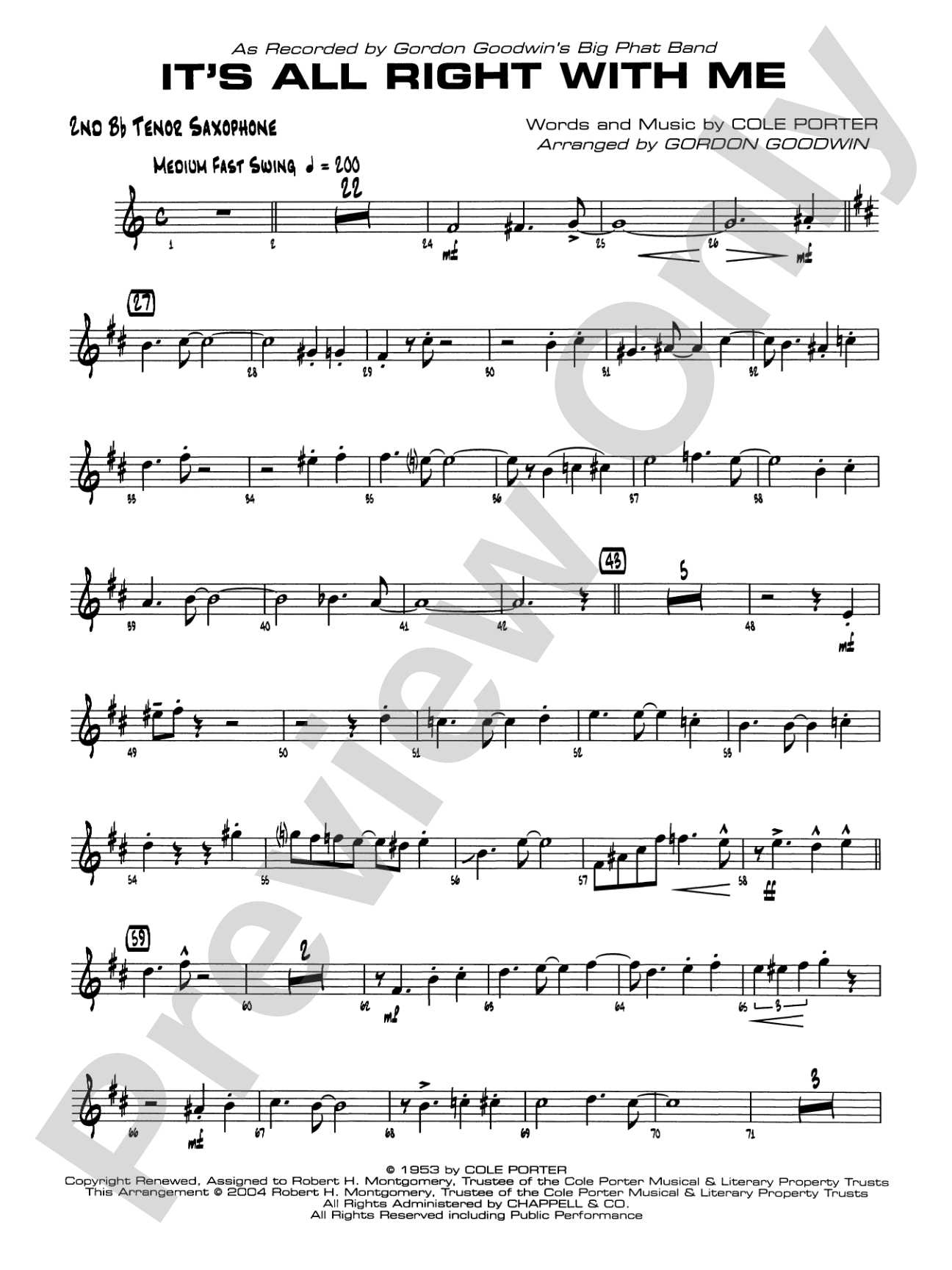
It's All Right with Me: 2nd B-flat Tenor Saxophone

Words and music by Cole Porter / arr. Gordon Goodwin

Grade: 5.5 (Advanced / Difficult)

Item: 00-PC-0014724_TX2

Digital Download
$3.00
Description
As recorded on the Silverline Records album XXL (CD and DVD Audio) by Gordon Goodwin's Big Phat Band. Originally written for vocal group Take 6 and the Big Phat Band, the chart was re-orchestrated for big band! A wonderful tune by Cole Porter and another phenomenal chart by Gordon, THIS CHART SWINGS. Jazz for alto 1 and an optional flute double for alto 2. If you have a hot, experienced band, this chart is for you!

Don't just read it, hear it, play along with it, and watch your students grow with it. In MakeMusic Cloud, It's All Right with Me: 2nd B-flat Tenor Saxophone comes alive with professional accompaniment, adjustable tempo, and built-in practice tools that turn solo practice into real progress.

Sample Audio
0:00
0:00
Sample Video
Additional Details
Series: Gordon Goodwin Series
Publisher: Alfred Music
Page Count: 78
SKU: 00-PC-0014724_TX2

More about this title

About the Composer: Cole Porter

Cole Porter (1891-1964) was an American composer and lyricist who created some of the most sophisticated and witty songs in the Great American Songbook. His melodies are marked by unexpected harmonic turns, clever modulations, and lyrics that sparkle with wordplay and romantic cleverness. Porter's work remains a cornerstone of jazz standards repertoire because his compositions reward both technical skill and interpretive musicianship.

Why we love this

Gordon Goodwin's re-orchestration captures the swagger and polish of a modern big band without losing the elegant simplicity that makes Porter's melody so memorable. The chart sits at a genuine advanced level, requiring rhythmic precision and section blend from your players, but the payoff is a performance that sounds polished and confident on any stage. This is the kind of arrangement that makes your band sound professional.

What to expect

Smooth, confident, and sophisticated. The tune swings with a contemporary big band sensibility while honoring Porter's gift for elegant melody. There's plenty of rhythmic energy and ensemble interplay, but never at the expense of the song itself.

Who it's for

This chart demands a well-trained jazz ensemble with strong section leaders and a drummer comfortable with modern big band swing. You need reliable readers who can handle chromatic passages and shifting ensemble textures without losing the groove. If your band has the chops and experience, this is a fantastic vehicle to showcase their maturity.

How to get the most out of it

  • Lock the rhythm section first. The swing feel depends entirely on the drummer and bass player moving as one unit; rehearse them separately before bringing in the full band.
  • Balance the alto sax lead carefully against the ensemble fills. Goodwin's voicings are dense, so the lead voice needs space to cut through without pushing the dynamic.
  • Shape the phrases like a vocalist would. Even though this is instrumental, Porter's melody has a natural legit singing quality; avoid clipping the ends of phrases and let them breathe.
  • Bring out the flute double in alto 2 during key passages. The timbral shift adds color and sophistication when used intentionally rather than as a permanent doubling.

How to use it

Program this in the second half of a concert where your band's best ensemble work and most experienced soloists are fresh. It pairs beautifully with other standards or modern big band charts, and audiences respond to hearing a familiar Porter melody delivered with this level of polish and swing.

Skills your students will build

  • Reading dense harmonic voicings and complex ensemble textures
  • Executing clean articulation across rapid rhythmic figures
  • Balancing individual voice lines within thick big band voicings
  • Sustaining swing feel over extended passages with syncopated rhythms
  • Responding to sectional cues and musical phrasing in an ensemble context

You May Also Like