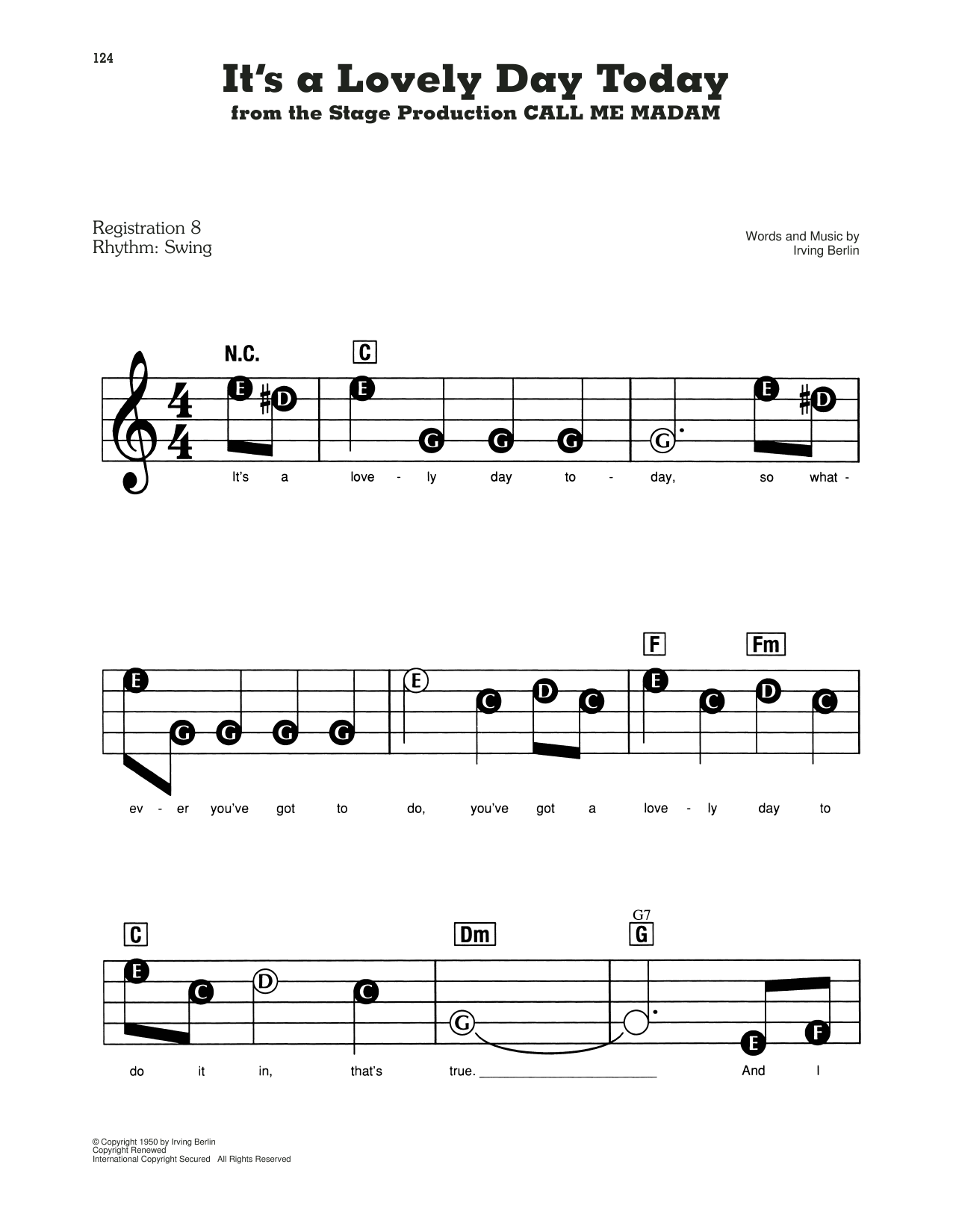
It's A Lovely Day Today (from Call Me Madam) Sheet Music Preview

It's A Lovely Day Today (from Call Me Madam): E-Z Play Today

As performed by Elmo Hope

Item: 35-DS01867919

Digital Download
$4.99
Description

It's A Lovely Day Today (from Call Me Madam): E-Z Play Today isn't in MakeMusic Cloud just yet...but it could be. Let us know you'd like to see it, and you'll help shape what comes next. In the meantime, start a free trial and dive into thousands of interactive titles your students can play along with today.

Sample Audio
No sample audio found.
Sample Video
Additional Details
Publisher: Hal Leonard
Page Count: 3
SKU: 35-DS01867919

More about this title

About the Artist: Elmo Hope

Elmo Hope was a pianist and composer who bridged bebop and hard bop during the 1950s and 1960s. His harmonic sophistication and rhythmic drive made him a sought-after session musician and bandleader, recording prolifically across small jazz labels while also composing pieces that have endured in the jazz repertoire.

Hope's work demonstrates how jazz musicians of his era engaged with the Great American Songbook, reharmonizing and reinterpreting popular standards with the harmonic complexity and improvisational spirit of modern jazz. His arrangements and interpretations remain valuable models for understanding the intersection of jazz and Broadway material.

Why we love this

This arrangement captures the melody and harmonic framework of a beloved standard while opening space for pianists to engage with jazz vocabulary and reharmonization. The three-page format keeps it accessible without sacrificing the sophisticated harmonic thinking that makes this material rewarding for advancing pianists who want to blend jazz language with familiar song repertoire.

What to expect

Warm and swinging, with the gentle sophistication of a song that feels effortless on the surface but reveals harmonic color and melodic grace with repeated listening. The arrangement invites a conversational, intimate musical voice rather than a grand or theatrical one.

Who it's for

Intermediate to advanced jazz pianists and students in jazz ensemble programs who want to expand their standards vocabulary. Teachers seeking Broadway material that authentically reflects how jazz musicians of the post-war era engaged with popular song.

How to get the most out of it

  • Approach the melody with legato phrasing through the bridge; this section often contains the harmonic interest that makes the tune swing rather than swing through pure rhythmic feel alone.
  • Map out the chord changes before diving into improvisation, particularly noting any substitutions or reharmonizations Hope has written in to maintain the tune's sophistication.
  • Balance stride or walking bass patterns with comping; let the left hand support the harmonic motion without crowding the space needed for the right hand melody and any solo sections.

How to use it

Pair this with other jazz interpretations of American standards to show students how different arrangers and eras approach the same material. It works equally well in a solo jazz piano recital, a jazz ensemble concert where the piano takes a feature, or as supplementary material in a jazz history or songwriting class exploring the Great American Songbook.

Skills your students will build

  • Reading and interpreting jazz notation conventions and chord symbols
  • Applying harmonic reharmonization and substitution in a melodic context
  • Balancing composed melody with improvisation over changes
  • Building stride and walking bass patterns that support harmonic motion
  • Phrasing vocal-influenced melodies with swing feel on an instrumental

You May Also Like