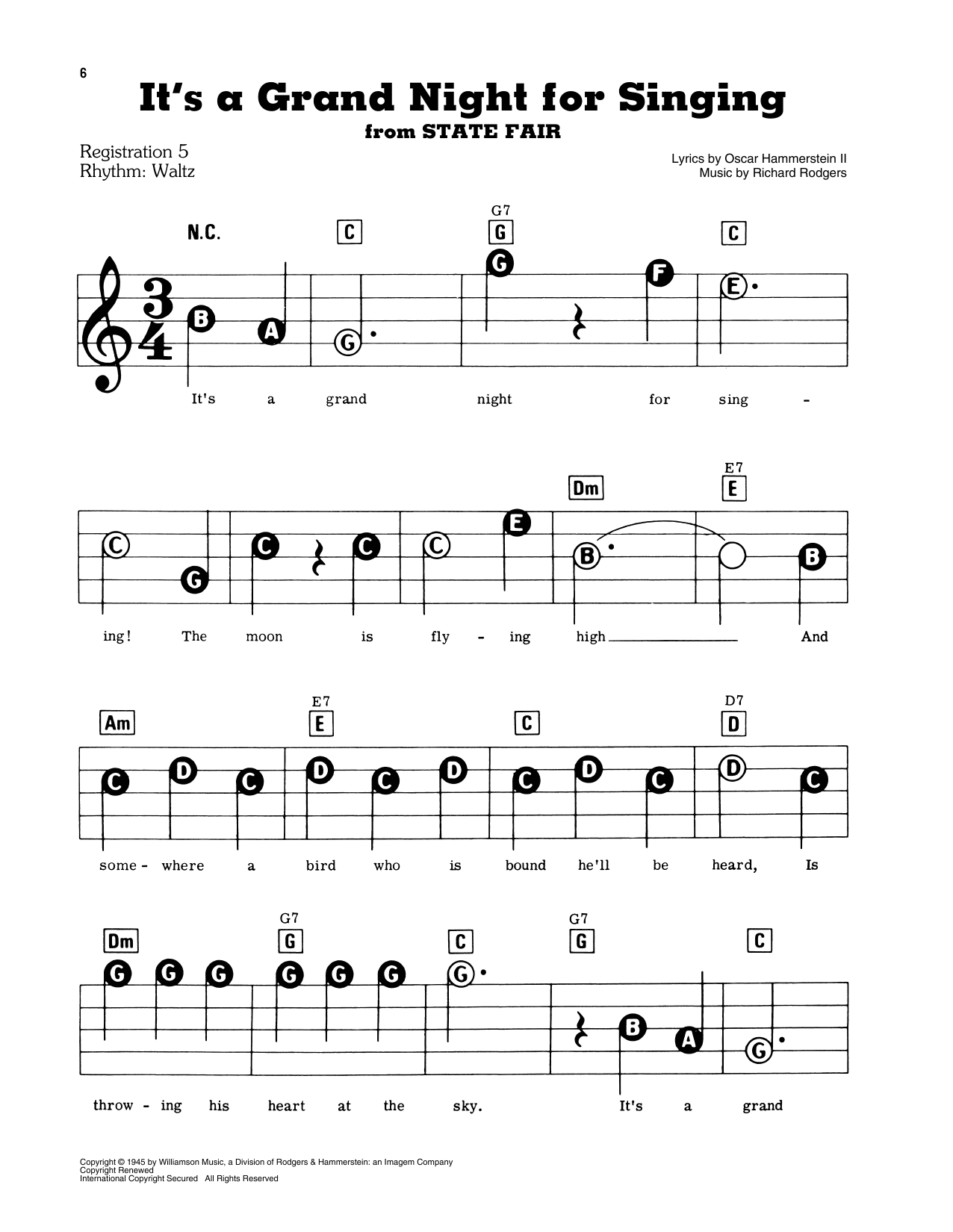
It's A Grand Night For Singing (from State Fair) Sheet Music Preview

It's A Grand Night For Singing (from State Fair): E-Z Play Today

Item: 35-DS00453526

Digital Download
$4.99
Description

It's A Grand Night For Singing (from State Fair): E-Z Play Today isn't in MakeMusic Cloud just yet...but it could be. Let us know you'd like to see it, and you'll help shape what comes next. In the meantime, start a free trial and dive into thousands of interactive titles your students can play along with today.

Sample Audio
No sample audio found.
Sample Video
Additional Details
Publisher: Hal Leonard
Page Count: 2
SKU: 35-DS00453526

More about this title

About the Creator: Richard Rodgers

Richard Rodgers composed the score for State Fair, the 1945 film musical that introduced "It's A Grand Night For Singing" to audiences. Working with lyricist Oscar Hammerstein II, Rodgers crafted a song that captures the infectious optimism and charm of a Midwestern county fair, complete with a melody that sits naturally in the voice and invites singers to project genuine warmth.

Hammerstein's lyrics paint vivid scenes of fair-ground joy, while Rodgers' tunefulness makes the song immediately accessible without sacrificing musical substance. The collaboration produced a standard that remains a staple of both vocal and instrumental repertoire across multiple genres.

Why we love this

The E-Z Play Today arrangement distills this American classic into a piano part that's genuinely playable for intermediate students without losing the song's character. The two-page format respects the melody's straightforward structure while offering enough harmonic support to feel musically complete, making it ideal for pianists who want to accompany singers or perform it solo.

What to expect

Nostalgic and full of genuine warmth, this melody radiates the simple pleasures of a summer evening. There's an almost waltzing quality to the phrasing that makes playing it feel both gentle and subtly buoyant, as though the piano is itself part of the fair-ground atmosphere.

Who it's for

This arrangement suits pianists at the late beginner to early intermediate level who want accessible repertoire with real musical payoff. It's equally useful for students learning to accompany singers or for those building a solo recital repertoire that includes American standards.

How to get the most out of it

  • Shape the melody with gentle rubato in the verse sections; the song breathes better when you let the accompaniment settle slightly behind the tune on lyrical phrases.
  • Keep the left hand rhythmically buoyant throughout. Even in slower passages, the accompaniment benefits from a light touch that suggests movement rather than weight.
  • Balance the dynamic arc across both pages. Build gradually toward the chorus and allow the familiar hook to land with natural emphasis without forcing volume.

How to use it

Program this as a solo piano interlude during a pops concert, or use it to accompany a vocalist in a recital setting where you want a moment of Americana charm. It also works beautifully in a program exploring the American songbook, especially alongside other Rodgers and Hammerstein favorites.

Skills your students will build

  • Accompanying vocal melody with independence between hands
  • Sustaining even tempo while managing shifting harmonic rhythm
  • Balancing chord voicings to support rather than overshadow a singer
  • Phrasing a familiar standard idiomatically across multiple eight-bar sections

You May Also Like