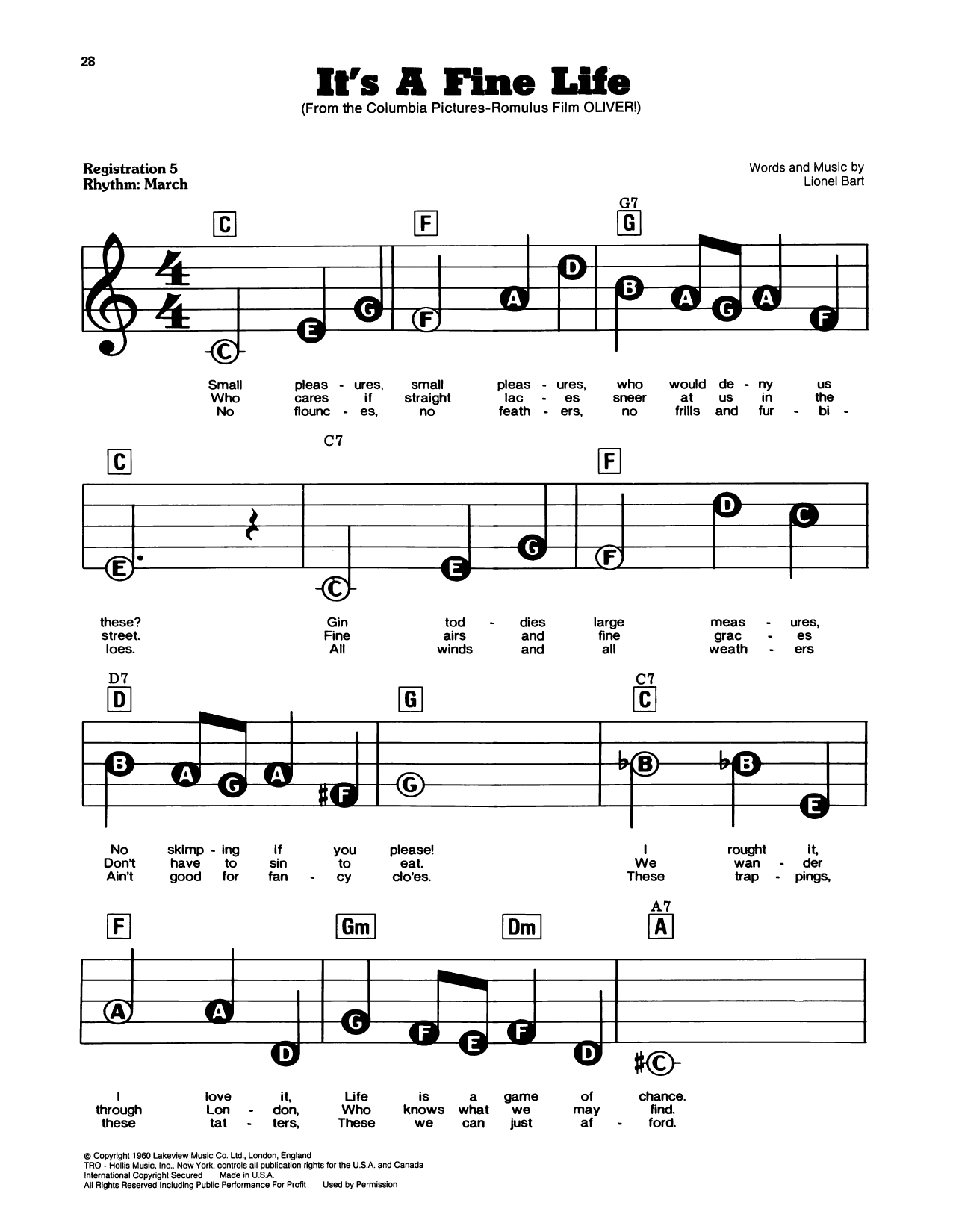
It's A Fine Life (from Oliver) Sheet Music Preview

It's A Fine Life (from Oliver): E-Z Play Today

Item: 35-DS01725782

Digital Download
$4.99
Description

It's A Fine Life (from Oliver): E-Z Play Today isn't in MakeMusic Cloud just yet...but it could be. Let us know you'd like to see it, and you'll help shape what comes next. In the meantime, start a free trial and dive into thousands of interactive titles your students can play along with today.

Sample Audio
No sample audio found.
Sample Video
Additional Details
Publisher: Hal Leonard
Page Count: 4
SKU: 35-DS01725782

More about this title

About the Creator: Lionel Bart

Lionel Bart composed the score for Oliver!, the 1960 British musical that became a global phenomenon and won the Tony Award for Best Musical. Drawing from Charles Dickens' novel, Bart created music that balances Victorian sensibility with contemporary rock and roll influences, making the show accessible to audiences across generations. His gift for memorable melody and his ability to write for young performers shaped musical theater pedagogy for decades to come.

Why we love this

This arrangement captures the infectious charm of Bart's melody without overwhelming younger pianists. The E-Z Play format strips away unnecessary complexity while preserving the song's character, making it an ideal choice for students building confidence with show tunes and learning to balance straightforward accompaniment patterns with expressive phrasing.

What to expect

Optimistic and sprightly, with an almost music box quality that feels both innocent and knowing. The tune radiates the scrappy resilience of its source material, capturing a moment of childish joy amid harder circumstances.

Who it's for

Piano students in the upper elementary to early intermediate range who are ready for show music but need arrangements that respect their technical limitations. This works equally well as a solo recital piece or as an accompaniment for a vocalist exploring musical theater repertoire.

How to get the most out of it

  • Shape the melody with subtle dynamic swells at the phrase peaks rather than playing each measure at the same level; the buoyancy of the tune depends on gentle momentum.
  • Keep the harmonic foundation steady and predictable so the left hand becomes almost conversational, supporting rather than competing with the vocal line.
  • Notice where the melody dips and rises to suggest pacing; resist the urge to rush through the faster note values.

How to use it

Consider pairing this with other classic show tunes at a spring recital, or use it as a bridge piece between classical and contemporary repertoire. It also works as a fun ensemble warm-up arrangement if you transpose it to involve multiple pianists or add a vocalist.

Skills your students will build

  • playing sustained accompaniment patterns that sit behind a melody
  • managing tempo consistency across moderate tempo transitions
  • phrasing a simple tune with dynamic shape and arc
  • reading four-page arrangements with confidence

You May Also Like