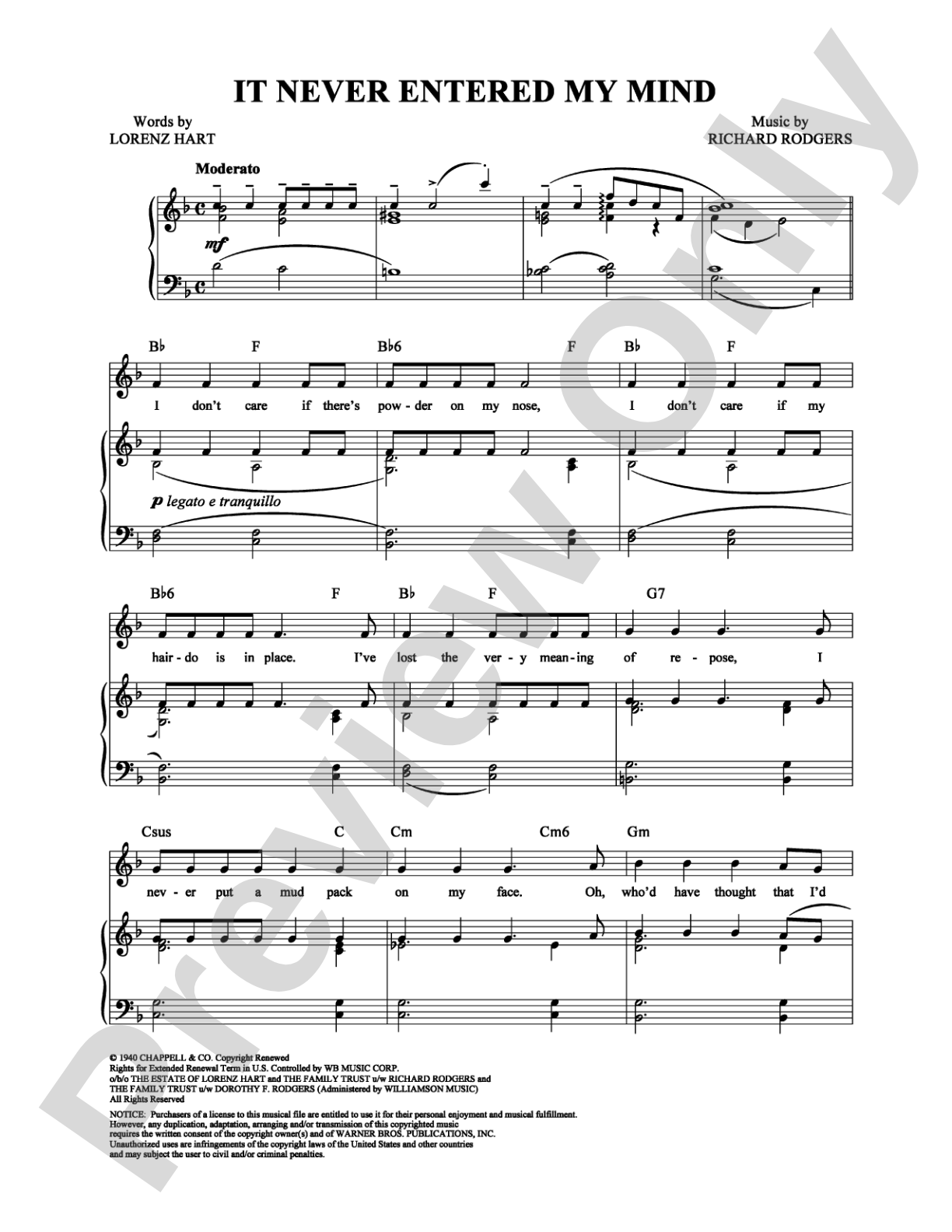
It Never Entered My Mind: Piano/Vocal/Chords Digital Sheet Music

It Never Entered My Mind: Piano/Vocal/Chords Digital Sheet Music

Richard Rodgers, Frank Sinatra

Item: 00-PS-0004530

Digital Download
$3.99
Description

It Never Entered My Mind: Piano/Vocal/Chords Digital Sheet Music isn't in MakeMusic Cloud just yet...but it could be. Let us know you'd like to see it, and you'll help shape what comes next. In the meantime, start a free trial and dive into thousands of interactive titles your students can play along with today.

Sample Audio
No sample audio found.
Sample Video
Additional Details
SKU: 00-PS-0004530

More about this title

About the Artist: Frank Sinatra

Frank Sinatra (1915-1998) was an American singer and actor whose interpretive approach to the American Songbook fundamentally shaped how musicians understand phrasing, emotional storytelling, and rhythmic flexibility in jazz standards. His vocal technique—particularly his control of dynamics, breath placement, and lyrical nuance—became the gold standard against which generations of singers and pianists measure their own interpretations of this repertoire.

Why we love this

Sinatra's reading of this Rodgers and Hart standard demonstrates how a master vocalist shapes melody through accompaniment, making this score invaluable for pianists learning to listen and support rather than lead. The harmonic sophistication of the changes rewards close study, and the emotional restraint of the lyric invites singers to find depth without excess.

What to expect

The song carries a quiet resignation tinged with affection, as though looking back on a relationship with acceptance rather than regret. The melody sits in a comfortable range and moves with conversational ease, while the chromatic harmony beneath it suggests emotional complexity just beneath the surface.

Who it's for

Singers preparing jazz standards for recital or performance study will find this score essential for understanding how a melody interacts with harmonic sophistication. Pianists accompanying vocalists benefit from the chord symbols and full harmonic framework, while solo pianists can use the score as a foundation for stylistically informed improvisation and reharmonization.

How to get the most out of it

  • Study Sinatra's phrasing by listening closely to his recording, then mark breath points and rubato moments directly into your score so you can anticipate where the vocal line will pull or push against the piano's time
  • Treat the piano part as a conversation partner rather than a backdrop; leave space in the harmony for the voice to breathe, and let slight tempo flexibility in the accompaniment follow the singer's emotional intention
  • Pay particular attention to the bridge section, where harmonic tension peaks; the piano should support the vocal climax without drowning it, which requires controlled dynamics and clear voicing of the upper structures

How to use it

This standard pairs naturally with other Rodgers and Hart compositions in a jazz or American songbook-focused recital, or can anchor a program exploring how different singers interpret the same standard. It also serves as a solid repertoire choice for students building a foundation in jazz vocal literature or for accompanists developing fluency with mid-century standards.

Skills your students will build

  • Interpreting rubato and phrase shaping within a jazz idiom
  • Reading and voicing chord symbols with stylistic awareness
  • Balancing vocal melody with harmonic support on piano
  • Understanding chromatic harmony in the context of the American Songbook

You May Also Like