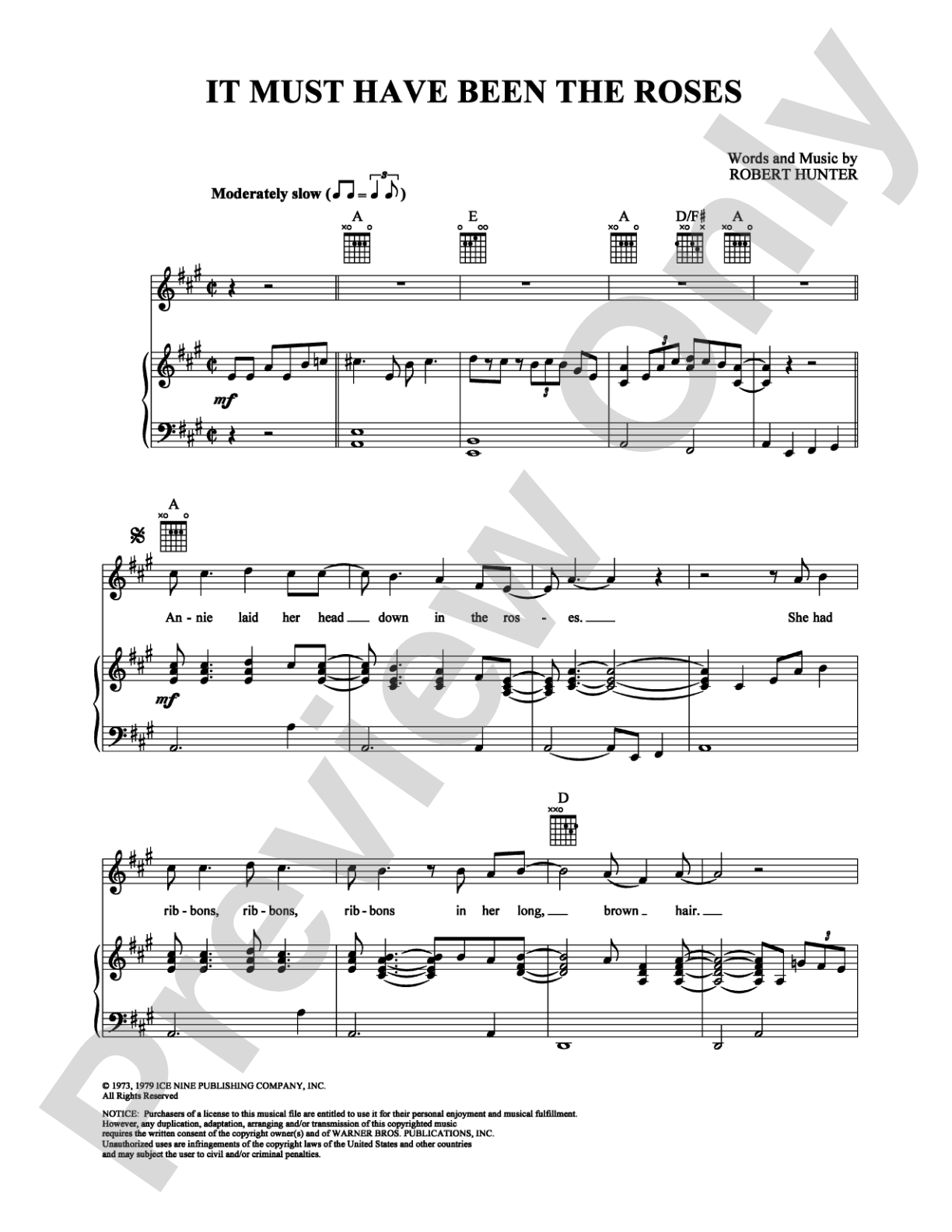
It Must Have Been The Roses: Piano/Vocal/Chords Digital Sheet Music

It Must Have Been The Roses: Piano/Vocal/Chords Digital Sheet Music

Grateful Dead, Robert Hunter

Item: 00-PS-0004196

Digital Download
$2.95
Description

It Must Have Been The Roses: Piano/Vocal/Chords Digital Sheet Music isn't in MakeMusic Cloud just yet...but it could be. Let us know you'd like to see it, and you'll help shape what comes next. In the meantime, start a free trial and dive into thousands of interactive titles your students can play along with today.

Sample Audio
No sample audio found.
Sample Video
Additional Details
SKU: 00-PS-0004196

More about this title

About the Artist: Grateful Dead

The Grateful Dead emerged from the San Francisco Bay Area in the mid-1960s and became one of rock music's most influential and enduring bands. Known for their improvisational approach, intricate musicianship, and devoted fanbase, the band blended rock, folk, blues, and country influences across five decades of touring and recording. Their songwriting catalog showcases sophisticated harmonic structures and poetic lyrics that have made their work accessible to musicians across genres and skill levels.

Why we love this

This song sits at the intersection of singability and harmonic interest, offering vocalists a chance to work with chord progressions that feel natural to play while remaining musically substantive. The piano/vocal/chords format makes it ideal for collaborative rehearsal, accompaniment practice, or recital programming that reaches beyond classical boundaries.

What to expect

The song carries warmth and reflection, with harmonic movement that feels both grounded and contemplative. There's an unpretentious beauty to the melody and lyrics that makes the piece emotionally accessible without sacrificing musical sophistication.

Who it's for

This arrangement works for intermediate to advanced pianists who want to accompany singers, vocalists seeking piano-based recital material that connects to rock and pop traditions, and music students exploring how to interpret and arrange songs beyond classical repertoire. It's equally at home in a studio session, a singer-songwriter setting, or an educational context exploring composition and arrangement.

How to get the most out of it

  • Establish the harmonic framework first by playing through the chord progression slowly, letting your hands find the voice leading before you layer the melody.
  • Shape the vocal line with attention to phrasing rather than metronomic precision; this song benefits from rubato that honors the natural speech rhythm of the lyrics.
  • Balance the vocal melody against the piano accompaniment so the chord voicings support rather than compete with the singer's line.
  • Experiment with the tempo and feel once you have the basic structure secure; many interpretations of Grateful Dead material thrive on subtle variations in rhythmic approach.

How to use it

Program this alongside other singer-songwriter material or contemporary compositions if you're building a recital that showcases the intersection of popular and classical music. It also serves as a bridge piece for students transitioning between genre-specific study, giving them permission to explore and perform music that matters to them outside traditional classical boundaries.

Skills your students will build

  • Reading and interpreting chord symbols in a pop/rock context
  • Coordinating melody, lyrics, and harmonic accompaniment
  • Balancing vocal melody with piano texture
  • Developing interpretive choices within a song structure
  • Transposing and adapting chord progressions for different vocal ranges

You May Also Like