
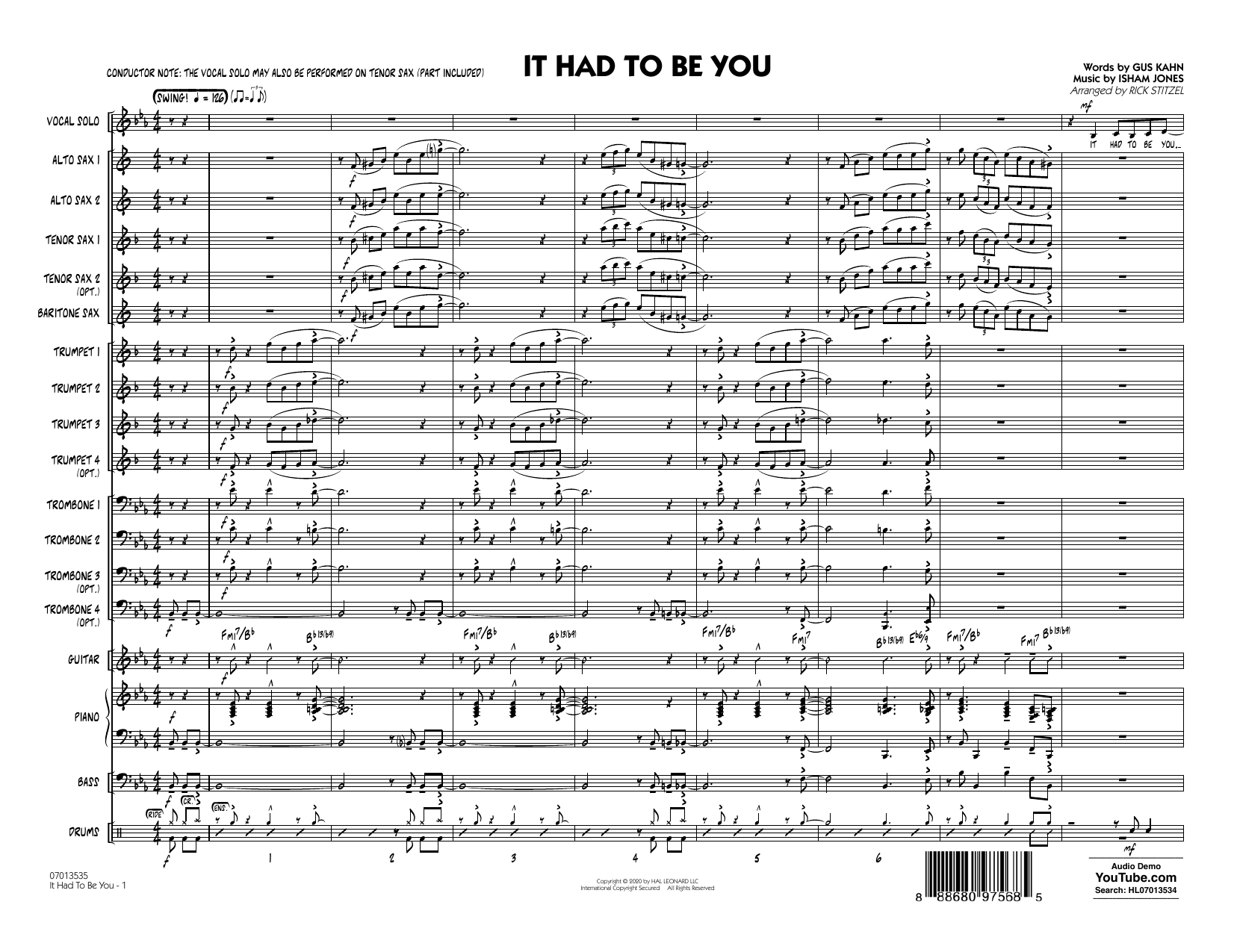

It Had to Be You (arr. Rick Stitzel): Jazz Ensemble Conductor Score & Parts
Arranged by Rick Stitzel
Grade: 3-4
Item: 35-PK00458451
$55.00
Pickup currently not available
Buy Extra Parts (Digital PDF Download)
Parts Added to Cart!
Description
Few standards have maintained the staying power of this popular ballad, having been recorded by such luminaries as Frank Sinatra and Bing Crosby to more recent versions by Harry Connick Jr., Barbra Streisand, and Michael Buble. This silky smooth arrangement is a perfect choice for your vocalist.


It Had to Be You (arr. Rick Stitzel): Jazz Ensemble Conductor Score & Parts isn't in MakeMusic Cloud just yet...but it could be. Let us know you'd like to see it, and you'll help shape what comes next. In the meantime, start a free trial and dive into thousands of interactive titles your students can play along with today.
Request This Title
Tell us you want it.
Start Your Free Trial
Explore everything that's ready to play right now.
Sample Audio
No sample audio found.
Sample Video
No sample videos found.
Additional Details
Publisher:
Hal Leonard
SKU:
35-PK00458451
More about this title
About the Arranger: Rick Stitzel
Rick Stitzel has built a reputation as an arranger who understands what works in the jazz ensemble setting. His scores consistently balance accessibility with musical sophistication, making them reliable choices for programs seeking material that sounds polished without requiring virtuosic soloists.
Why we love this
Stitzel's treatment respects the song's melodic identity while adding the harmonic sophistication and rhythmic drive that keep audiences engaged. The orchestration sits comfortably for Grade 3-4 ensembles, meaning your students can focus on phrasing and ensemble blend rather than technical survival. A vocalist with moderate range and solid pitch control can shine here without needing Broadway chops.
What to expect
Warm and nostalgic without slipping into pastiche. The arrangement wraps the listener in that perfect moment when a great standard feels both timeless and intimate, like eavesdropping on a late-night performance in a small room.
Who it's for
Jazz ensembles at the intermediate level with a capable vocalist looking for repertoire that sounds elegant and familiar to audiences. Directors programming showcase concerts, jazz nights, or spring concerts will find this piece draws genuine connection from listeners who know the song.
How to get the most out of it
- Balance the rhythm section carefully in early rehearsals. The arrangement's 'silky smooth' character depends on the piano, bass, and drums locking into a conversational feel rather than pushing the tempo.
- Shape the accompaniment as if it's singing behind the vocalist. Listen for places where the horns can breathe together, and where the rhythm section can step back slightly to give the solo space.
- Establish the ballad's natural rubato with your vocalist before sectional rehearsals. Once everyone hears the flexible phrasing, the ensemble adapts more intuitively than if you drill strict metronomic time first.
- Reserve this piece for a vocalist who can handle sustained phrases without scooping into the pitch. The standard's beauty lives in simplicity.
How to use it
Schedule this late in your concert when the ensemble is warmed up and your vocalist is confident. It works beautifully as a showcase feature after a few up-tempo numbers, offering audiences the chance to hear individual musicianship and ensemble restraint.
Skills your students will build
- Accompanying a soloist with dynamic shape and sensitivity
- Maintaining steady pulse while responding to a vocalist's flexible phrasing
- Balancing blend and articulation in a ballad setting
- Reading jazz chord symbols and comping changes
- Listening for and adjusting to intonation nuances in the upper register