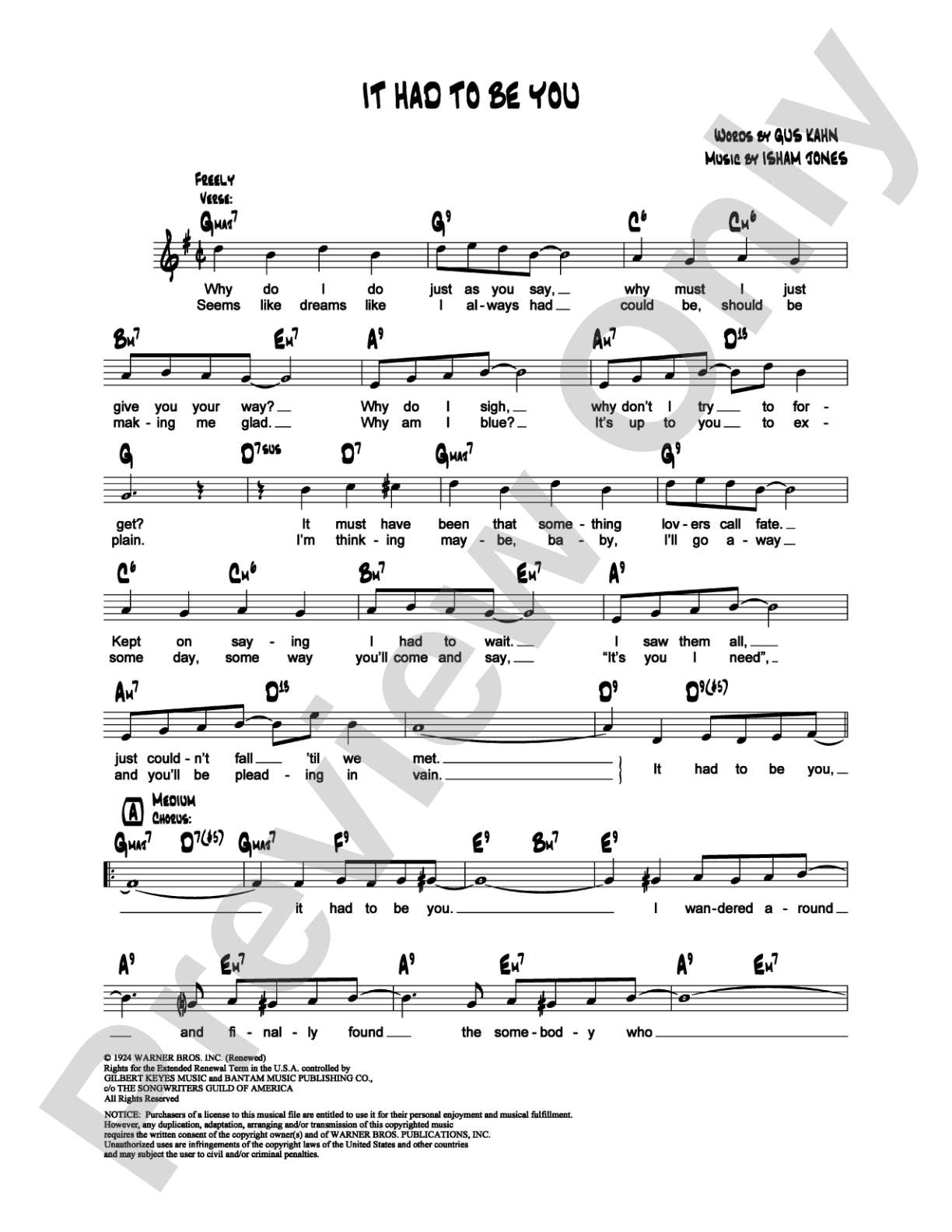
It Had to Be You: Lead Sheet Digital Sheet Music

It Had to Be You: Lead Sheet Digital Sheet Music

Isham Jones, Cliff Edwards

Item: 00-PS-0002042

Digital Download
$1.99
Description

It Had to Be You: Lead Sheet Digital Sheet Music isn't in MakeMusic Cloud just yet...but it could be. Let us know you'd like to see it, and you'll help shape what comes next. In the meantime, start a free trial and dive into thousands of interactive titles your students can play along with today.

Sample Audio
No sample audio found.
Sample Video
Additional Details
SKU: 00-PS-0002042

More about this title

About the Artist: Cliff Edwards

Cliff Edwards (1895-1971) was a singer, ukulele player, and actor who became famous for his distinctive, high-pitched vocal delivery and his pioneering work in early sound film. He starred in numerous Hollywood musicals during the 1920s and 1930s and is perhaps best remembered as the original voice of Jiminy Cricket in Disney's Pinocchio (1940). Edwards was instrumental in popularizing the ukulele as a solo instrument during the jazz age and recorded extensively as a vocalist and instrumentalist.

Isham Jones (1894-1956) was a composer, bandleader, and violinist who led one of the most successful dance orchestras of the 1920s and 1930s. His compositions became standards of the Great American Songbook, and his arrangements and orchestral innovations influenced jazz and popular music across decades. Jones was known for his sophisticated harmonic writing and his ability to blend classical training with popular idioms.

Why we love this

This standard offers everything a jazz ensemble, vocal jazz group, or combo needs for a polished, instantly recognizable number that audiences love. The lead sheet format gives you complete harmonic freedom to arrange and reharmonize as your ensemble's skills and style demand, from straightforward swing interpretations to more adventurous harmonic substitutions.

What to expect

Romantic and wistful, this standard captures the sentiment of 1930s popular song with elegant simplicity. The melody sits naturally in the voice, and the harmonic progression has just enough sophistication to keep accompanists engaged without overwhelming a straightforward interpretation.

Who it's for

Jazz singers, vocal jazz ensembles, jazz combos, and pianists building a standards repertoire will find this a reliable, audience-friendly choice. Lead sheet format makes it accessible to musicians at intermediate and advanced levels who can improvise over changes and adapt the tune to their own performance style.

How to get the most out of it

  • Support the melody with clear voice leading through the changes; this tune rewards singers who shape the line through the bridge.
  • Experiment with different rhythmic feels on the accompaniment part. The tune works equally well in a relaxed ballad swing or a more uptempo 1940s-style crooner groove.
  • Pay attention to the lyrical phrasing over metric placement. The tune's charm often comes from slight pushes and pulls against the beat rather than strict time.

How to use it

Program this alongside other classic standards in a vocal jazz concert or pops show. It works beautifully as a vehicle for a featured vocalist in a big band or jazz ensemble setting, or as part of a standards-focused recital that celebrates the Great American Songbook.

Skills your students will build

  • Reading and interpreting lead sheet notation
  • Vocal phrasing and legit singing technique over jazz harmony
  • Comping and voice leading from chord symbols
  • Improvisation and reharmonization over a standard progression

You May Also Like