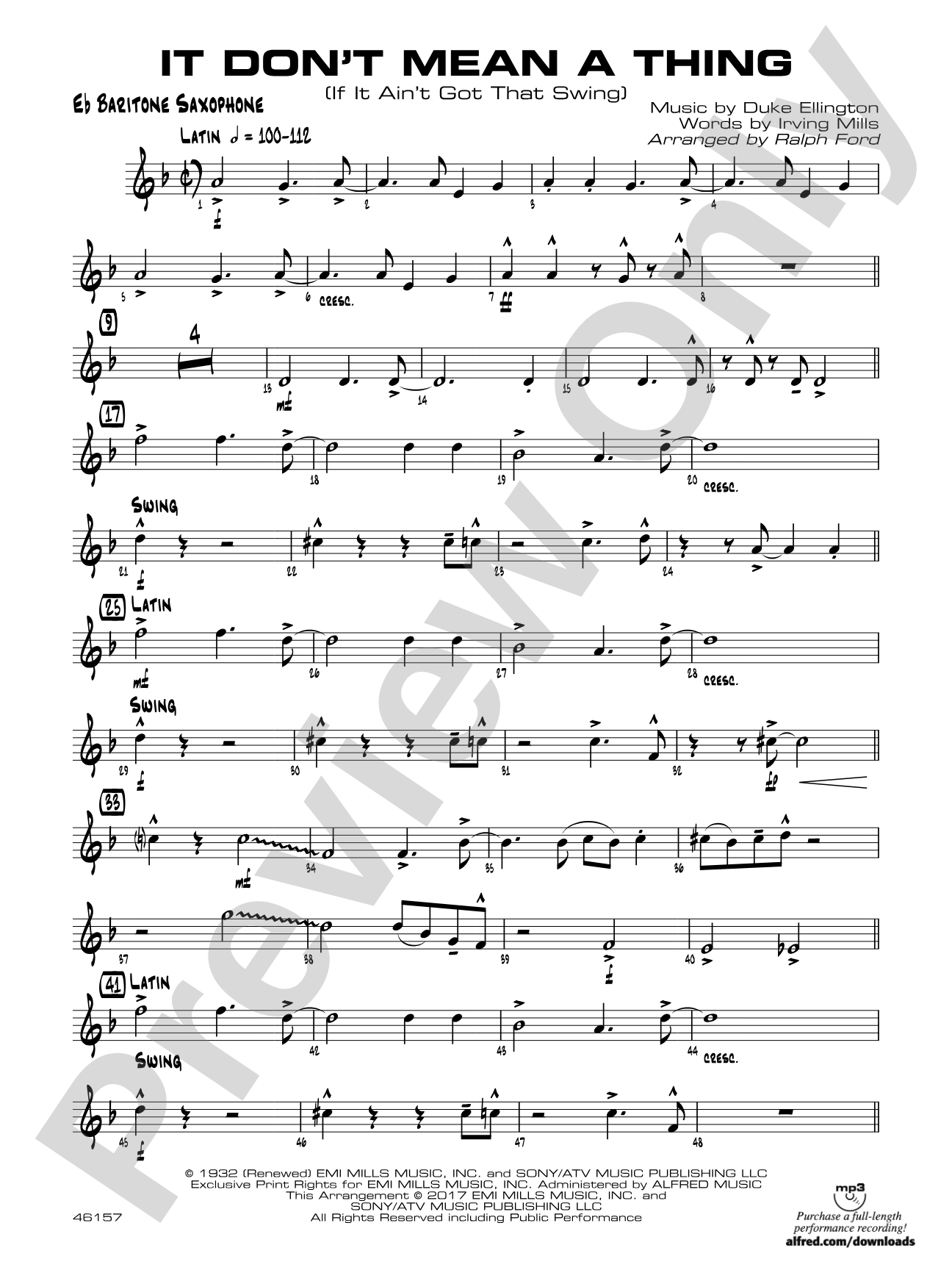
It Don't Mean a Thing (If It Ain't Got That Swing): E-flat Baritone Saxophone Sheet Music Preview

It Don't Mean a Thing (If It Ain't Got That Swing): E-flat Baritone Saxophone

Music by Duke Ellington, words by Irving Mills / arr. Ralph Ford

Grade: 2.5 (Medium Easy)

Item: 00-PC-0017749_BTX

Digital Download
$3.00
Description
You may think this chart is all swing but it begins as a Latin then alternates with a swing feel---very clever! The tempo is bright at around 190-200 BPM. With written-out solos for trumpet and tenor sax, a few piano montunas, a big shout chorus and the big ending closes up this fine chart. It's hot! (3:20)

Don't just read it, hear it, play along with it, and watch your students grow with it. In MakeMusic Cloud, It Don't Mean a Thing (If It Ain't Got That Swing): E-flat Baritone Saxophone comes alive with professional accompaniment, adjustable tempo, and built-in practice tools that turn solo practice into real progress.

Sample Audio
0:00
0:00
Sample Video
Additional Details
Series: Young Jazz Ensemble
Publisher: Alfred Music
Page Count: 102
SKU: 00-PC-0017749_BTX

More about this title

About the Composer: Duke Ellington

Duke Ellington (1899-1974) stands as one of the most significant composers in American music history. His innovations in jazz harmony, orchestration, and form fundamentally shaped how the genre developed, and his compositions remain essential to any serious jazz curriculum. Ellington's prolific output spans jazz standards, extended concert works, and film scores, all marked by sophistication, elegance, and an uncompromising commitment to artistic vision. For educators, his music offers students a masterclass in how to balance accessibility with harmonic complexity and how to write idiomatically for jazz instruments.

Why we love this

Ralph Ford's arrangement captures the swagger and sophistication of Ellington's original while making it achievable for young ensembles. The clever construction (Latin foundation shifting into swing) teaches students that jazz is about more than steady grooves; it's about contrast, surprise, and intentional reharmonization. The written-out solos provide clear melodic models for improvisation without asking students to invent from scratch.

What to expect

Sophisticated and swinging, with that distinctive Ellington elegance. The Latin opening feels warm and grooved before the chart pivots into bright, driving swing; the contrast keeps the piece feeling fresh and purposeful rather than repetitive.

Who it's for

Young jazz ensembles (high school or advanced middle school) ready to tackle genuine big band writing at an accessible level. Students need solid fundamental swing and Latin feel, plus basic improvisation confidence for the solo sections.

How to get the most out of it

  • Lock the Latin rhythm section first. Before touching the swung sections, get your bass, drums, and piano locked into the montuno groove at this tempo; everything else builds from that pocket.
  • Bring the trumpet and tenor sax solos forward in the mix during their written passages. They're carrying the tune, not just coloring the background.
  • Shape the transition from Latin to swing deliberately. This isn't accidental; make the audience hear the gear shift by having the rhythm section telegraph the change slightly before the melody follows.
  • Push the final shout chorus and ending with energy and precision. At 190-200 BPM, these sections need clarity and drive to land the chart's conclusion.

How to use it

This works beautifully on a concert that mixes standards with arrangements that challenge students beyond basic chart reading. Its contest-friendly energy and reasonable length (3:20) make it ideal for festival programming or as a showpiece without requiring an entire set.

Skills your students will build

  • Executing Latin and swing feels with conviction and style
  • Balancing written solos with section support
  • Responding to harmonic reharmonization within a familiar melody
  • Maintaining tempo integrity at bright tempos (190-200 BPM) without rushing
  • Understanding how arrangement contrast (texture, groove, dynamics) shapes a chart's arc

You May Also Like