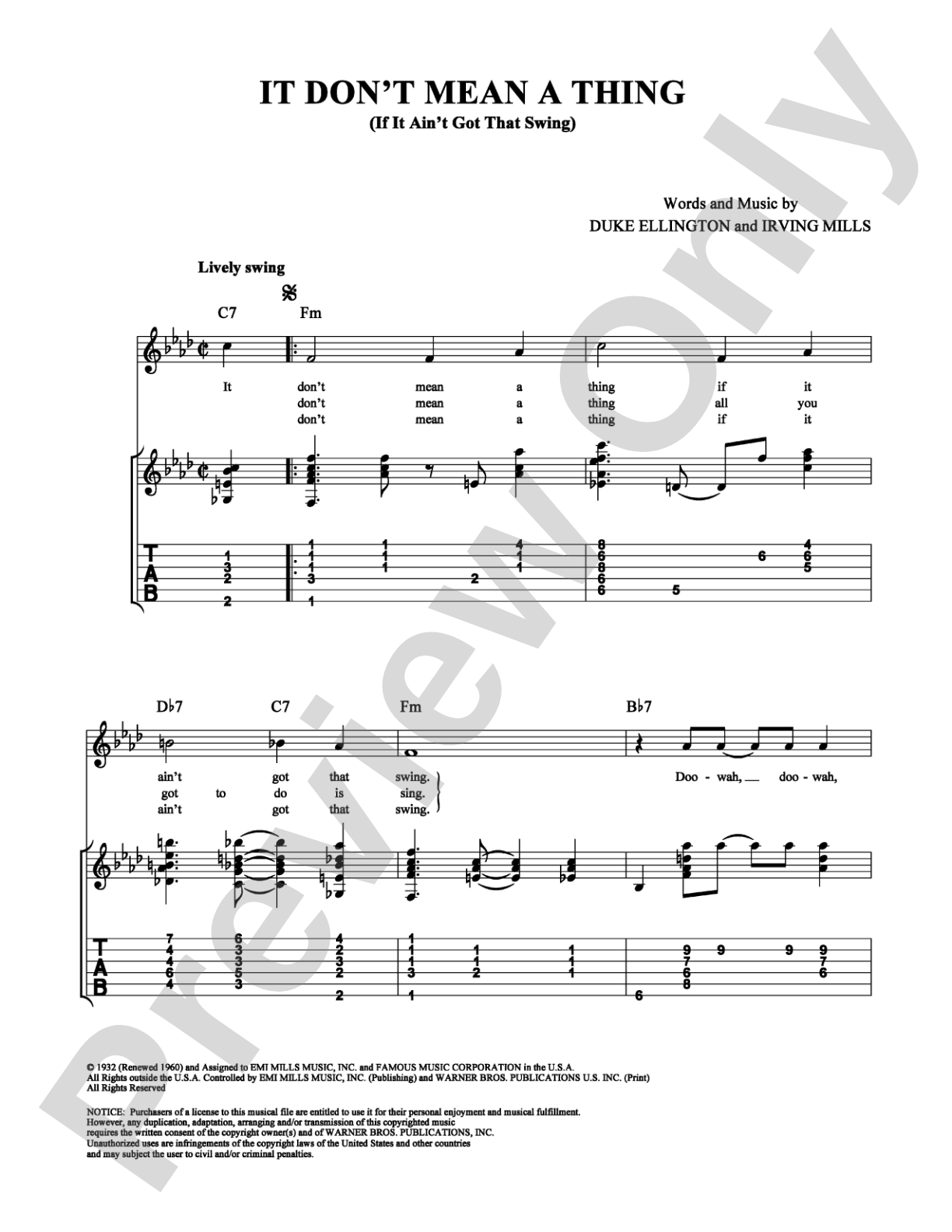
It Don't Mean a Thing (If It Ain't Got That Swing): Guitar TAB Digital Sheet Music

It Don't Mean a Thing (If It Ain't Got That Swing): Guitar TAB Digital Sheet Music

Duke Ellington, Irving Mills

Item: 00-PS-0007543

Digital Download
$2.99
Description

It Don't Mean a Thing (If It Ain't Got That Swing): Guitar TAB Digital Sheet Music isn't in MakeMusic Cloud just yet...but it could be. Let us know you'd like to see it, and you'll help shape what comes next. In the meantime, start a free trial and dive into thousands of interactive titles your students can play along with today.

Sample Audio
No sample audio found.
Sample Video
Additional Details
SKU: 00-PS-0007543

More about this title

About the Creator: Duke Ellington

Duke Ellington composed "It Don't Mean a Thing (If It Ain't Got That Swing)" in 1930 with lyricist Irving Mills, creating one of jazz's most enduring standards. The piece became a signature Ellington composition, recorded countless times and performed across every jazz idiom from bebop to fusion. Ellington's genius lay in writing melodies that swung naturally while remaining accessible to musicians at every level, a quality that makes this tune a staple of jazz curricula worldwide.

Why we love this

This standard swings hard, and the TAB format makes it accessible to guitarists who might not read traditional notation fluently. The laid-back attitude of the tune itself—all about rhythm and feel rather than flash—transfers perfectly to the fingerboard, letting players focus on locking into the groove.

What to expect

Urbane and irresistible. The tune has an effortless sophistication that makes it sound deceptively simple until you try to nail the pocket. It's pure swing DNA.

Who it's for

Jazz guitarists exploring the standard repertoire, whether in a small combo setting or working alone. Players with intermediate TAB reading skills will find this a great entry point into swinging rhythm changes and blues-based phrasing.

How to get the most out of it

  • Prioritize the swing feel over strict rhythmic precision. Let the eighth notes breathe with a triplet lilt, even if the notation suggests straight eighths.
  • Listen to the melody line carefully and phrase it conversationally. This tune rewards interpretation and space between ideas rather than running straight through.
  • Experiment with fingerstyle or pick approach to find what gives you the right texture. The choice shapes whether the tune sounds urbane or casual.

How to use it

Pair this with other jazz standards in a recital or combo performance to establish a cohesive jazz identity. It works equally well as a solo feature or as part of a larger set exploring the American songbook through a guitar lens.

Skills your students will build

  • Reading guitar TAB with rhythmic accuracy
  • Interpreting swing feel and eighth-note triplet placement
  • Phrasing melody lines conversationally in a jazz context
  • Internalizing chord changes and comping opportunities in a 12-bar blues framework

You May Also Like