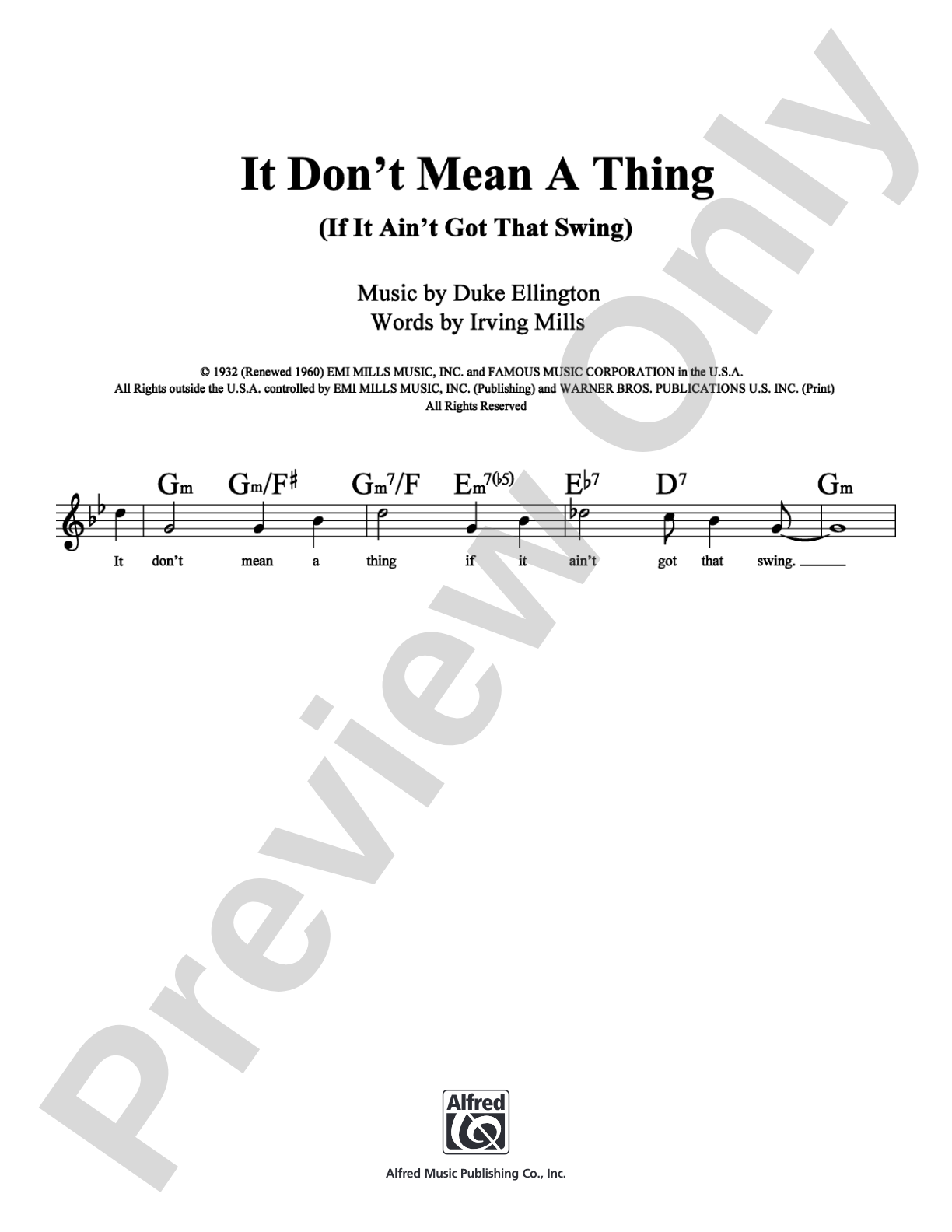
It Don't Mean a Thing (If It Ain't Got That Swing): Lead Sheet Digital Sheet Music

It Don't Mean a Thing (If It Ain't Got That Swing): Lead Sheet Digital Sheet Music

Duke Ellington, Irving Mills

Item: 00-PS-0007541

Digital Download
$1.99
Description

It Don't Mean a Thing (If It Ain't Got That Swing): Lead Sheet Digital Sheet Music isn't in MakeMusic Cloud just yet...but it could be. Let us know you'd like to see it, and you'll help shape what comes next. In the meantime, start a free trial and dive into thousands of interactive titles your students can play along with today.

Sample Audio
No sample audio found.
Sample Video
Additional Details
SKU: 00-PS-0007541

More about this title

About the Artist: Duke Ellington

Duke Ellington (1899-1974) stands as one of the most influential composers and bandleaders in American music history. His vast catalog ranges from three-minute dance numbers to extended suites, but what unites his output is an unflinching commitment to advancing jazz as a serious compositional art form. He wrote and arranged for his own orchestra for nearly five decades, using the ensemble itself as a compositional instrument and developing harmonic and orchestral techniques that permanently expanded jazz vocabulary.

Ellington's output for educational ensembles remains essential because his melodies are singable, his harmonies are rich without being inaccessible, and his rhythmic drive is instantly recognizable. Musicians of all levels respond to his music because it swings naturally and rewards both careful listening and spirited performance.

Why we love this

This lead sheet captures one of jazz's most irresistible melodies and a perfect teaching vehicle for understanding swing phrasing, jazz articulation, and harmonic movement. The tune's deceptive simplicity makes it accessible to students new to jazz idiom while the changes reward deeper harmonic exploration in upper-level ensembles.

What to expect

Effervescent and irresistible, with a melody that dances across the changes and refuses to sit still. The tune has a conversational ease about it, as if the composer is making a simple observation about groove and life in the same breath. Once it gets into your ears, it stays there.

Who it's for

Jazz ensemble musicians at the intermediate level or higher who are developing solo and section reading skills; vocalists learning jazz phrasing and interpretation; music theory students analyzing jazz harmony and form; directors building jazz repertoire for combos, big bands, or small vocal groups.

How to get the most out of it

  • Emphasize the swing eighth-note feel from the opening phrase; the pulse should breathe and lay slightly behind the beat rather than landing squarely on it.
  • Shape the melody with forward motion into strong harmonic points, particularly where the changes suggest natural phrase endings or turnarounds.
  • Balance clarity in the lead line with space for comping underneath; a lead sheet works best when the soloist commits to the groove rather than playing ahead of or fighting the rhythm section's pocket.
  • Explore the title itself as a musical direction: find the swing, the groove, the thing that makes the piece actually swing in performance.

How to use it

Pair this with other Ellington standards in a jazz-focused concert or educational set; use it as an opening number to establish swagger and ensemble cohesion in a jazz showcase; feature it as a vehicle for student soloists to take turns over the changes while building confidence in jazz improvisation and interpretation.

Skills your students will build

  • Reading and interpreting lead sheet notation
  • Swing articulation and the swung eighth-note feel
  • Jazz phrasing and note placement relative to the beat
  • Understanding and navigating jazz harmony and chord changes
  • Balancing melody with accompaniment in a small ensemble
  • Improvisation over a standard form and harmonic progression

You May Also Like