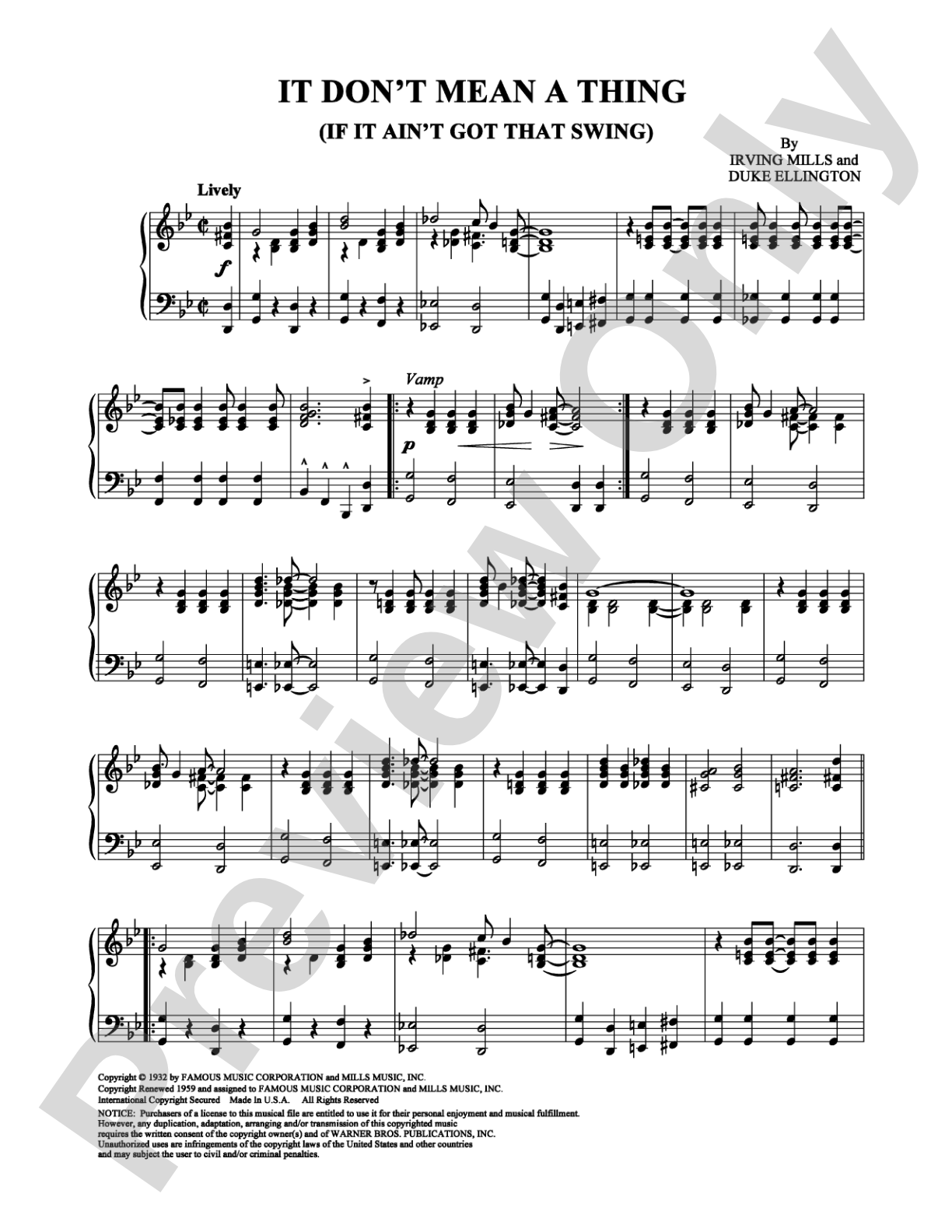
It Don't Mean a Thing (If It Ain't Got That Swing): Piano Digital Sheet Music

It Don't Mean a Thing (If It Ain't Got That Swing): Piano Digital Sheet Music

Duke Ellington, Irving Mills

Item: 00-PS-0007540

Digital Download
$3.99
Description

It Don't Mean a Thing (If It Ain't Got That Swing): Piano Digital Sheet Music isn't in MakeMusic Cloud just yet...but it could be. Let us know you'd like to see it, and you'll help shape what comes next. In the meantime, start a free trial and dive into thousands of interactive titles your students can play along with today.

Sample Audio
No sample audio found.
Sample Video
Additional Details
SKU: 00-PS-0007540

More about this title

About the Artist: Duke Ellington

Duke Ellington (1899-1974) was a composer, bandleader, and pianist whose harmonic sophistication and prolific output fundamentally shaped American jazz and popular music. His works span from dance hall standards to extended concert pieces, all marked by distinctive orchestration, chromatic harmony, and an ear for melody that transcends genre boundaries.

Ellington's influence on music education extends beyond his compositions. His approach to arranging and orchestration offers jazz educators a masterclass in voice leading, instrumental color, and the balance between composition and improvisation. Teachers turn to his work to demonstrate how jazz can achieve both popular accessibility and artistic depth.

Why we love this

This is an absolute cornerstone of the jazz piano repertoire, and for good reason. The syncopation is infectious without being overly complicated, making it accessible for intermediate pianists while offering endless interpretive possibilities for more advanced players. It's the kind of piece that reminds students why they fell in love with jazz in the first place.

What to expect

Sophisticated but never pretentious, with a bounce that sits just behind the beat. The melody floats over chords that shift beneath it in unexpected ways, creating a sense of elegant inevitability.

Who it's for

Jazz pianists at the intermediate level and above will find this rewarding to learn and perform. It works equally well for students developing their swing feel and seasoned players refining their harmonic interpretation.

How to get the most out of it

  • Lock in the rhythm section pulse first, even though you're playing solo piano. The "swing" depends entirely on your ability to lay back slightly on the backbeat while keeping the forward momentum clear.
  • Approach the melody line with a vocalist's phrasing rather than a strict metronomic attack. Ellington wrote this for singers originally, and the piano should breathe with that lyrical quality.
  • Experiment with comping voicings behind the head before diving into improvisation. The harmonic movement is rich enough to sustain interesting backing patterns without overshadowing the tune.

How to use it

Pair this with other Ellington standards in a jazz recital program to showcase the breadth of his songwriting. It also works beautifully as a warm-up or encore piece because its familiarity puts audiences at ease while your performance demonstrates genuine musical maturity.

Skills your students will build

  • Swing eighth-note articulation and feel
  • Comping with seventh and extended chord voicings
  • Balancing melody phrasing with harmonic accompaniment
  • Improvisation over a standard 32-bar form
  • Listening to and interpreting rubato while maintaining groove

You May Also Like