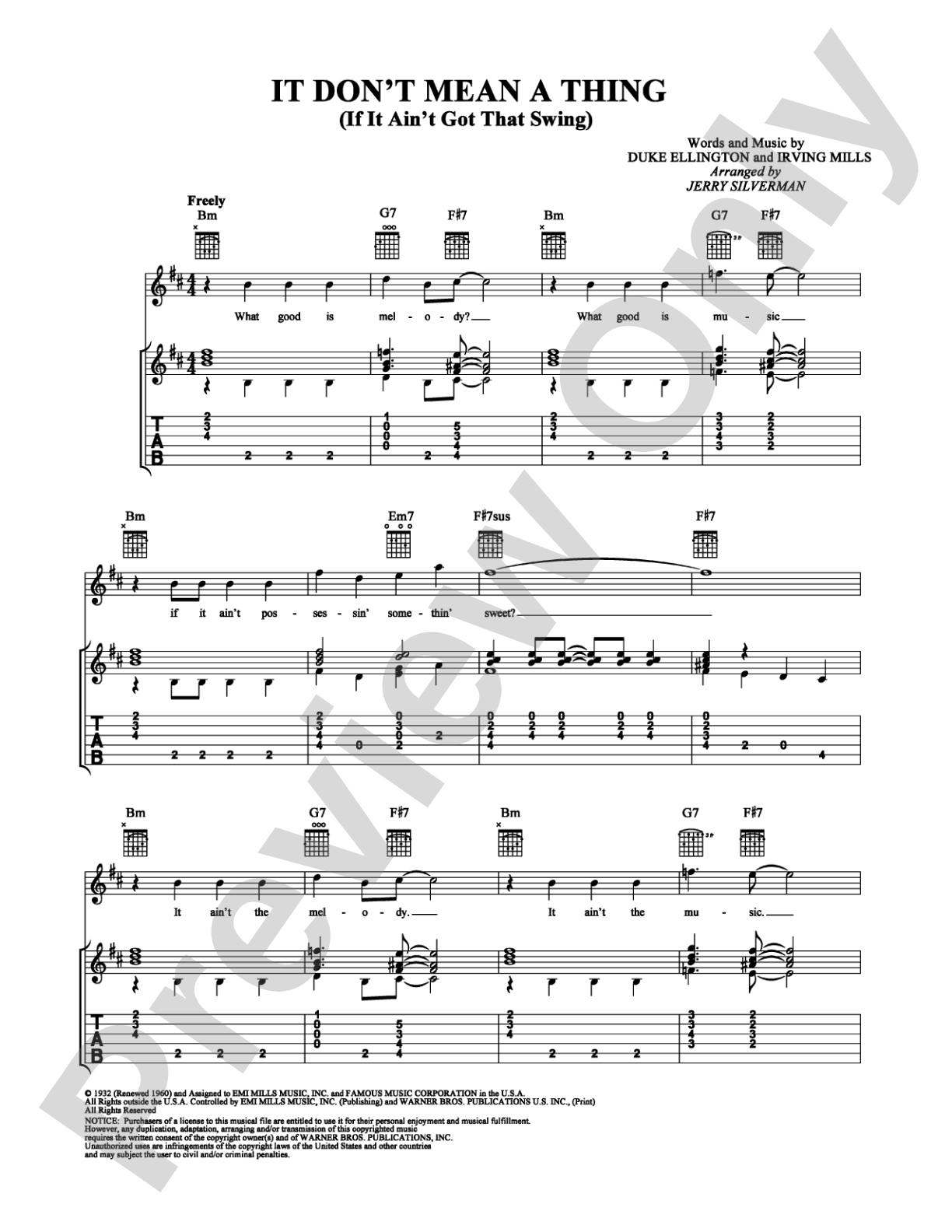
It Don't Mean a Thing (If It Ain't Got That Swing): Guitar TAB Digital Sheet Music

It Don't Mean a Thing (If It Ain't Got That Swing): Guitar TAB Digital Sheet Music

Duke Ellington, Irving Mills

Item: 00-PS-0004399

Digital Download
$2.99
Description

It Don't Mean a Thing (If It Ain't Got That Swing): Guitar TAB Digital Sheet Music isn't in MakeMusic Cloud just yet...but it could be. Let us know you'd like to see it, and you'll help shape what comes next. In the meantime, start a free trial and dive into thousands of interactive titles your students can play along with today.

Sample Audio
No sample audio found.
Sample Video
Additional Details
SKU: 00-PS-0004399

More about this title

About the Artist: Duke Ellington

Duke Ellington (1899-1974) was an American composer, pianist, and bandleader who fundamentally shaped jazz and American music. His output spanned seven decades and included thousands of compositions ranging from three-minute standards to extended suites. Ellington's harmonic sophistication, orchestral imagination, and prolific output earned him recognition as one of the most important composers of the twentieth century.

Why we love this

This standard is a masterclass in swing rhythm and blues tonality that guitarists genuinely enjoy playing. The melody sits beautifully on the fingerboard, and the harmonic language opens doors to understanding jazz comping and reharmonization without overwhelming beginners.

What to expect

Sophisticated yet approachable, with a melody that sits comfortably on the fretboard and harmonic movement that feels natural to finger. The rhythm has an easy, infectious bounce that makes you want to hear the whole song again.

Who it's for

Jazz guitarists learning to navigate swing standards, intermediate players building jazz repertoire, and students looking to understand how chord melody and improvisation work over a simple, iconic form. This is equally valuable for fingerstyle and electric players.

How to get the most out of it

  • Lock into the swing feel by playing behind the beat slightly; the groove depends on rhythmic relaxation, not metronomic precision.
  • Voice the chord extensions (sevenths, ninths, thirteenths) in your comping voicings rather than stacking only root-position triads.
  • Listen to Ellington's original recording to internalize the phrasing and space; TAB alone won't capture the breath and timing that make this tune swing.

How to use it

Feature this in a jazz guitar recital or ensemble showcase where it can stand alone or pair with other standards from the same era. It also works well as a repertoire piece for students building a jazz standards book, bridging accessibility with genuine musical substance.

Skills your students will build

  • Reading and playing swing rhythm notation
  • Voice leading and chord comping on guitar
  • Melody phrasing over jazz changes
  • Blues tonality and blues scale integration
  • Navigating 12-bar and 32-bar jazz song forms

You May Also Like