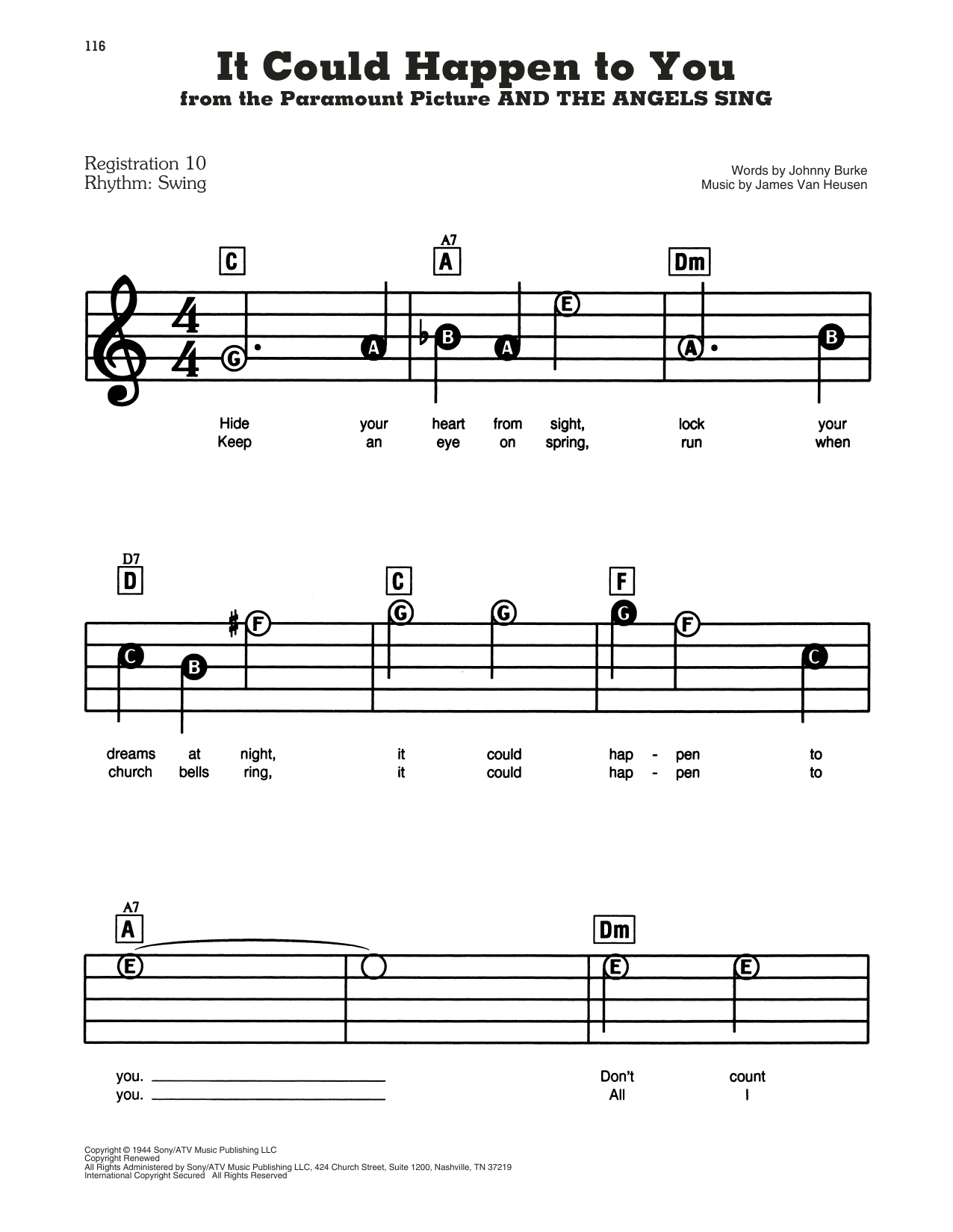
It Could Happen To You (from And The Angels Sing) Sheet Music Preview

It Could Happen To You (from And The Angels Sing): E-Z Play Today

As performed by June Christy

Item: 35-DS00453520

Digital Download
$4.99
Description

It Could Happen To You (from And The Angels Sing): E-Z Play Today isn't in MakeMusic Cloud just yet...but it could be. Let us know you'd like to see it, and you'll help shape what comes next. In the meantime, start a free trial and dive into thousands of interactive titles your students can play along with today.

Sample Audio
No sample audio found.
Sample Video
Additional Details
Publisher: Hal Leonard
Page Count: 2
SKU: 35-DS00453520

More about this title

About the Artist: June Christy

June Christy (1925-1995) was a jazz vocalist whose cool, understated phrasing and impeccable intonation made her one of the defining voices of 1950s West Coast jazz. She recorded prolifically for Capitol Records and worked closely with arranger Nelson Riddle, bringing sophistication and restraint to popular standards and film material.

Christy's interpretive approach valued clarity and emotional directness over vocal pyrotechnics. Her recordings remain models for how to phrase a melody with integrity while honoring the harmonic and melodic intent of the composer.

Why we love this

This arrangement captures the sophisticated harmonic language of a mid-century standard without overwhelming the pianist. The two-page format keeps focus on melody and voicing rather than technical display, making it accessible for pianists exploring jazz interpretations of the Great American Songbook.

What to expect

The tune settles into a warm, conversational groove. There's a gentle optimism in the melody; the harmonies provide richness without complexity, and the overall effect is intimate and reflective, like overhearing someone singing softly in the next room.

Who it's for

Pianists working through classic jazz standards and film songs will find this a natural addition to their repertoire. It suits students ready to explore voicing and interpretation beyond lead-sheet notation, as well as teachers building a library of accessible Great American Songbook material.

How to get the most out of it

  • Pay close attention to the voice leading in the accompaniment. These aren't random chord shells; they create a conversational counterpoint beneath the melody.
  • Balance the melodic line so it floats above the harmonic foundation. Resist the urge to push; the song's charm lies in its unhurried quality.
  • Use the recorded accompaniment as a reference for tempo and phrasing nuance, but develop your own interpretation of rubato within the harmonic structure.

How to use it

Pair this with other mid-century film and jazz standards to create a themed concert or salon-style performance. It works equally well as an elegant intermission piece or as part of a study unit on vocal jazz and the Great American Songbook.

Skills your students will build

  • Interpreting jazz voicings and chord substitutions
  • Balancing melody with harmonic accompaniment
  • Phrasing and rubato within a song form
  • Sight-reading lead-sheet style notation with implied harmony

You May Also Like