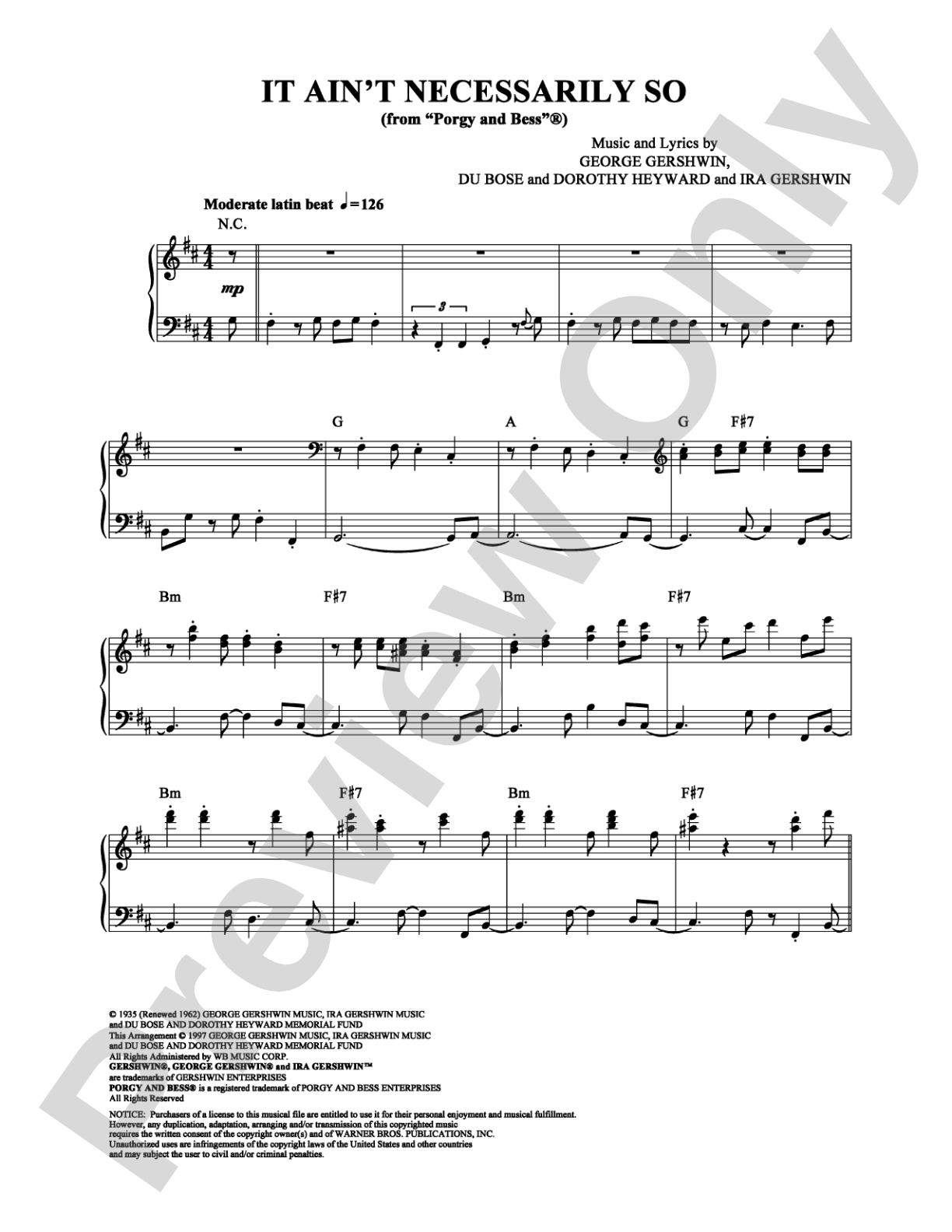
It Ain't Necessarily So: Piano Digital Sheet Music

It Ain't Necessarily So: Piano Digital Sheet Music

George Gershwin, Ira Gershwin, Dorothy Heyward, Du Bose Heyward, Marcus Roberts

Item: 00-PS-0001118

Digital Download
$3.99
Description

It Ain't Necessarily So: Piano Digital Sheet Music isn't in MakeMusic Cloud just yet...but it could be. Let us know you'd like to see it, and you'll help shape what comes next. In the meantime, start a free trial and dive into thousands of interactive titles your students can play along with today.

Sample Audio
No sample audio found.
Sample Video
Additional Details
SKU: 00-PS-0001118

More about this title

About the Artist: Marcus Roberts

Marcus Roberts is a pianist and composer whose work spans jazz standards, original compositions, and arrangements that draw deeply from the American songbook. His approach to jazz piano emphasizes harmonic sophistication and melodic clarity, making his interpretations accessible to students while remaining musically substantive.

Why we love this

Roberts's arrangement of this Gershwin standard respects the melody's elegance while showcasing jazz piano vocabulary that students can study and absorb. The voicings and comping patterns offer concrete models for how to reharmonize and reinvent a familiar tune without losing its character.

What to expect

Conversational and grounded, with a wry humor that matches the lyric's skeptical charm. Roberts's touch brings out the song's gentle irony while the jazz harmonies add sophistication and depth without overwhelming Gershwin's original melody.

Who it's for

Advanced jazz pianists and serious students of jazz standards looking for a recorded artist's take on how to reimagine familiar material. This works well for recital preparation, jazz ensemble soloists, or pianists interested in studying contemporary approaches to the American songbook.

How to get the most out of it

  • Pay attention to the harmonic rhythm in the accompaniment; Roberts's chord choices often move more frequently than you might expect, and these shifts anchor the phrasing.
  • Balance the melody against the jazz comping so the tune stays singable even within the more complex harmonic context.
  • Use the recorded version (if available separately) as a reference for the interpretive touches: timing, dynamics, and how much to lean into particular phrases.

How to use it

Pair this with other Great American Songbook standards in a jazz or popular music recital context. It also serves as an excellent study score for jazz piano students who want to see how an experienced pianist approaches reharmonization and arrangement of a well-known tune.

Skills your students will build

  • Analyzing jazz reharmonization and voice leading
  • Reading chord symbols in a jazz context
  • Interpreting melody within complex harmonic environments
  • Understanding comping rhythms and accompaniment patterns

You May Also Like