
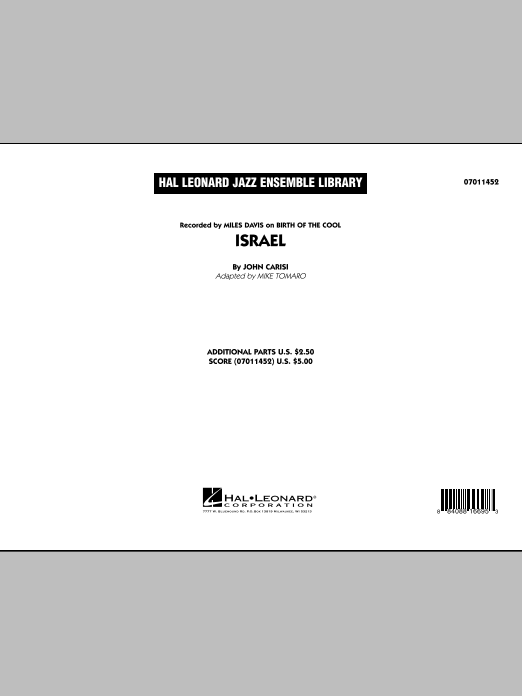

Israel: Jazz Ensemble Conductor Score & Parts
By John Carisi / As performed by Miles Davis / Arranged by Mike Tomaro
Grade: 4
Item: 35-PK00159932
$50.00
Pickup currently not available
Buy Extra Parts (Digital PDF Download)
| Product | Price | Quantity |
|---|---|---|
| Israel - Conductor Score (Full Score) | $6.00 | |
| Israel - Alto Sax 1 | $6.00 | |
| Israel - Alto Sax 2 | $6.00 | |
| Israel - Tenor Sax 1 | $6.00 | |
| Israel - Tenor Sax 2 | $6.00 | |
| Israel - Baritone Sax | $6.00 | |
| Israel - Trumpet 1 | $6.00 | |
| Israel - Trumpet 2 | $6.00 | |
| Israel - Trumpet 3 | $6.00 | |
| Israel - Trumpet 4 | $6.00 | |
| Israel - Trombone 1 | $6.00 | |
| Israel - Trombone 2 | $6.00 | |
| Israel - Trombone 3 | $6.00 | |
| Israel - Trombone 4 | $6.00 | |
| Israel - Guitar | $6.00 | |
| Israel - Piano | $6.00 | |
| Israel - Bass | $6.00 | |
| Israel - Drums | $6.00 |
Parts Added to Cart!
Description
Skillfully adapted directly from the famous version recorded by Miles Davis on the landmark album "Birth of the Cool," this arrangement for standard jazz ensemble instrumentation features an advanced harmonic structure along with the inherent ultra-smooth style. The solos for alto and trumpet include transcriptions from the original recording, and additional optional solo space is provided for extending the length of the arrangement if desired.


Israel: Jazz Ensemble Conductor Score & Parts isn't in MakeMusic Cloud just yet...but it could be. Let us know you'd like to see it, and you'll help shape what comes next. In the meantime, start a free trial and dive into thousands of interactive titles your students can play along with today.
Request This Title
Tell us you want it.
Start Your Free Trial
Explore everything that's ready to play right now.
Sample Audio
No sample audio found.
Sample Video
No sample videos found.
Additional Details
Publisher:
Hal Leonard
SKU:
35-PK00159932
More about this title
About the Composer: John Carisi
John Carisi was a trumpeter, composer, and arranger who became central to the cool jazz movement of the 1950s. His compositions, including "Israel," revealed a gift for writing sophisticated harmonies and memorable melodic lines that bridged bebop complexity with the restrained aesthetic of cool jazz. Though he stepped away from music professionally in later years, his catalog remains a touchstone for understanding how jazz composition evolved during one of the idiom's most generative periods.
Why we love this
This arrangement taps directly into one of jazz history's most influential recordings without sacrificing the substance that makes the tune worth playing. Mike Tomaro's adaptation respects both the harmonic sophistication that defines Carisi's writing and the particular voice Miles Davis brought to the original, giving your ensemble access to a legitimate jazz standard arranged at a level that challenges without overwhelming.
What to expect
Elegantly poised and unhurried. The tune unfolds with the kind of melodic clarity and harmonic richness that feels both modern and timeless, never rushing itself or demanding flash from the ensemble. There's a quietness to it, a confidence that the writing will speak without needing to overwhelm.
Who it's for
Jazz ensemble directors working at the intermediate to advanced level who want their students to engage with genuine jazz repertoire rooted in a canonical recording. This is for ensembles ready to tackle advanced harmonic language and for soloists willing to invest in transcription and understanding of jazz vocabulary beyond the printed page.
How to get the most out of it
- Approach the harmonic movement with deliberate voice leading in the ensemble parts; these chords demand clarity and precision from your section players, not just accuracy on the written notes.
- Study the transcribed solos before rehearsal so you can model the phrasing and articulation for your alto and trumpet soloists. The original recording captures a specific restraint that sets the tone.
- If you use the optional extended solo sections, establish clear head arrangements with your soloists beforehand so they can comfortably navigate the changes without losing the tune's intrinsic cool.
How to use it
Pair this with other cool jazz standards or post-bop material to create a cohesive set that traces the lineage of modern jazz composition. It works equally well as a concert opener that establishes sophistication or as a mid-set piece that showcases your ensemble's harmonic maturity.
Skills your students will build
- Reading advanced harmonic structures and voice leading
- Interpreting transcribed solos and analyzing jazz articulation
- Navigating changes in ensemble context without over-playing
- Building ensemble cohesion around complex chord progressions