Isn't This A Lovely Day (To Be Caught In The Rain?) Sheet Music Preview

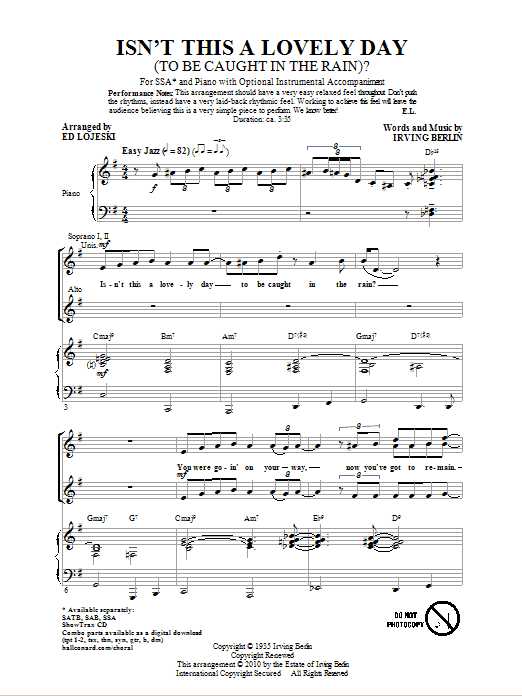
Isn't This A Lovely Day (To Be Caught In The Rain?): SSA Choral Octavo

By Irving Berlin / Arranged by Ed Lojeski

Item: 35-DS00175375

Digital Download
$2.99
Description

Isn't This A Lovely Day (To Be Caught In The Rain?): SSA Choral Octavo isn't in MakeMusic Cloud just yet...but it could be. Let us know you'd like to see it, and you'll help shape what comes next. In the meantime, start a free trial and dive into thousands of interactive titles your students can play along with today.

Sample Audio
No sample audio found.
Sample Video
Additional Details
Publisher: Hal Leonard
Page Count: 7
SKU: 35-DS00175375

More about this title

About the Composer: Irving Berlin

Irving Berlin (1888-1989) wrote some of the most enduring melodies in American popular music, composing over 1,000 songs across nearly a century. His gift for crafting instantly memorable tunes with clever, conversational lyrics made him a dominant force on Broadway and in Hollywood from the 1920s onward. For music educators, Berlin's work offers students authentic encounters with American songwriting tradition: his melodies sit naturally in the voice, his harmonies reward careful listening, and his lyrics model how good writing serves the music rather than overshadowing it.

Berlin's influence on choral arranging runs deep. His standards have been adapted countless times across every imaginable voicing and style, making his catalog a reliable resource for building singers' musicianship. Whether teaching jazz phrasing, swing feel, or simply how to shape a lyrical line with intention, Berlin's melodies provide the kind of musical scaffolding that lets singers focus on execution rather than wrestling with awkward vocal writing.

Why we love this

Ed Lojeski's SSA arrangement captures the conversational warmth and rhythmic sophistication of Berlin's original without demanding excessive technical facility from your singers. The voicing sits comfortably for developing groups while the jazz and swing elements give singers real experience with style and interpretation beyond classical technique. It's the kind of standard that sounds instantly recognizable to audiences yet teaches singers something genuine about phrasing and ensemble balance.

What to expect

There's an almost nostalgic intimacy here, as if someone is humming a favorite memory in your ear. The melody floats effortlessly over jazz chords that shimmer and shift, creating moments of harmonic richness that feel both familiar and gently sophisticated. The rain in the title becomes less about the weather and more about the simple pleasure of good company.

Who it's for

This arrangement works beautifully for high school and college SSA choirs seeking material that bridges concert repertoire and popular song standards. It's equally suited for groups that already work with jazz phrasing and those encountering swing style for the first time.

How to get the most out of it

  • Treat the lyric as spoken rhythm. Berlin's text sits so naturally on the melody that overly legato singing flattens the charm; lean into the conversational phrasing and let the punctuation guide your breath.
  • Balance the inner voices carefully in the homophonic sections so the harmonic color emerges without covering the top line. This is where jazz arrangements often lose their sparkle.
  • Settle into a relaxed swing feel rather than chasing tempo. The piece benefits from breathing room and a sense of ease, particularly in the sections that quote the original piano voicing.

How to use it

Pair this with other Berlin standards or American songbook selections for a concert exploring the roots of American musical theater. It also serves as an accessible entry point for introducing jazz vocabulary and swing interpretation if your choir is new to the style. The seven-page length keeps rehearsal demands reasonable while the performance value is immediate.

Skills your students will build

  • Conversational phrasing and text interpretation
  • Jazz and swing feel; rhythmic flexibility beyond straight notation
  • Part independence in a jazz harmonic context
  • Balancing inner voices while maintaining melodic prominence
  • Chord recognition and harmonic listening in jazz voicings

You May Also Like