
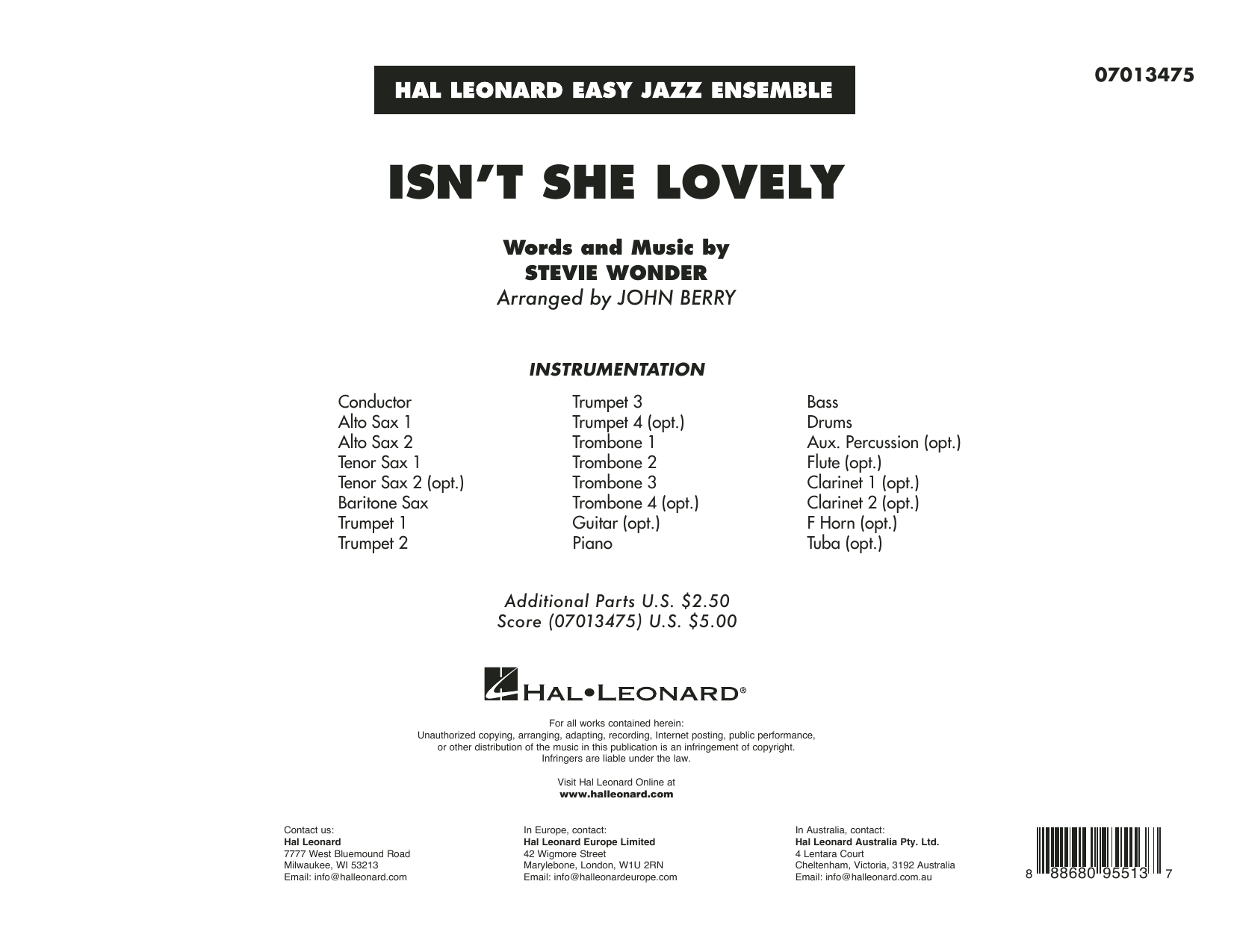

Isn't She Lovely (arr. John Berry): Jazz Ensemble Conductor Score & Parts
As performed by Stevie Wonder / Arranged by John Berry
Grade: 2
Item: 35-PK00441436
$45.00
Pickup currently not available
Buy Extra Parts (Digital PDF Download)
Parts Added to Cart!
Description
From Stevie Wonder's landmark 1976 album "Songs in the Key of Life", this smooth and tender hit has gone on to become a jazz standard recorded by many artists. In a moderate swing style, John Berry perfectly captures the essence of the original in this version for younger bands. Includes brief solos for alto sax and trumpet.


Isn't She Lovely (arr. John Berry): Jazz Ensemble Conductor Score & Parts isn't in MakeMusic Cloud just yet...but it could be. Let us know you'd like to see it, and you'll help shape what comes next. In the meantime, start a free trial and dive into thousands of interactive titles your students can play along with today.
Request This Title
Tell us you want it.
Start Your Free Trial
Explore everything that's ready to play right now.
Sample Audio
No sample audio found.
Sample Video
No sample videos found.
Additional Details
Publisher:
Hal Leonard
SKU:
35-PK00441436
More about this title
About the Artist: Stevie Wonder
Stevie Wonder stands as one of the most influential songwriters and musicians of the past fifty years, composing across soul, funk, pop, and jazz with equal mastery. His work combines sophisticated harmonic language with emotionally direct melodies, making his catalog endlessly rewarding for ensemble arrangements and student musicians learning to balance complexity with accessibility.
Why we love this
John Berry's arrangement honors the tenderness of the original while giving younger ensembles genuine musical meat to sink their teeth into. The moderate swing feel sits perfectly at Grade 2, and the built-in solo spots for alto sax and trumpet create natural moments for your soloists to step forward without overextending their technical reach.
What to expect
Warm, unhurried, and genuinely graceful. The arrangement lets Wonder's original melody breathe while the moderate swing tempo creates space for nuance and expression rather than technical scrambling.
Who it's for
Grade 2 jazz ensembles and young bands developing their swing vocabulary and solo confidence. Directors looking for accessible material that still teaches real musicianship without dumbing down the source material will find exactly what they need here.
How to get the most out of it
- Establish the swing feel early in sectionals by locking the rhythm section into a comfortable pocket; the groove should feel easy and conversational, not mechanical.
- Bring out the melody's inherent phrasing by having the lead voice breathe where a vocalist naturally would, even when a phrase spans multiple measures.
- Give your alto and trumpet soloists space to interpret their parts expressively; encourage them to listen to professional recordings for stylistic reference without copying them note-for-note.
- Balance the band's texture behind the solos by keeping backgrounds supportive rather than driving; the arrangement should frame the soloists, not compete with them.
How to use it
Pair this with other Motown-era standards to build a set that speaks to students across genres, or use it as a confidence builder early in the jazz band season when you want to establish swing feel without steep technical demands. Its familiar melody also makes it an excellent outreach piece for concert audiences unfamiliar with jazz ensemble repertoire.
Skills your students will build
- Reading and executing swing rhythms in a moderate tempo context
- Accompanying soloists with sensitive, supportive textures
- Phrasing melodic lines with lyrical intent
- Trading roles between melody and background figures
- Listening and responding to ensemble balance in real time