
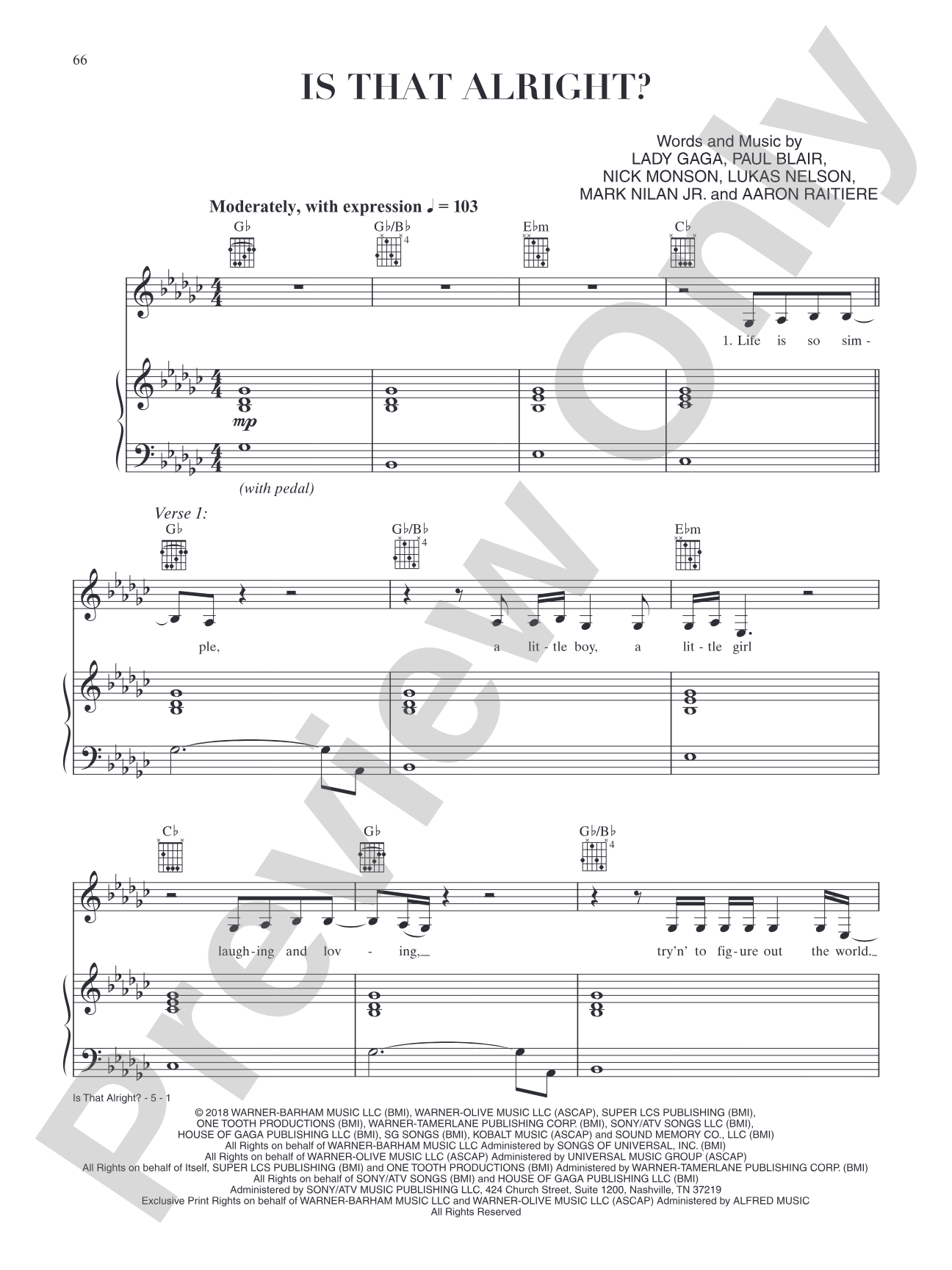

Is That Alright? (from A Star Is Born): Piano/Vocal/Guitar
Music from the Original Motion Picture Soundtrack
Item: 00-PS-0016081
$4.99
Pickup currently not available
Related Items
Alibi (from A Star Is Born): Piano/Vocal/Guitar |
$4.99
|
View | |
Always Remember Us This Way (from A Star Is Born): Piano/Vocal/Guitar |
$5.99
|
View | |
Before I Cry (from A Star Is Born): Piano/Vocal/Guitar |
$4.99
|
View | |
Black Eyes (from A Star Is Born): Piano/Vocal/Guitar |
$5.99
|
View | |
Diggin' My Grave (from A Star Is Born): Piano/Vocal/Guitar |
$5.99
|
View | |
Hair Body Face (from A Star Is Born): Piano/Vocal/Guitar |
$5.99
|
View | |
I Don't Know What Love Is (from A Star Is Born): Piano/Vocal/Guitar |
$4.99
|
View | |
I'll Never Love Again (from A Star Is Born): Piano/Vocal/Guitar |
$5.99
|
View | |
Look What I Found (from A Star Is Born): Piano/Vocal/Guitar |
$4.99
|
View | |
Maybe It's Time (from A Star Is Born): Piano/Vocal/Guitar |
$4.99
|
View | |
Music to My Eyes (from A Star Is Born): Piano/Vocal/Guitar |
$4.99
|
View | |
Too Far Gone (from A Star Is Born): Piano/Vocal/Guitar |
$4.99
|
View | |
A Star Is Born: Piano/Vocal/Guitar Book |
$24.99
|
View |
Description
Alfred Music presents a piano/vocal/guitar songbook featuring the soundtrack to 2018's box-office hit, starring Lady Gaga and Bradley Cooper. Original, full-color photography and movie artwork within this beautifully packaged portfolio help provide a glimpse into the music and visual aesthetic of a Hollywood classic's third remake. Titles: Black Eyes * La Vie en Rose * Maybe It's Time * Alibi * Shallow * Music to My Eyes * Diggin' My Grave * Always Remember Us This Way * Look What I Found * Heal Me * I Don't Know What Love Is * Is That Alright? * Why Did You Do That? * Hair Body Face * Before I Cry * Too Far Gone * I'll Never Love Again


Discover MakeMusic Cloud: thousands of interactive titles your students can play along with today.
Sample Audio
No sample audio found.
Sample Video
No sample videos found.
Additional Details
Publisher:
Alfred Music
Page Count:
104
SKU:
00-PS-0016081
More about this title
About the Composer: Lady Gaga
Lady Gaga emerged as a groundbreaking pop artist whose work consistently blends theatrical storytelling with sophisticated harmonic language. Her collaboration on the A Star Is Born soundtrack demonstrated her ability to craft deeply personal material that resonates across vocal and instrumental contexts, drawing from jazz, country, and classical influences to create songs that demand both technical skill and emotional authenticity from performers.
As a composer, Gaga has spent her career prioritizing melodic strength and harmonic depth over trend-chasing production. Her partnership with co-composers Paul Blair, Nick Monson, Lukas Nelson, Mark Nilan Jr., and Aaron Ratiere on this album produced a catalog of songs that translate remarkably well to acoustic settings, making them accessible to musicians working across ensemble and solo contexts.
Why we love this
This collection captures music written for intimate, emotionally driven storytelling in a film, which means every song rewards careful attention to lyrical phrasing and harmonic color. The vocal lines sit naturally in the voice without requiring extreme range or technical display, letting singers focus on interpretive depth rather than virtuosity. For pianists and guitarists, the arrangements provide both structural clarity and room for personal interpretation, making this material genuinely engaging to perform rather than merely functional.
What to expect
These songs balance intimacy with cinematic scope. They contain moments of quiet vulnerability alongside soaring emotional climaxes, with harmonic language that feels both contemporary and timeless. The collection as a whole moves through states of yearning, defiance, acceptance, and heartbreak with directness and sophistication.
Who it's for
Pianists, guitarists, and singers preparing material for recitals, auditions, or performance classes who want contemporary songs with genuine depth. Music teachers looking to bridge popular music and classical technique will find songs here that reward careful study without condescension.
How to get the most out of it
- Treat the piano part as a conversational partner to the vocal line rather than accompaniment. The harmonic voicings deserve attention equal to the melody, especially in songs like Shallow where the accompaniment establishes the song's emotional arc.
- Balance dynamics carefully across the full range of each song. These pieces live in intimate moments even when they build in intensity, so clarity at soft volumes matters as much as impact during climaxes.
- Use the guitar voicings to inform your understanding of the harmonic language. When you see how chords are voiced for guitar, it clarifies the composer's intentions and can suggest interpretive choices for the vocalist.
How to use it
This material works exceptionally well as standalone recital pieces or as a thematic concert exploring modern film songwriting. A voice student performing a song from this collection gains exposure to material that sits between art song and popular music, developing flexibility in interpretation and style. Piano or guitar students can use individual songs to explore accompanying within contemporary idioms.
Skills your students will build
- Balancing lyrical phrasing with harmonic awareness in contemporary settings
- Reading lead sheet notation and making interpretive choices based on chord voicings
- Accompanying singers with sensitivity to emotional arc and dramatic timing
- Navigating songs with sophisticated harmonic language and unexpected chord progressions
- Developing interpretive maturity in music written for narrative and character rather than abstract beauty