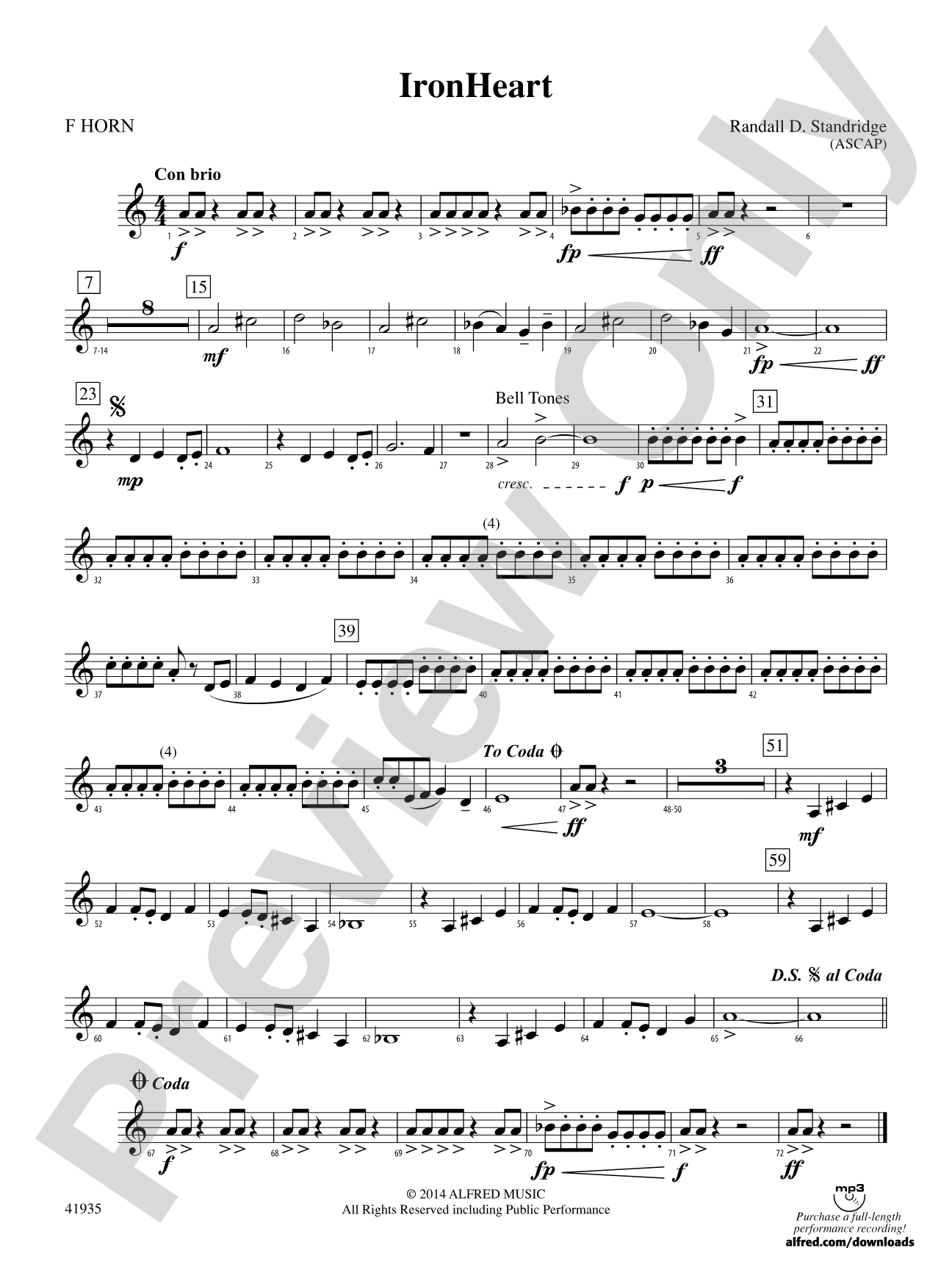
IronHeart: 1st F Horn Sheet Music Preview

IronHeart: 1st F Horn

By Randall D. Standridge

Grade: 1.5 (Easy)

Item: 00-PC-0016417_H1

Digital Download
$3.00
Description
This work for concert band is inspired by the inner strength that all artists must call on to devote themselves to their craft. The work uses the sounds of a beating heart combined with metallic accents in the mallet percussion, brake drum, and China crash to create a uniquely industrial sound. The melody races through life's obstacles (represented in an altered scale) before climaxing in a beautiful, triumphant fanfare. (2:25) This title is available in MakeMusic Cloud.

Don't just read it, hear it, play along with it, and watch your students grow with it. In MakeMusic Cloud, IronHeart: 1st F Horn comes alive with professional accompaniment, adjustable tempo, and built-in practice tools that turn solo practice into real progress.

Sample Audio
0:00
0:00
Sample Video
Additional Details
Series: Alfred Debut Series
Publisher: Alfred Music
Page Count: 138
SKU: 00-PC-0016417_H1

More about this title

About the Composer: Randall D. Standridge

Randall D. Standridge has built a reputation as a composer who writes for young musicians without condescension, creating works that challenge them musically while remaining accessible. His pieces consistently appear on festival programs and contest lists, reflecting both the quality of his writing and his deep understanding of what works in the rehearsal room.

Standridge's approach to composition centers on clear melodic ideas and orchestration that lets each section shine. He often draws inspiration from contemporary themes and human experiences, translating abstract concepts like resilience and courage into musical language that students can connect with personally.

Why we love this

IronHeart succeeds because it trusts your students to handle both technical novelty and emotional depth at Grade 1.5. The heartbeat ostinato and industrial percussion palette create immediate sonic interest, while the altered-scale melody gives your band something genuinely contemporary to sink their teeth into. It's the kind of piece that energizes your program without requiring superhuman execution.

What to expect

IronHeart pulses with determination. The heartbeat foundation grounds everything in something primal and human, while the metallic percussion adds an edge that suggests struggle and grit. When the melody breaks through to that final fanfare, it earns its moment of brightness through the journey that came before it.

Who it's for

Young concert bands looking for repertoire that feels current and speaks to real artistic challenges. Your students will respond to a work that pairs accessible ranges and rhythms with genuinely interesting compositional ideas and unconventional sounds.

How to get the most out of it

  • Layer in the heartbeat accompaniment gradually during early rehearsals. Start with just the low voices or mallets keeping the pulse, then add instruments section by section until the full effect emerges. This prevents the texture from overwhelming your ensemble's ability to lock in.
  • Treat the altered scale passages as a compositional color, not a technical problem. Encourage your melody players to think musically through the unusual intervals rather than mechanically finger-reading their way through.
  • Balance the brake drum and China crash with restraint in the climactic fanfare. These sounds should punctuate the triumph, not overpower the melodic statement your entire band is making.

How to use it

Program this on a concert where you want to signal that your band takes contemporary music seriously. It pairs well with both traditional classics and other modern works, serving as a natural centerpiece that demonstrates your ensemble's range. The two-minute-twenty-five-second duration also makes it an excellent choice for festival competition slots or concert finales.

Skills your students will build

  • Reading and executing altered scale patterns
  • Maintaining steady pulse against complex rhythmic layers
  • Balancing melodic line against rhythmic and textural accompaniment
  • Executing non-traditional percussion techniques with precision
  • Shaping melodic phrases through changing harmonic contexts

You May Also Like