
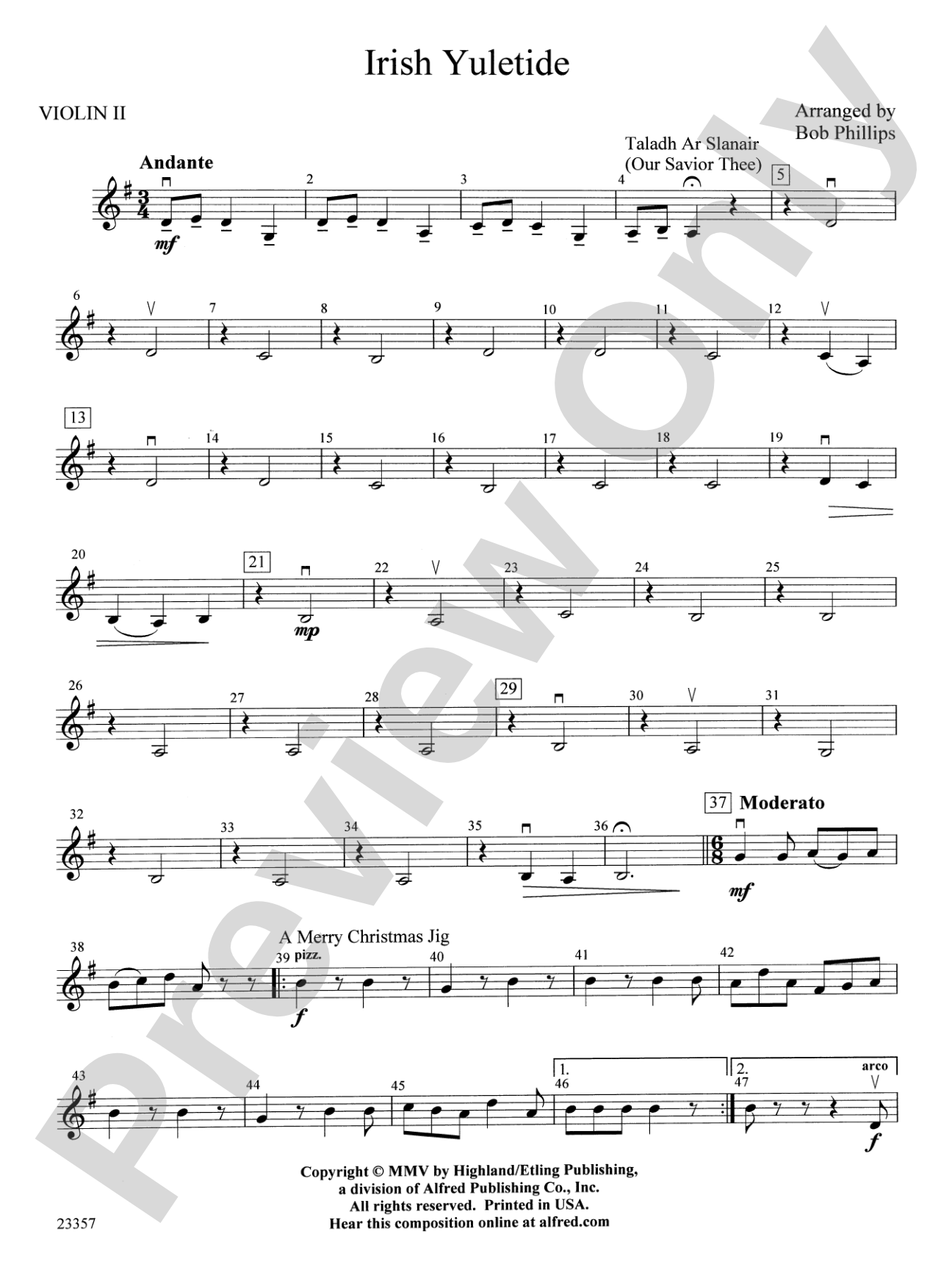

Irish Yuletide: 2nd Violin
By Bob Phillips
Grade: 2.5
Item: 00-PC-0000702_VN2
$7.99
Pickup currently not available
Description
Irish Yuletide blends three ancient Irish Christmas melodies into a lovely Celtic medley that touches the heart. "Our Savior Thee" ("Taladh ar Slanair" in Gaelic), "A Merry Christmas Jig" and "Christmas Eve Reel" begin with a beautiful Irish air, move into a Celtic jig, and then build into a very exciting Irish reel ending with a flourish. Each melody in this piece is in a different meter, providing an easy introduction to changing meters.


Don't just read it, hear it, play along with it, and watch your students grow with it. In MakeMusic Cloud, Irish Yuletide: 2nd Violin comes alive with professional accompaniment, adjustable tempo, and built-in practice tools that turn solo practice into real progress.
Open in the Player
Jump straight in and assign it today.
Start Your Free Trial
Open this title and explore the full library in minutes.
Sample Audio
1
Audio File
--:--
0:00
0:00
Sample Video
No sample videos found.
Additional Details
Series:
Highland/Etling String Orchestra
Publisher:
Alfred Music
Page Count:
124
SKU:
00-PC-0000702_VN2
More about this title
About the Composer: Bob Phillips

Bob Phillips (b. 1953) has shaped string education through decades of work as a composer, pedagogue, and conductor. His career spans over 200 published works for orchestras and bands, six levels of the Sound Innovations series, and groundbreaking eclectic style publications including Fiddlers Philharmonic, Jazz Philharmonic, and Rock Philharmonic. His compositions are performed annually by thousands of string students worldwide and regularly appear on Midwest Clinic programs.
For 27 years, Phillips built the Saline, Michigan string program into a national model serving over 700 students in both classical and contemporary idioms. He founded the Saline Fiddlers Philharmonic, which performed internationally, at the White House, and at major festivals. Phillips has conducted all-state orchestras across the country and served as resident conductor and arranger for Seattle's Wintergrass Festival for 12 years. An ASCAP award-winning composer, he is also known for his instructional video series String Clinics to Go, which has become a resource for thousands of teachers.
Why we love this
Phillips writes for real orchestras playing at this level, and it shows. The three melodies work together naturally rather than feeling stitched together, and the meter changes serve as musical moments, not curriculum checkboxes. Your students will recognize the joy of the Irish tradition in every phrase.
What to expect
A journey through candlelit Irish villages. The opening is gentle and reflective, steeped in the timeless quality of ancient sacred melody. The piece then springs to life with infectious rhythmic energy, moving from the playful bounce of the jig into the whirling exhilaration of the reel, closing with genuine celebration.
Who it's for
String orchestras at Grade 2.5 level who are ready to explore music beyond the classical tradition and experience how folk melody shapes arrangement choices. Directors looking for a winter program piece that engages students emotionally while building practical skills will find this especially rewarding.
How to get the most out of it
- Honor the character shift between each melody by adjusting bow weight and articulation. The opening air calls for singing, legato lines; the jig demands lighter, shorter strokes; and the reel needs crisp, energetic bow work.
- Shape the transitions between meters as musical breaths rather than stops. Let the ensemble feel the pulse carry through the meter signature change.
- Build the dynamic arc across all three melodies so the ending flourish feels earned. Resist the urge to start loud in the reel; save your energy for the final push.
- Listen for balance between melody and accompaniment parts. Viola and cello voices support the tune but should remain clear enough to define the Celtic harmonic character.
How to use it
This works beautifully in a winter concert when paired with classical holiday repertoire or as the folk anchor in a program celebrating world traditions. The manageable length and accessible energy make it ideal for mid-concert placement, where it can lift the room and remind audiences why students love playing together.
Skills your students will build
- Reading and executing meter changes (air in one meter, jig in another, reel in a third)
- Stylistic articulation across Celtic idioms (legato sacred melody, staccato jig rhythm, driving reel figures)
- Melodic phrasing in folk tradition (understanding how tune-based music differs from formal classical structure)
- Ensemble balance and listening across arrangement layers