
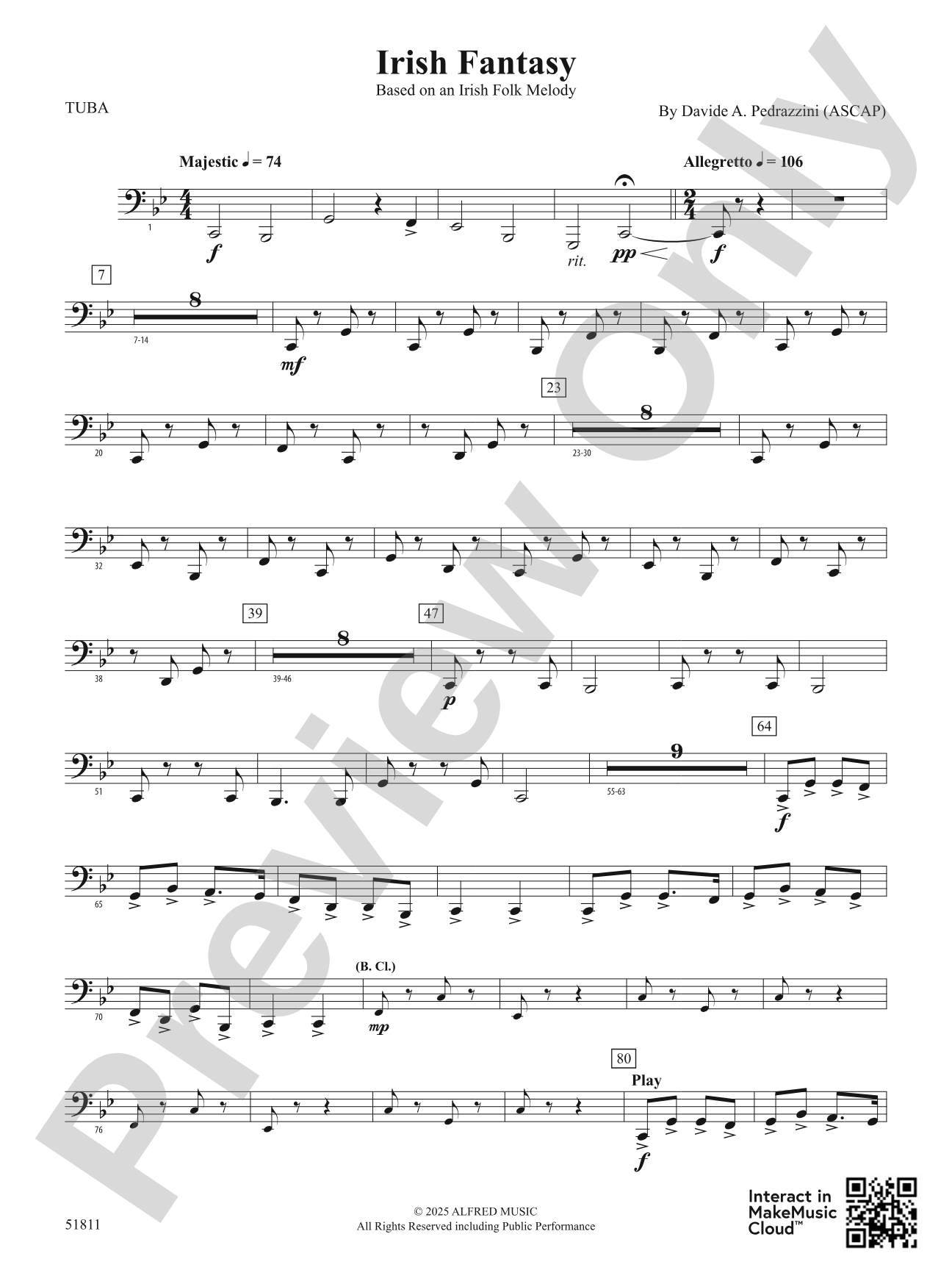

Irish Fantasy: Tuba
Based on an Irish Folk Melody
By Davide A. Pedrazzini
Grade: 2.5
Item: 00-PC-0019511_TB1
$3.00
Pickup currently not available
Description
Irish Fantasy draws inspiration from an Irish folk melody ("The Road to Lisdoonvarna"), which Davide Pedrazzini freely transforms and elaborates. The result is a fantasy that is very characteristic and surprising, just as the landscapes of Ireland are surprising.
The majestic opening theme, which brings the Dorian mode to your ear, is common in Celtic music. Performers will also experience rich counterpoint that includes a fugue section where all the instruments chase each other. A final accelerando will lead to a recapitulation of the majestic opening. The composer created this piece while recalling his holiday in Ireland. Let yourself be carried away on this surprising journey! (3:20)


The majestic opening theme, which brings the Dorian mode to your ear, is common in Celtic music. Performers will also experience rich counterpoint that includes a fugue section where all the instruments chase each other. A final accelerando will lead to a recapitulation of the majestic opening. The composer created this piece while recalling his holiday in Ireland. Let yourself be carried away on this surprising journey! (3:20)
Irish Fantasy: Tuba isn't in MakeMusic Cloud just yet...but it could be. Let us know you'd like to see it, and you'll help shape what comes next. In the meantime, start a free trial and dive into thousands of interactive titles your students can play along with today.
Request This Title
Tell us you want it.
Start Your Free Trial
Explore everything that's ready to play right now.
Sample Audio
1
Audio File
--:--
0:00
0:00
Sample Video
Additional Details
Series:
Young Symphonic Series
Publisher:
Alfred Music
SKU:
00-PC-0019511_TB1
More about this title
About the Composer: Davide A. Pedrazzini

Davide A. Pedrazzini (born Lodi, Italy, 1981) discovered music at age 11 and went on to study saxophone and clarinet before pursuing formal composition training. He earned degrees in Composition from the Conservatorio of Piacenza and in Arranging for Band from the Conservatorio of Parma, and has studied band conducting with respected masters including José Rafael Pascual Vilaplana, Lorenzo Della Fonte, and Angelo Bolciaghi.
Pedrazzini's works have earned recognition in numerous national and international composition competitions, including the 2023 Grand Prize at the Grand Mesa Young Band Composition Contest in Colorado. His pieces appear with major publishers across Europe and North America, and he is notably the only Italian composer featured in J.W. Pepper's Editors' Choice selection. Currently he teaches Arranging, Composition, and Band Conducting at the Conservatory of Udine and Composition for Music Education at Livorno.
Why we love this
Pedrazzini balances immediate appeal with genuine compositional substance. The Dorian melody captures audiences from the opening, but the counterpoint and fugal development that follow reward both players and listeners with real musical weight, all at a grade level that won't overextend a solid intermediate ensemble.
What to expect
The piece unfolds like a guided tour through Irish landscape, beginning with a serene, stately view colored by modal harmonies before the musical topography grows more complex and textured. The fugal section creates delightful surprise as familiar melodies weave together, building to a final accelerando that feels earned and exhilarating rather than arbitrary.
Who it's for
Concert bands at the intermediate level (Grade 2.5) looking for repertoire with both melodic warmth and compositional sophistication. This works especially well for groups preparing for festivals or contests that value folk-inspired literature with arranging craft.
How to get the most out of it
- Feature the principal melody in the opening section with warmth and slight rubato to highlight the Celtic character of the Dorian mode; resist the urge to rush the majestic opening phrase.
- In the fugal section, ensure each entrance is distinctly voiced and balanced so the chasing lines remain audible without losing ensemble cohesion; mark cue notes in parts that don't carry the main subject.
- Build momentum steadily into the final accelerando and recapitulation, treating it as a genuine return rather than simply repeating the opening; this structural moment should feel like the culmination of the journey.
How to use it
Program this as a concert opener or festival selection that establishes sophistication without demanding virtuosic display from soloists. Its three-minute duration and multicultural character make it a natural fit alongside other folk-based works or as a contrasting centerpiece in a program mixing classical and contemporary band music.
Skills your students will build
- Understanding Dorian mode and its application in contemporary concert band writing
- Executing counterpoint and fugal technique at intermediate level
- Balancing textural clarity when multiple melodic lines occur simultaneously
- Controlling tempo and phrasing through sustained opening section and accelerando closure
- Ensemble coordination during thematic development and recapitulation