
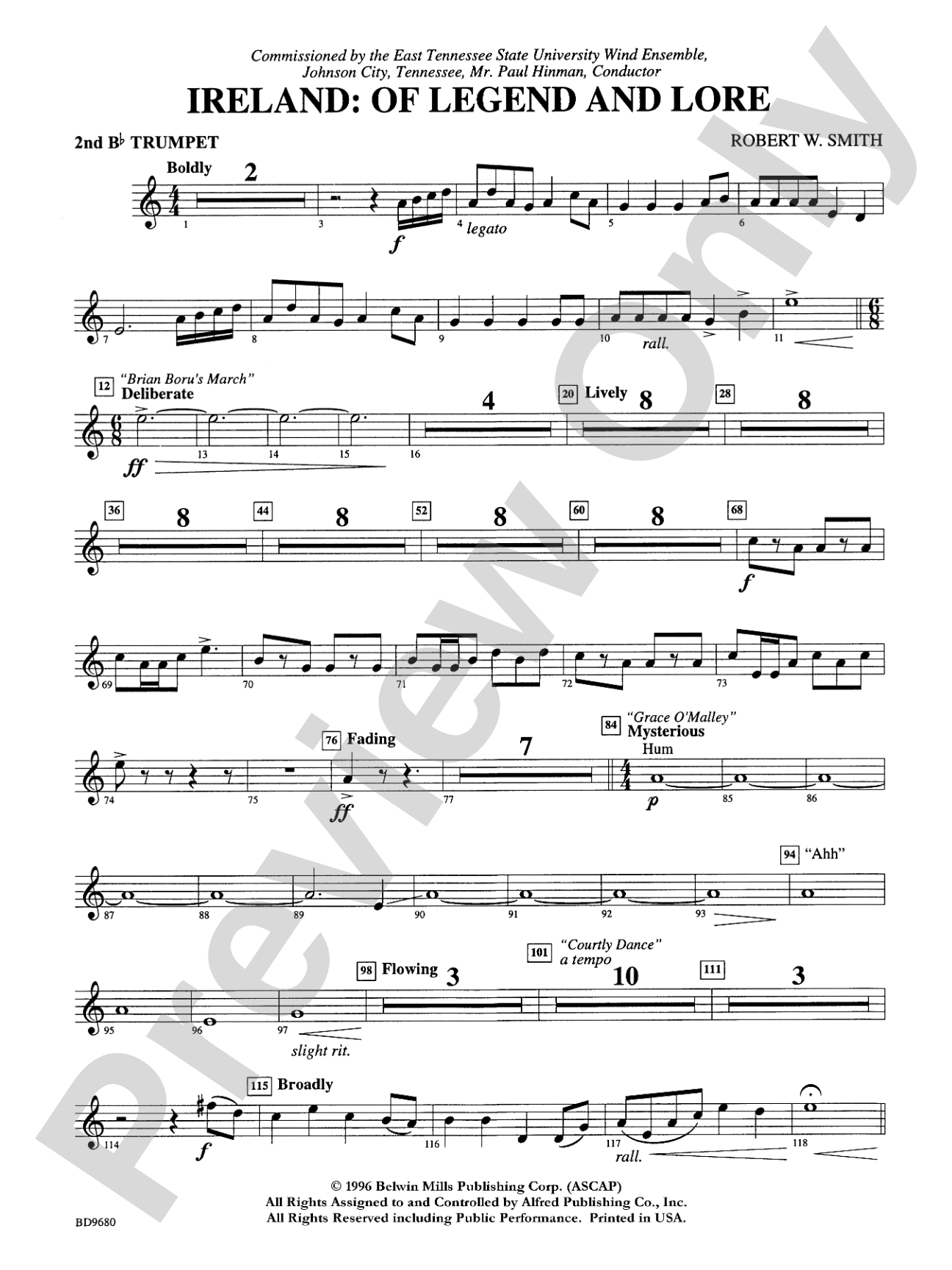

Ireland: Of Legend and Lore: 2nd B-flat Trumpet
By Robert W. Smith
Grade: 4 (Medium)
Item: 00-PC-0002044_T2
$5.99
Pickup currently not available
Description
Robert W. Smith has chosen three castles and several colorful characters known for legendary deeds from Irish history and folklore to put to music. The use of tinwhistle, the Irish drum bodran and hints of traditional Irish melodies add ethnic authenticity and fascination to the performance of this work. As we have come to expect from this highly inventive composer, the arena of sounds is expanded at every turn of the page. Musical imagery at its finest! (6:59)


Don't just read it, hear it, play along with it, and watch your students grow with it. In MakeMusic Cloud, Ireland: Of Legend and Lore: 2nd B-flat Trumpet comes alive with professional accompaniment, adjustable tempo, and built-in practice tools that turn solo practice into real progress.
Open in the Player
Jump straight in and assign it today.
Start Your Free Trial
Open this title and explore the full library in minutes.
Sample Audio
No sample audio found.
Sample Video
No sample videos found.
Additional Details
Series:
Belwin Symphonic Band
Publisher:
Alfred Music
Page Count:
318
SKU:
00-PC-0002044_T2
More about this title
About the Composer: Robert W. Smith

Robert W. Smith stands among America's most recorded and performed composers for concert band and orchestra, with over 400 published works to his credit. Trained at Troy State University (AL) and the University of Miami (FL), Smith has built a career on expansive orchestration and narrative depth that resonates with musicians at every level.
His symphonic works, including The Divine Comedy and The Odyssey, have traveled across continents and established themselves as cornerstones of the band repertoire. Beyond the concert hall, Smith's music has accompanied ceremonial moments of national significance, from presidential state dinners in Japan to Olympic broadcasts and the opening of the Macy's Thanksgiving Day Parade. His work as a clinician and conductor has taken him across North America, Europe, and Asia, where he continues to shape how contemporary band music is understood and performed.
Why we love this
Smith's approach to ethnic representation here avoids surface decoration. The tinwhistle, bodran, and traditional melodic fragments are woven into the harmonic and rhythmic fabric rather than sprinkled on top, giving students a genuine encounter with Irish musical language. At Grade 4, this work demands nothing beyond the ensemble's reach while delivering orchestral richness that makes the effort feel substantial.
What to expect
The piece unfolds like a guided tour through Irish legend, complete with atmosphere and character at every turn. Moments of lush, consonant harmony frame the glimpses of folk melody, while rhythmic interplay between traditional percussion and contemporary band writing creates an almost theatrical energy that keeps the ear engaged.
Who it's for
This conductor score and parts set is ideal for Grade 4 concert bands seeking repertoire that honors a specific cultural tradition while expanding the ensemble's orchestral vocabulary. Directors preparing for contest or festival performance will find a work that balances accessibility with musical substance.
How to get the most out of it
- Balance the tinwhistle and bodran against the full ensemble. These instruments carry cultural weight and should be heard clearly without drowning the band's harmonic support; work dynamic balance in sectionals before full rehearsals.
- Shape the traditional melodies with slight agogic emphasis on their characteristic intervals and rhythms. Smith embeds these melodies within contemporary harmony, so highlighting their contour helps audiences recognize the folklore element.
- Give the varied timbral colors time to register. At nearly seven minutes, the piece moves through distinct sonic territories tied to different castles and characters. Let each section breathe so the imagery lands.
- Anchor the ensemble's precision during rhythmic figures that accompany the bodran. The interaction between drum texture and band rhythm defines much of the work's character.
How to use it
Program this alongside repertoire that explores other cultural soundworlds to create a thematic concert around global traditions and storytelling in music. Its moderate length and accessible grade level also make it suitable for a spring festival appearance after the ensemble has developed confidence with the technical and stylistic demands.
Skills your students will build
- Balancing soloistic and accompanying roles within an ensemble context
- Interpreting non-traditional percussion writing (bodran) and its rhythmic relationship to the band
- Recognizing and performing modal and folk-influenced melodic contours within contemporary harmonic settings
- Sustaining dynamic control and phrase shape across extended sections with varied orchestration
- Responding to programmatic structure and using imagery to inform interpretation