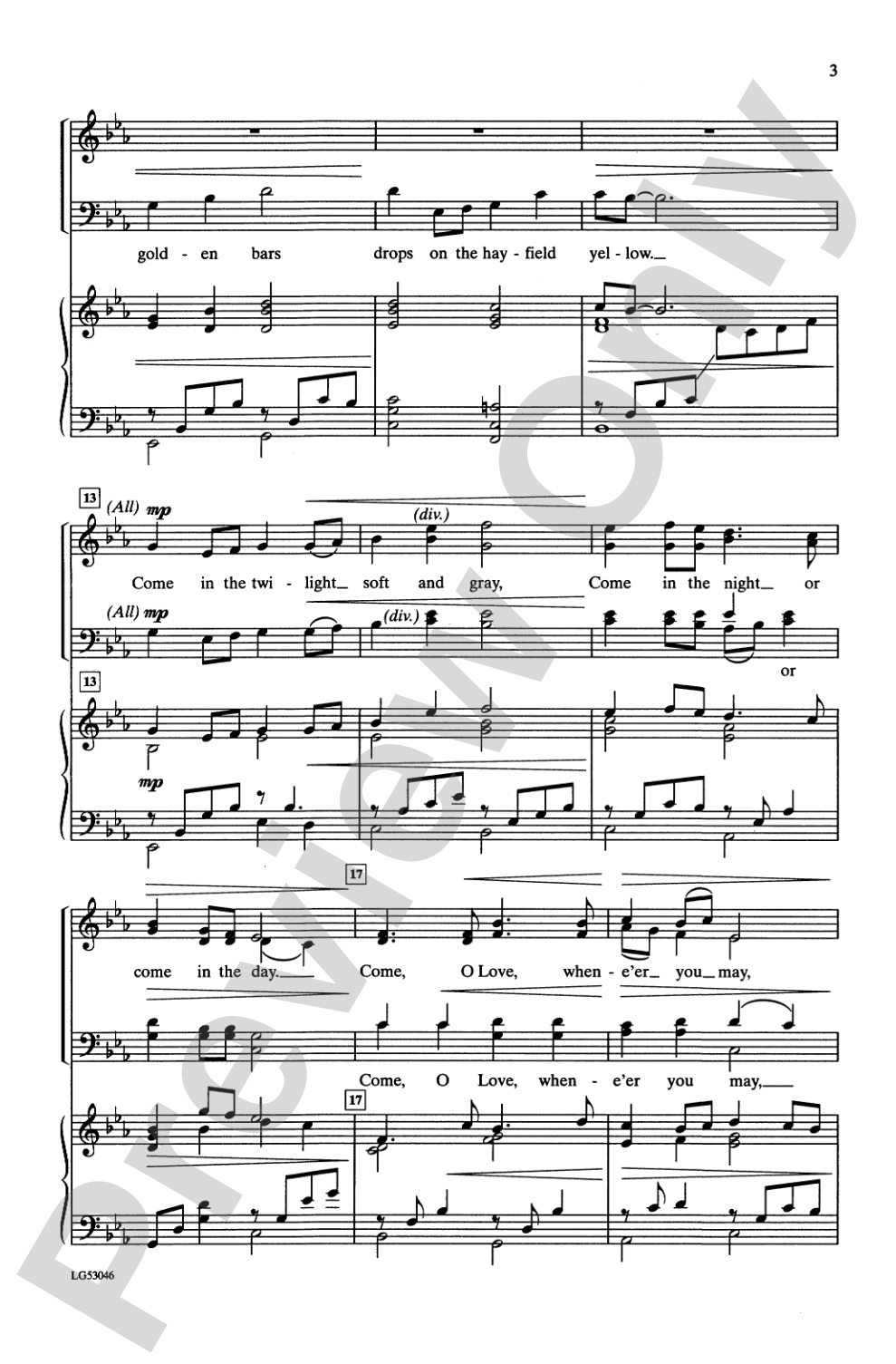
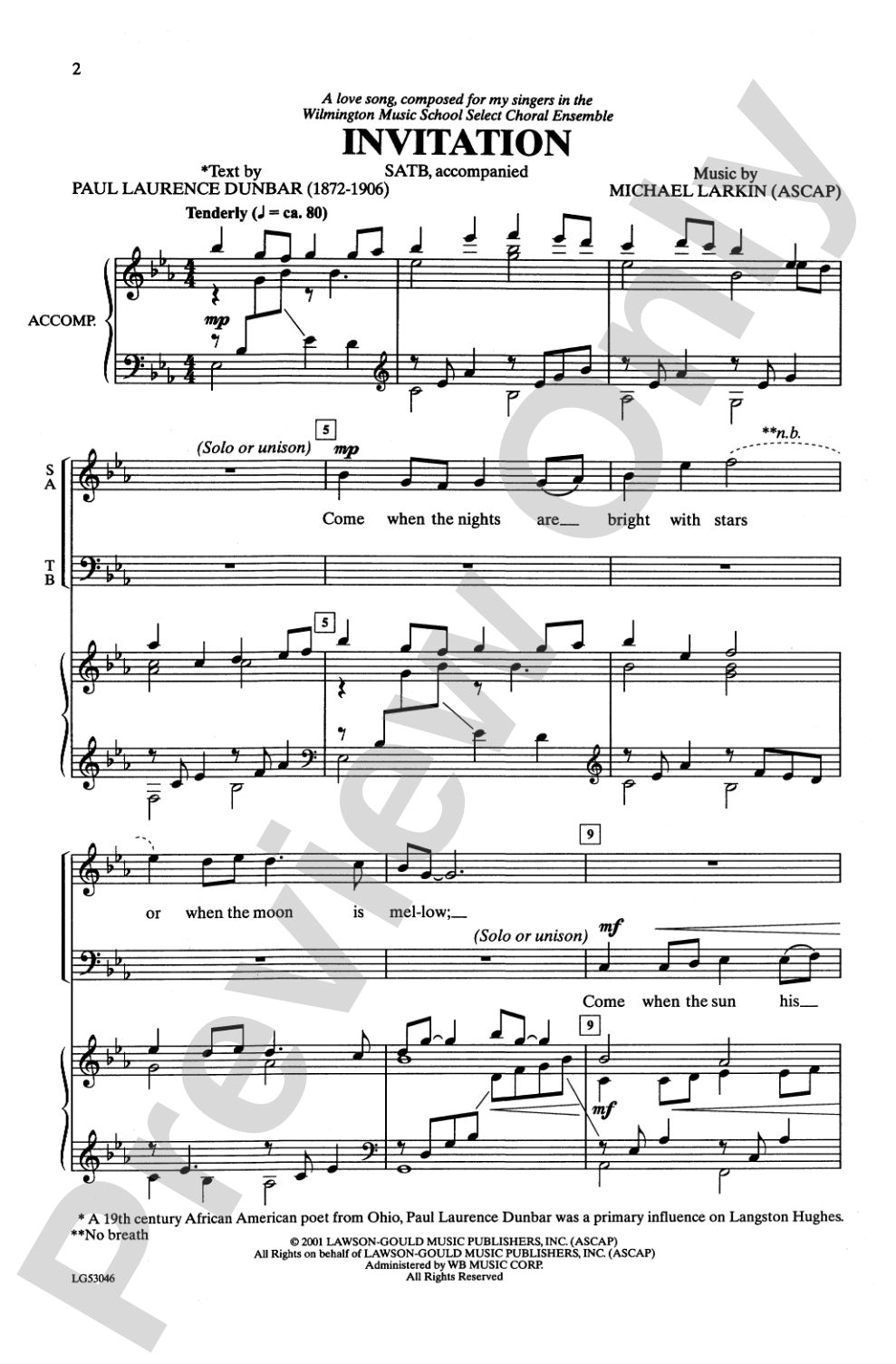
Invitation Sheet Music Preview

Invitation: SATB Choral Octavo

Text by Paul Laurence Dunbar / music by Michael Larkin

Level: Moderate

Item: 00-PO-0005108

Digital Download
$2.25

Minimum order quantity: 20 copies

Description
Paul Lawrence Dunbar is an African-American poet who was a major influence on Langston Hughes. Based on his poetry, this delightful work will add substance to your next concert because of its wonderful melody and highly descriptive lyric.

Invitation: SATB Choral Octavo isn't in MakeMusic Cloud just yet...but it could be. Let us know you'd like to see it, and you'll help shape what comes next. In the meantime, start a free trial and dive into thousands of interactive titles your students can play along with today.

Sample Audio
No sample audio found.
Sample Video
Additional Details
Series: Alfred Archive Edition: Lawson-Gould Music Publishers
Publisher: Alfred Music
Page Count: 8
SKU: 00-PO-0005108

More about this title

About the Composer: Michael Larkin

Michael Larkin

Michael Larkin has shaped choral music in the Delaware Valley for decades, bringing together his work as a conductor, composer, and voice teacher. After 28 years leading the Vocal/Choral Department at the Music School of Delaware, where he held the title of artist faculty voice teacher with distinction, he continues to direct music at St. Barnabas Episcopal Church in Wilmington and founded the New Ark Chorale, recognized as one of the region's leading ensembles.

Larkin's compositional output spans over 300 works published by major American houses, covering choral, vocal, orchestral, and piano literature. His dual work as a baritone soloist, guest conductor, and festival clinician has made him a respected voice in American music education and performance.

Why we love this

Larkin sets Dunbar's words with genuine melodic generosity, giving your singers material that feels natural to perform while honoring the poet's voice. At Grade 3, the piece lands in that sweet spot where moderate difficulty doesn't require a fully mature ensemble, making it accessible for many programs without sacrificing musical substance.

What to expect

Warm and welcoming, with a melody that settles comfortably in the voice even as the harmonies create subtle color. The piece unfolds with the grace of genuine conversation, inviting the listener in rather than demanding attention.

Who it's for

Choral directors looking for repertoire that combines accessible musicianship with substantive poetry and cultural significance. This works equally well for community choirs, school groups at the upper middle school or early high school level, and church choirs seeking secular literature with depth.

How to get the most out of it

  • Shape the phrase endings with gentle dynamics rather than letting them drop off; Dunbar's language rewards a conversational quality in delivery.
  • Balance the four parts to highlight how the harmonic movement supports the text—the melody isn't always on top, and that interplay matters.
  • Bring out the descriptive moments in the lyric through subtle tempo flexibility; resist the urge to lock into one tempo throughout.
  • Use light articulation to capture the inviting tone of the title; over-pronouncing will work against the piece's warm character.

How to use it

Program this alongside other American choral works that explore African-American poetry and experience, or pair it with spirituals and art songs to create a concert focused on the American choral tradition. Its moderate difficulty and appealing sound make it an excellent choice for a mixed concert that balances newer repertoire with familiar audience favorites.

Skills your students will build

  • Singing in four independent vocal lines with clear part definition
  • Connecting lyrical text to harmonic color and emotional shape
  • Sustaining melodic lines through longer phrases with proper breath control
  • Balancing ensemble blend while maintaining individual part integrity
  • Interpreting American poetry through musical setting

You May Also Like