Johann Sebastian Bach (1685-1750) was a German composer and organist whose mathematical precision and harmonic language shaped Western music for centuries. His output spanned sacred and secular works across nearly every genre available in his era, yet it remained largely forgotten until the 19th-century Bach revival. For music education, Bach's inventions and sinfonias stand as foundational texts: they teach voice leading, counterpoint, and keyboard technique through music of uncompromising integrity.
Why we love this
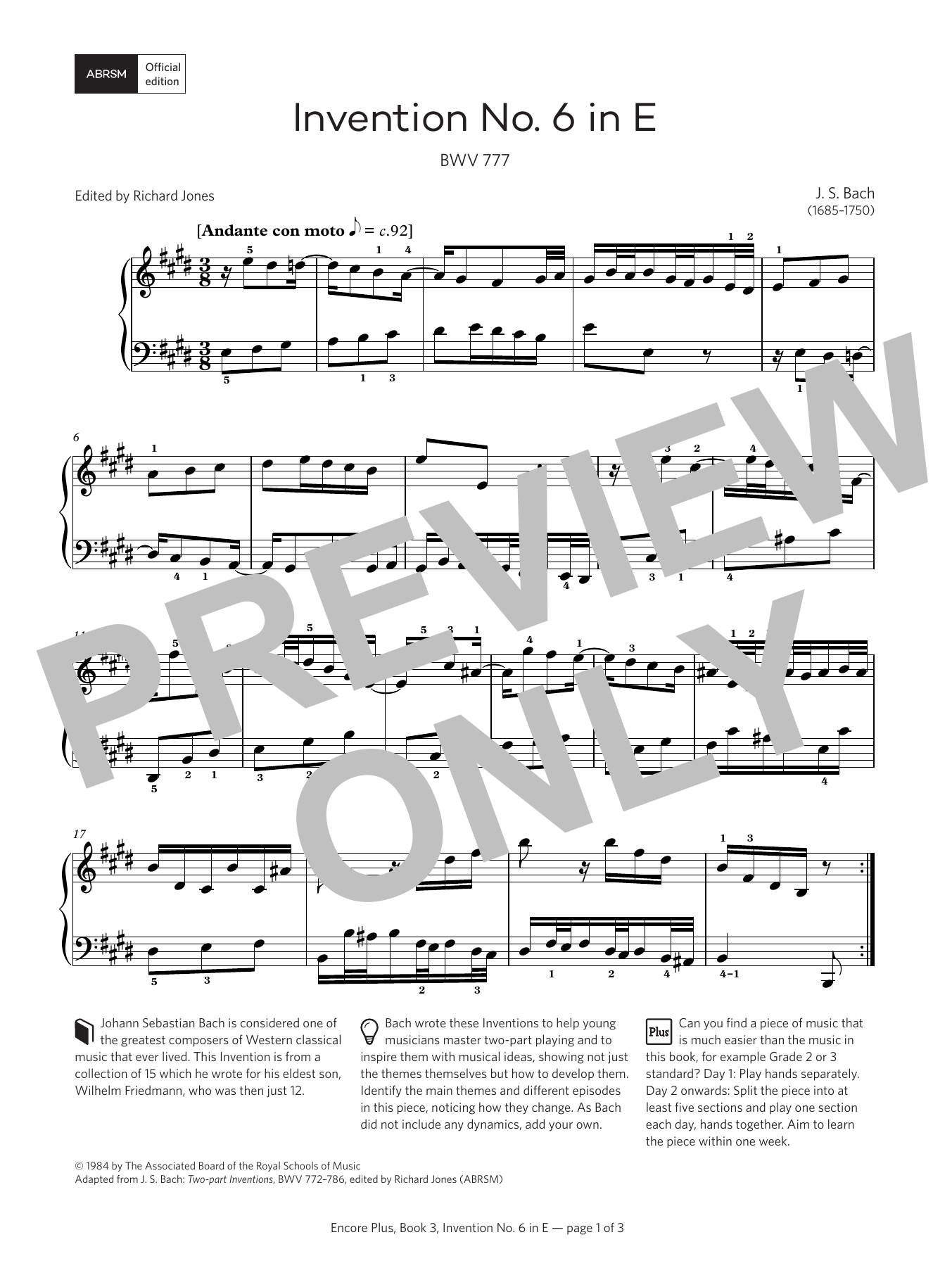
The Two-Part Inventions occupy a rare pedagogical sweet spot where technical challenge and artistic substance meet without compromise. Bach's E major invention sparkles with energy and requires genuine independence between the hands, making it rewarding for students ready to shed their first real counterpoint piece while playing something that sounds genuinely musical from day one.
What to expect
Bright and purposeful, with the animated character of a two-voice dialogue in a major key. Bach's inventive subject bounces between the hands with intellectual playfulness, creating forward momentum that feels crisp and clean without becoming mechanical.
Who it's for
Grade 6 pianists who have mastered basic repertoire and are ready for genuine contrapuntal thinking. This invention bridges the gap between elementary technique and the more complex Bach works they will encounter later, making it ideal for students preparing for theory study or advanced classical training.
How to get the most out of it
Distinguish the two voices clearly by varying touch and weight; the inventions demand transparent texture, not blended pedal work. Each hand should sound like a separate instrument having a conversation.
Map the motivic exchanges between right and left hand before touching the keys. Understanding where the subject lives helps you breathe with each voice rather than relying on muscle memory.
Find a tempo where the sixteenth-note passages speak without rushing. Bach's counterpoint rewards rhythmic clarity far more than surface speed.
Practice hands separately for longer than you might expect. Bach's part writing is deceptively independent, and each line needs secure footing before combining.
How to use it
Slot this into a solo recital or a Bach-focused program as a perfect opener or interlude between larger works. Its three-page length and clear structure make it an excellent choice for adjudicated festivals where judges value technique alongside musicality, and it pairs naturally with other inventions or with Baroque keyboard miniatures.
Skills your students will build
Two-voice counterpoint and independent hand coordination
Voice leading across the grand staff and tracking a subject through multiple key areas
Articulation and touch differentiation to clarify polyphonic texture
Understanding motivic development and fugal-adjacent compositional techniques
Keyboard confidence in the upper intermediate range with sixteenth-note passage work
You May Also Like
Scan to Complete Your Purchase
Use your phone's camera to scan the code below
You'll log in on your phone and the order will be added to your account