Invasion!: Tuba Sheet Music Preview

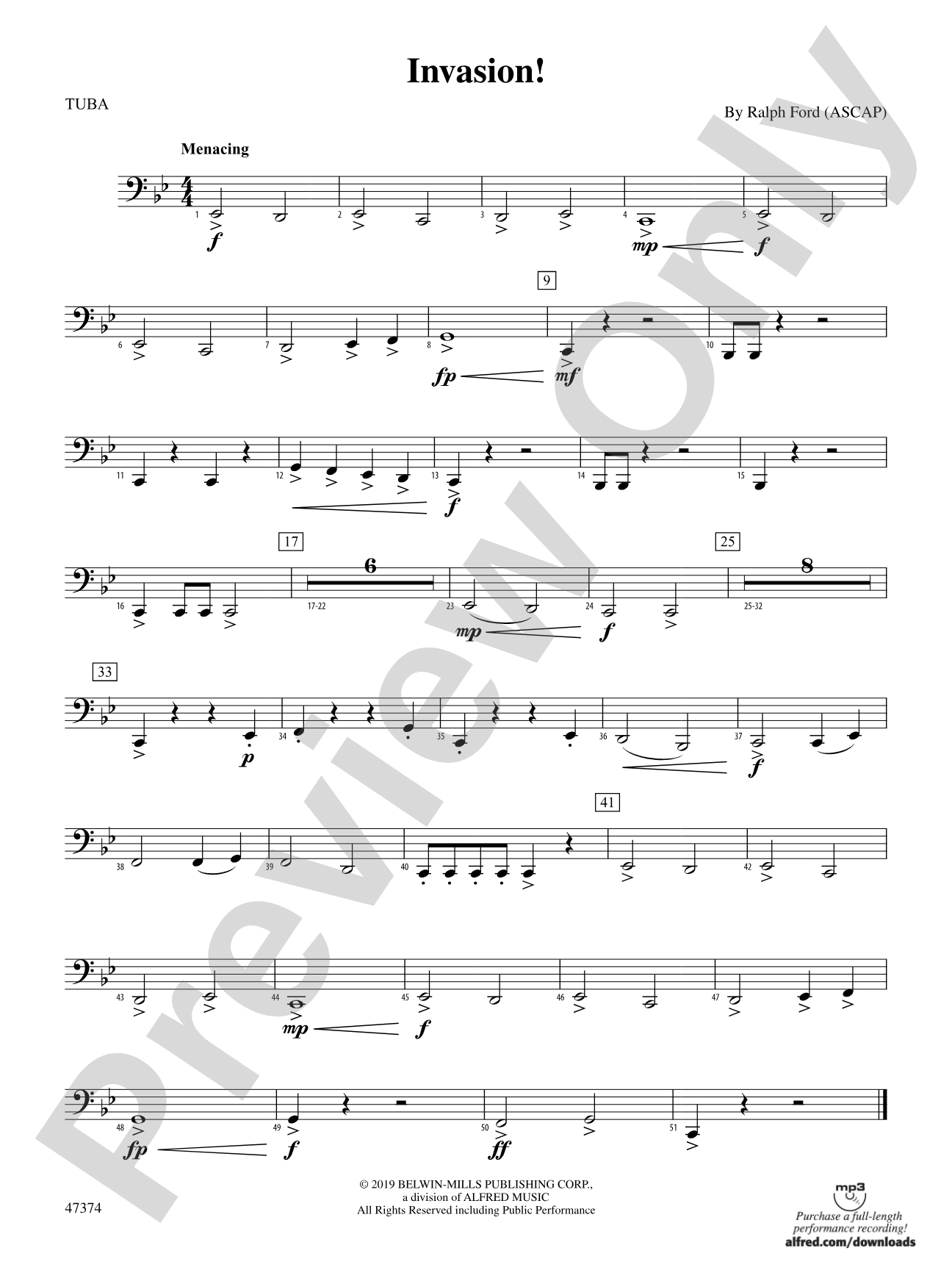
Invasion!: Tuba

By Ralph Ford

Grade: 0.5 (Very Easy)

Item: 00-PC-0017908_TB1

Digital Download
$3.00
Description
Since the dawn of time, there have been invading armies that changed the course of many civilizations. Careful attention to uniformity of articulations and balanced dynamic shifts is an excellent teaching opportunity that will help your students as they imagine those historical invasions or even a futuristic alien invasion! (2:00)

Don't just read it, hear it, play along with it, and watch your students grow with it. In MakeMusic Cloud, Invasion!: Tuba comes alive with professional accompaniment, adjustable tempo, and built-in practice tools that turn solo practice into real progress.

Sample Audio
0:00
0:00
Sample Video
Additional Details
Series: Belwin Very Beginning Band
Publisher: Alfred Music
Page Count: 134
SKU: 00-PC-0017908_TB1

More about this title

About the Composer: Ralph Ford

Ralph Ford

Ralph Ford brings three decades of university teaching alongside a prolific career as a composer and arranger. His output for Belwin includes over 250 works across orchestra, concert band, jazz ensemble, and marching band, performed by school, university, military, and professional ensembles internationally.

Before establishing himself as an exclusive composer for Alfred Music, Ford served on the faculty at Troy State University for fifteen years, where he taught orchestration, arranging, theory, and applied brass while earning his Master of Science degree. His early work as a staff arranger began at age fifteen and continued during his undergraduate years, when he directed the university jazz ensemble. Beyond concert music, his professional experience spans broadcast and media production, including commercial jingles, television and radio work, and news music packages for national networks.

Why we love this

Invasion! teaches precision and ensemble cohesion through a concept students genuinely care about. The focused demands on articulation clarity and dynamic control create immediate, audible results, giving young bands tangible evidence of how careful listening and technical attention improve their sound.

What to expect

Invasion! conjures tension and forward motion through orchestral colors and rhythmic momentum. The programmatic concept transforms technical challenges into dramatic moments, allowing young musicians to inhabit a narrative as they play rather than simply execute exercises.

Who it's for

Beginning concert bands ready to tackle ensemble refinement through accessible, engaging music. This score works equally well for first-year students discovering how technique shapes musical storytelling and for teachers seeking repertoire that teaches fundamental skills without overwhelming inexperienced players.

How to get the most out of it

  • Mark all articulation patterns in advance and drill them separately from the melodic line until they become automatic; this frees students to concentrate on dynamic shaping during full rehearsals.
  • Balance the dynamic shifts by having each section identify which voice carries the primary material in each phrase and adjust supporting voices accordingly.
  • Create a visual or verbal narrative during rehearsal (which army or threat is approaching?) to help students understand why the dynamics and articulations change; the story makes the technique meaningful.
  • Record a section rehearsal early in your preparation cycle so students can hear how articulation uniformity affects the ensemble's precision and power.

How to use it

This two-minute piece fits naturally into a full concert program as an opener or palate cleanser between contrasting works. Its vivid imagery and relatively short duration make it appealing for festival seasons and contests where younger ensembles benefit from approachable yet musically substantial material.

Skills your students will build

  • Uniform articulation across all sections and sustained dynamic control
  • Listening for balance and blend within a programmatic musical context
  • Responding to conductor cues for dramatic intensity and musical phrasing
  • Connecting visual imagery to interpretive choices in performance

You May Also Like