
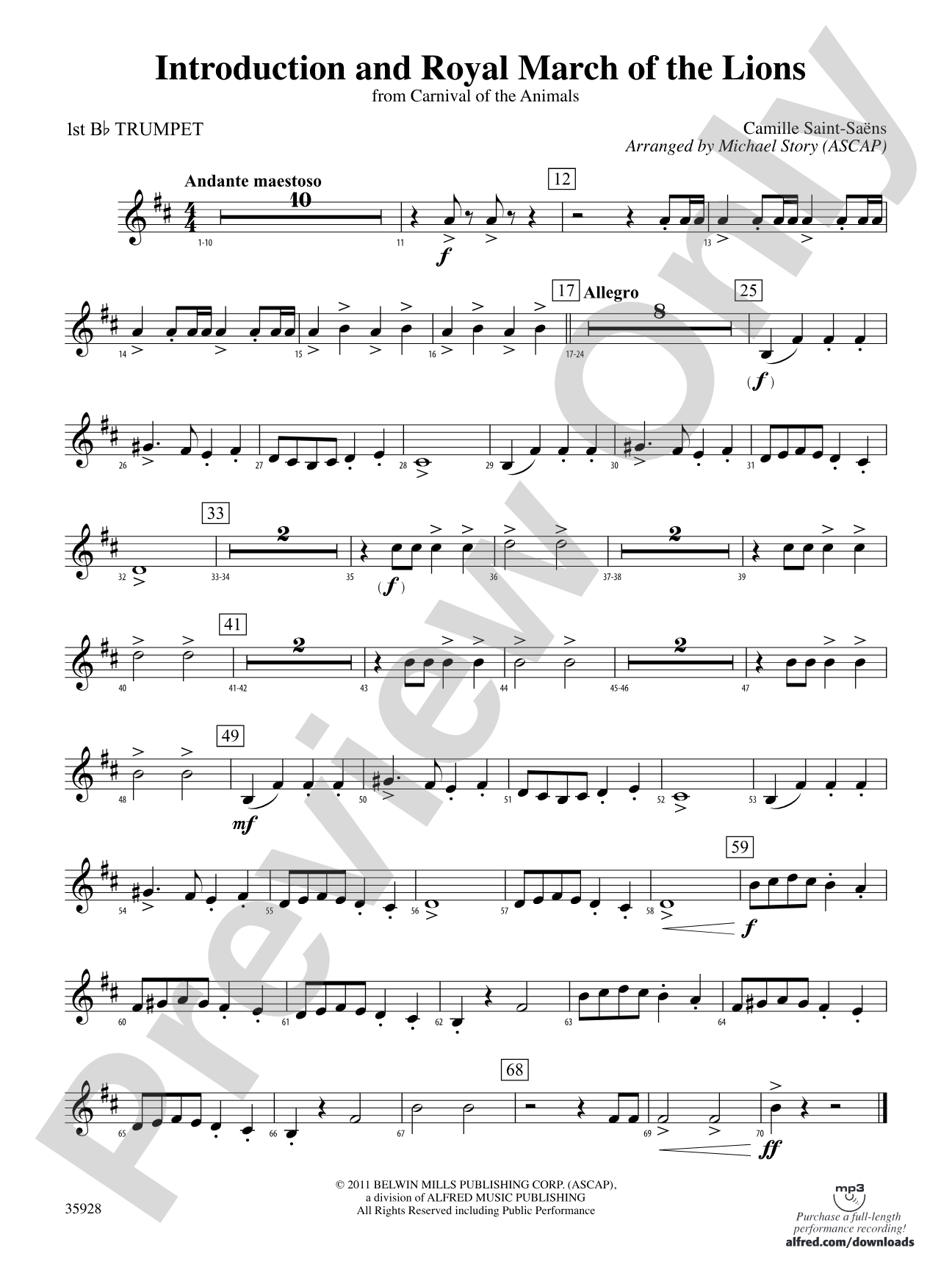

Introduction and Royal March of the Lions (from Carnival of the Animals): 1st B-flat Trumpet
From Carnival of the Animals
By Camille Saint-Saëns / arr. Michael Story
Grade: 3
Item: 00-PC-0015012_T1
$3.00
Pickup currently not available
Description
This charming transcription of the opening piece from Saint-Saens' Carnival of the Animals, has captured the grandeur of the king of the jungle. The work is both majestic and descriptive, and is a great teaching tool for marcato style and chromaticism in the cellos and basses. Sure to be a favorite of both your students and your audience! This title is available in MakeMusic Cloud.
"Playable as a symphonic or strings-only work, this charming transcription of the opening of Carnival of The Animals is sure to please."
-The Instrumentalist


"Playable as a symphonic or strings-only work, this charming transcription of the opening of Carnival of The Animals is sure to please."
-The Instrumentalist
Don't just read it, hear it, play along with it, and watch your students grow with it. In MakeMusic Cloud, Introduction and Royal March of the Lions (from Carnival of the Animals): 1st B-flat Trumpet comes alive with professional accompaniment, adjustable tempo, and built-in practice tools that turn solo practice into real progress.
Open in the Player
Jump straight in and assign it today.
Start Your Free Trial
Open this title and explore the full library in minutes.
Sample Audio
1
Audio File
--:--
0:00
0:00
Sample Video
No sample videos found.
Additional Details
Series:
Belwin Intermediate String/Full Orchestra
Publisher:
Alfred Music
Page Count:
120
SKU:
00-PC-0015012_T1
Instrumentation:
full (bells, timp, suscym/tamb, pno (opt), vln3)
More about this title
About the Composer: Camille Saint-Saëns
Camille Saint-Saëns (1835-1921) was a French composer and virtuoso pianist whose prolific output spanned symphonies, concertos, operas, and orchestral suites. He possessed an extraordinary gift for melody and orchestral color, and his technical mastery influenced generations of composers. Saint-Saëns remains a cornerstone of music education repertoire, and his works balance accessibility with genuine musical substance.
Saint-Saëns wrote Carnival of the Animals late in his career as a witty suite of 14 character pieces, each depicting a different animal or musical concept. Though he initially restricted its performance, the work has become beloved worldwide for its humor, inventiveness, and immediate appeal to audiences of all ages.
Why we love this
Michael Story's transcription preserves the orchestral brilliance and character detail of the original while making it accessible to developing ensembles. The opening movement's majestic presentation of the lion gives your orchestra an immediate win with audiences, and the marked emphasis on marcato articulation and chromatic writing in the lower strings provides genuine pedagogical value without sacrificing musical integrity.
What to expect
Grand and processional, with a touch of humor in the harmonic movement of the lower strings. The piece exudes confidence and pageantry; you hear the king's entrance before you see it. The chromaticism keeps it modern and slightly mischievous, preventing the march from becoming merely stately.
Who it's for
Grade 3 orchestras seeking a serious yet approachable masterwork that engages students and audiences alike. This transcription works for ensembles with developing musicianship, string players new to articulation and chromatic writing, and programs that need a concert opener with both character and substance.
How to get the most out of it
- Shape the opening theme with clarity and nobility; the lions should stride across the stage with conviction, not shuffle. Establish a strong, steady pulse that supports the marcato figures without rushing.
- Lock in the rhythmic precision between strings and percussion. The timpani and bass drum add theatrical weight, but they must follow the conductor rather than lead. Cue the ensemble generously during the chromatic passages.
- Balance the upper strings carefully during tuttis so the melody projects above the harmonic foundation. Young violins often play too loudly here, obscuring the very lines they're meant to carry.
- Demonstrate the marcato style explicitly with your own bow arm. Have cellists and bassists practice the marked articulations separately before combining them with the upper parts; these passages are both the teaching opportunity and the ensemble's biggest challenge.
How to use it
Program this as a confident concert opener that immediately establishes your ensemble's musical maturity and technical capability. It pairs well with other Romantic-era selections or works as the anchor piece in a themed program exploring animal life in music. The relatively compact duration makes it ideal for festival competition when you need an impactful selection that demonstrates both artistry and ensemble precision.
Skills your students will build
- Marcato articulation and clarity in string playing
- Reading and executing chromatic passages in lower string parts
- Ensemble precision in rhythmic coordination between strings and percussion
- Dynamic control and phrasing in a processional form
- Recognizing character and orchestration techniques from the Romantic era