
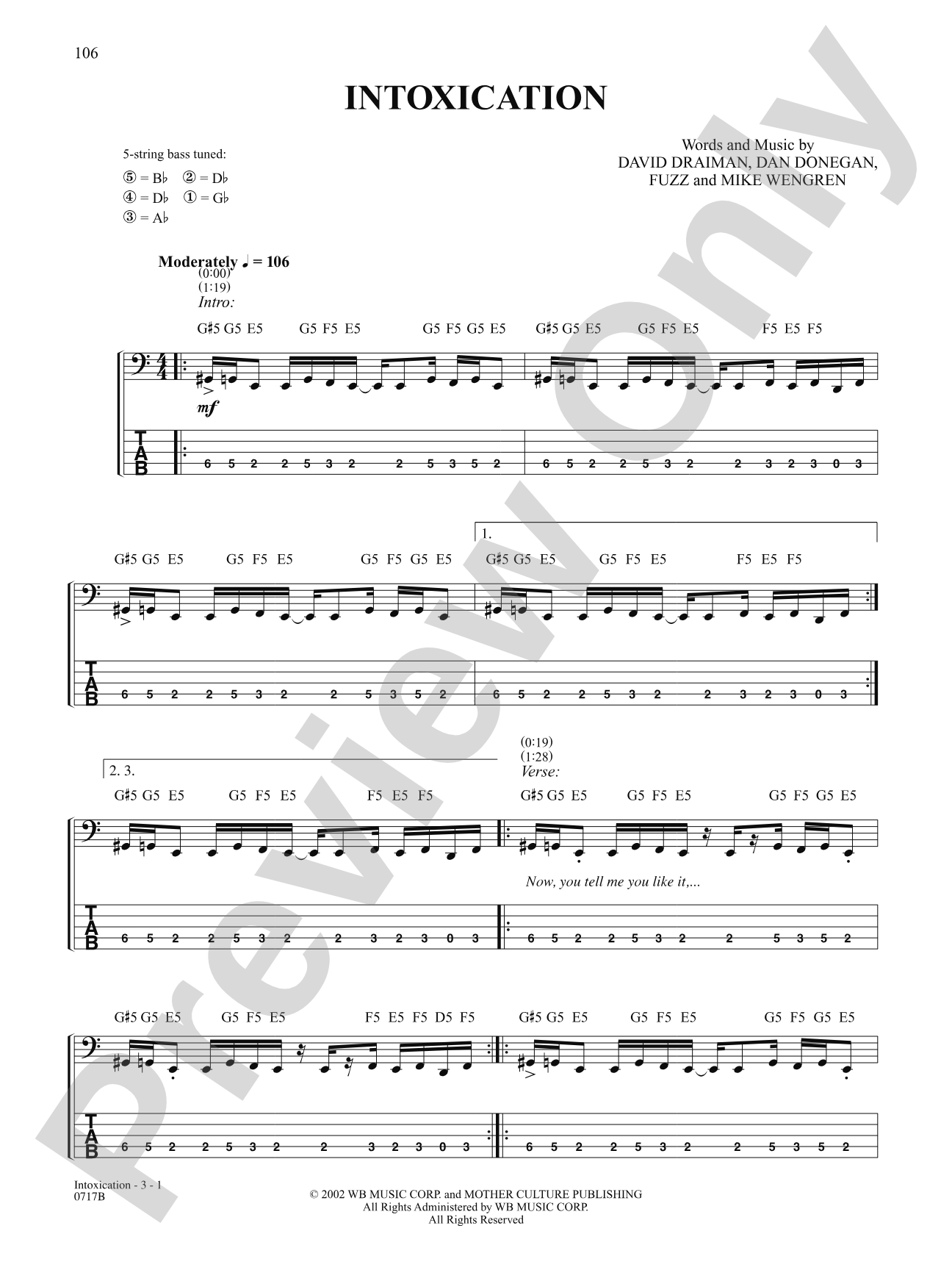

Intoxication: Bass TAB
Disturbed
Item: 00-PS-0009755
$4.99
One moment…
Related Items
Believe: Authentic Guitar TAB |
$5.99
|
View | |
Bound: Authentic Guitar TAB |
$5.99
|
View | |
Liberate: Authentic Guitar TAB |
$5.99
|
View | |
Remember: Authentic Guitar TAB |
$5.99
|
View | |
Intoxication: Authentic Guitar TAB |
$5.99
|
View | |
Mistress: Authentic Guitar TAB |
$5.99
|
View | |
Devour: Authentic Guitar TAB |
$4.99
|
View | |
Prayer: Bass TAB |
$4.99
|
View | |
Liberate: Bass TAB |
$4.99
|
View | |
Believe: Bass TAB |
$4.99
|
View | |
Remember: Bass TAB |
$4.99
|
View | |
Mistress: Bass TAB |
$4.99
|
View | |
Bound: Bass TAB |
$4.99
|
View | |
Devour: Bass TAB |
$4.99
|
View | |
Darkness: Bass TAB |
$4.99
|
View | |
Darkness: Authentic Guitar TAB |
$4.99
|
View | |
Awaken: Authentic Guitar TAB |
$5.99
|
View | |
Awaken: Bass TAB |
$4.99
|
View | |
Rise: Bass TAB |
$4.99
|
View | |
Rise: Authentic Guitar TAB |
$5.99
|
View | |
Breathe: Bass TAB |
$4.99
|
View | |
Breathe: Authentic Guitar TAB |
$5.99
|
View | |
Prayer: Authentic Guitar TAB |
$5.99
|
View |
Description
This folio contains complete guitar transcriptions with TAB, plus a separate bass TAB section, full lyrics, and full-color artwork. Titles are: Prayer * Liberate * Awaken * Believe * Remember * Intoxication * Rise * Mistress * Breathe * Bound * Devour * Darkness.


Intoxication: Bass TAB isn't in MakeMusic Cloud just yet...but it could be. Let us know you'd like to see it, and you'll help shape what comes next. In the meantime, start a free trial and dive into thousands of interactive titles your students can play along with today.
Request This Title
Tell us you want it.
Start Your Free Trial
Explore everything that's ready to play right now.
Sample Audio
No sample audio found.
Sample Video
No sample videos found.
Additional Details
Publisher:
Alfred Music
Page Count:
124
SKU:
00-PS-0009755
More about this title
About the Composer: David Draiman
David Draiman is the lead vocalist and primary songwriter for Disturbed, the heavy metal band that emerged from Chicago in the late 1990s. His songwriting combines aggressive guitar riffs with introspective lyrics that explore themes of personal struggle, resilience, and psychological complexity. Draiman's contributions to metal songwriting extend beyond vocal performance; his compositional voice shapes the band's conceptual direction and thematic depth, making him a significant figure in contemporary metal composition.
Why we love this
This folio captures the complete instrumental architecture of Disturbed's catalog with precision TAB notation, making authentic metal songwriting accessible for serious guitarists. The inclusion of both guitar transcriptions and dedicated bass TAB creates a full-band learning opportunity, letting ensemble-minded players understand how parts interact. A 124-page resource of this depth rewards dedicated study and builds genuine command of contemporary metal technique.
What to expect
Raw intensity shaped by melodic intent. These tracks blend crushing riff work and syncopated rhythms with moments of restraint that build back into the heaviness, creating dynamic peaks and valleys rather than relentless aggression. The guitar writing demands precision and control; heaviness emerges from clarity and timing as much as volume.
Who it's for
Guitarists working toward fluency in contemporary metal styles and those seeking to understand the compositional mechanics of heavy rock songwriting at a professional level. This folio also serves players who want to learn Disturbed's catalog in full detail, including those preparing ensemble performances or developing their own metal compositions grounded in real examples.
How to get the most out of it
- Establish the tuning and drop-D variations before moving through the material; several tracks use alternate tunings that frame the riff construction differently than standard tuning might suggest.
- Study the bass TAB section alongside the guitar parts to understand how rhythm and low-end texture support the riff movement; this relationship is central to Disturbed's sound.
- Pay attention to palm-muting and distortion dynamics indicated in the transcriptions; these articulation choices are essential to the metal aesthetic and affect both tone and clarity.
- Use the full lyrics provided to connect vocal phrasing with instrumental timing, especially where rhythmic syncopation aligns the vocal line with specific riff accents.
How to use it
This resource works best as supplementary material for students pursuing metal or contemporary styles outside traditional ensemble settings. Individual guitarists can work through the transcriptions as part of their practice rotation, building technique and understanding of professional arranging choices. A small ensemble could use the guitar and bass parts as the foundation for an interdisciplinary project exploring how metal songwriting differs from classical and jazz traditions.
Skills your students will build
- Drop-D and alternate tuning fluency
- Palm-muting and distortion articulation control
- Syncopated riff reading and rhythmic precision
- Ensemble listening and rhythmic coordination between guitar and bass parts
- Interpretation of distortion, dynamics, and tone notation in TAB context