
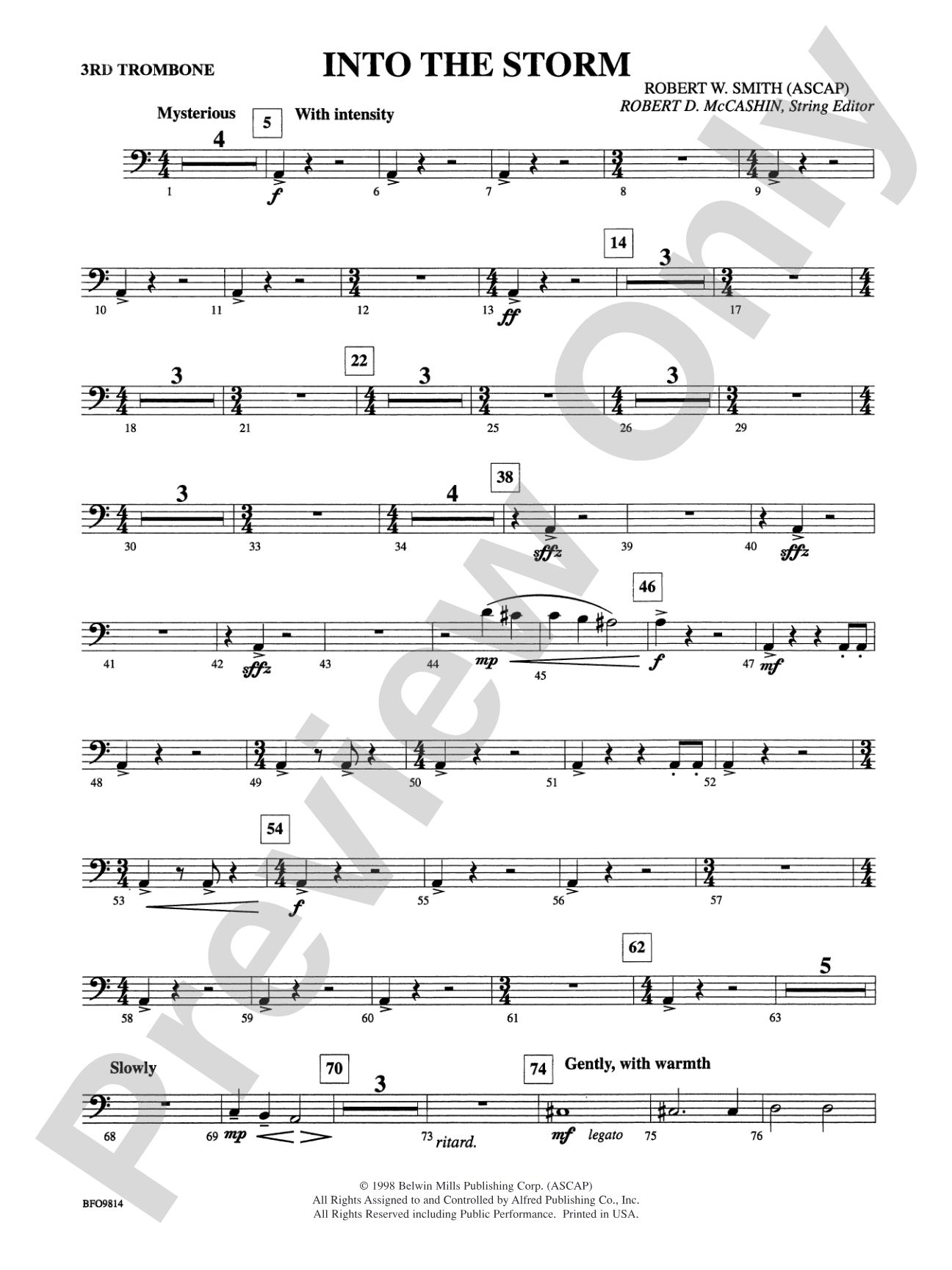

Into the Storm: 3rd Trombone
By Robert W. Smith
Grade: 3.5
Item: 00-PC-0002214_TN3
$3.00
Pickup currently not available
Description
All mankind is at the mercy of Mother Nature. Robert W. Smith musically explores the power, the drama and the fury of weather at its wildest. Close your eyes and you will be surrounded by this dramatic force. Your audience will be completely swept up at each and every performance. The highest of high energy! (5:10) This title is available in MakeMusic Cloud. A Federation Festivals 2020-2024 selection.


Don't just read it, hear it, play along with it, and watch your students grow with it. In MakeMusic Cloud, Into the Storm: 3rd Trombone comes alive with professional accompaniment, adjustable tempo, and built-in practice tools that turn solo practice into real progress.
Open in the Player
Jump straight in and assign it today.
Start Your Free Trial
Open this title and explore the full library in minutes.
Sample Audio
1
Audio File
--:--
0:00
0:00
Sample Video
No sample videos found.
Additional Details
Series:
Belwin Concert Full Orchestra
Publisher:
Alfred Music
Page Count:
78
SKU:
00-PC-0002214_TN3
More about this title
About the Composer: Robert W. Smith

Robert W. Smith stands among the most frequently performed American composers of orchestral and concert band music. His catalog exceeds 400 published works, establishing him as a defining voice in school and community music repertoire. Smith earned his Bachelor of Music Education from Troy State University in Alabama and his Master of Music from the University of Miami, foundational training that shaped his gift for writing idiomatically across ensemble types.
Smith's symphonies, including The Divine Comedy and The Odyssey, have resonated with performers and audiences across North America, Europe, Australia, and Asia. His concert works appear in major broadcasts and high-profile events, from Olympic ceremonies to opening day celebrations at Dodger Stadium. As both composer and clinician, he has conducted throughout the United States, Canada, Japan, Australia, and Europe, deepening his understanding of how music connects with diverse audiences.
Why we love this
Smith's gift for cinematic orchestration makes Into the Storm a showstopper that energizes both players and listeners without requiring advanced technical writing. The piece balances genuine musical drama with Grade 3.5 accessibility, meaning your ensemble can deliver a visceral, professional performance without months of preparation. It's the kind of concert moment that reminds students why they play.
What to expect
Into the Storm sweeps you into a sonic landscape where nature dominates every moment. Wind textures swirl and collide, percussion drives the chaos forward, and strings rise and fall with the turbulent energy of an approaching tempest. When performed well, the orchestra becomes a living weather system.
Who it's for
Full orchestras at the Grade 3.5 level seeking high-impact concert and festival repertoire. This works equally well for spring concerts and contest seasons, offering dramatic storytelling that engages student musicians and captivates audiences.
How to get the most out of it
- Build the storm gradually from the opening; resist the urge to hit full intensity immediately. Dynamics matter as much as tempo in creating the sense of weather building.
- Balance the orchestral blend so percussion doesn't overwhelm the melodic sections. Smith's scoring works only when all colors remain audible.
- Lock tempo with your winds and strings; the dramatic force depends on unwavering rhythmic confidence throughout the ensemble.
- Use the 5:10 duration as a rehearsal anchor. If the piece feels rushed or dragging, check whether your middle sections have space to breathe.
How to use it
Program this as a concert closer or festival finale when you want to leave audiences breathless. The high energy and programmatic content work especially well in spring concerts or Earth Day themed programs. It also pairs effectively with lighter orchestral selections, since its dramatic arc will feel even more impactful by contrast.
Skills your students will build
- Reading and executing rapid dynamic shifts and tempo changes
- Balancing sustained melodic lines against accompaniment figures
- Maintaining ensemble cohesion during thick, layered orchestration
- Responding to conductor cues for dramatic expression and phrasing
- Coordinating wind, string, and percussion sections in complex textures