
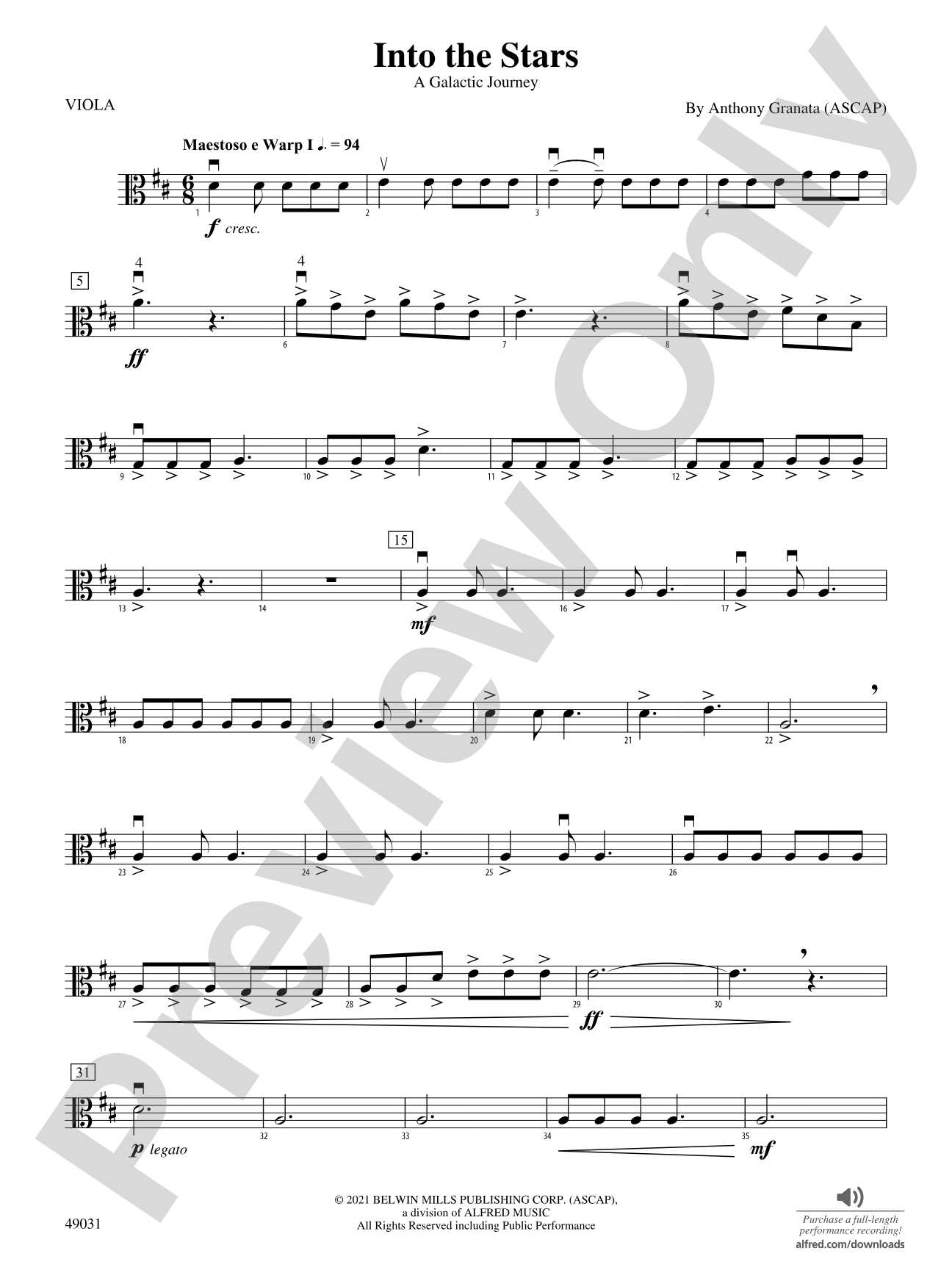

Into the Stars: Viola
A Galactic Journey
By Anthony Granata
Grade: 2
Item: 00-PC-0018641_VA1
$3.00
Pickup currently not available
Description
Written by Anthony Granata, Into the Stars: A Galactic Journey is an exciting space-themed adventure piece that will captivate your developing orchestras and have them feeling and playing confidently in 6/8 time. With an epic and memorable sounding main theme, your students will be transported into a world of simple and compound meters as they dig into their strings for this fun programmatic piece of music. Students will feel as though they have stepped into the sound stage for a film score of a Hollywood science fiction movie. (1:45)


Don't just read it, hear it, play along with it, and watch your students grow with it. In MakeMusic Cloud, Into the Stars: Viola comes alive with professional accompaniment, adjustable tempo, and built-in practice tools that turn solo practice into real progress.
Open in the Player
Jump straight in and assign it today.
Start Your Free Trial
Open this title and explore the full library in minutes.
Sample Audio
1
Audio File
--:--
0:00
0:00
Sample Video
Additional Details
Series:
Belwin Intermediate String Orchestra
Publisher:
Alfred Music
Page Count:
84
SKU:
00-PC-0018641_VA1
More about this title
About the Composer: Anthony Granata

Anthony Granata teaches middle school orchestra in Westport, Connecticut, and composes music specifically designed to engage young string players. A violist who performs regularly, Granata began composing at age twelve, stepped back from writing to focus on his teaching career, and eventually returned to composition as a tool for helping his students navigate difficult musical concepts and meters.
A graduate of Western Connecticut State University, Granata has taught orchestra, band, and general music across elementary, middle, and high school settings. He credits his own preliminary string education to the Norwalk public school music program and remains a passionate advocate for public school music. He is currently pursuing a degree in school administration.
Why we love this
Granata writes with a deep understanding of what developing orchestras can handle musically and technically. The space-themed narrative gives your students a reason to commit to the rhythmic complexities; they're not just learning 6/8 and simple/compound meter shifts, they're scoring a sci-fi adventure. The memorable main theme and Hollywood film score sound mean your players leave the first rehearsal excited to come back.
What to expect
You and your students step into a film studio the moment the opening theme launches. The music swells with the wonder of space travel, carries you through cosmic passages with confident orchestral color, and lands with the kind of satisfying resolution that makes young players feel like they just performed something important.
Who it's for
Grade 2 string orchestras ready to tackle compound meter with musical purpose. This works for groups with solid ensemble fundamentals who can handle rhythm reading without struggling on intonation.
How to get the most out of it
- Establish the pulse in 6/8 from the opening bars. Have your orchestra tap the pulse on their bows before playing anything; this grounds the compound meter before they add pitch.
- Balance the main theme so it cuts through the accompaniment, even when your violins are in a lower register. The programmatic impact depends on the audience following the melody clearly.
- Use the meter transitions as an opportunity to reinforce conducting clarity. Mark those shifts between 6/8 and 4/4 with deliberate gesture so players stay confident during the modulation.
How to use it
Program this as a concert opener or mid-set energizer. Its thematic power and accessible drama make it engaging for a family audience, and the science fiction context pairs well with other contemporary or programmatic pieces in a spring concert. The 1:45 duration fits comfortably into a mixed repertoire rehearsal schedule.
Skills your students will build
- Reading and playing confidently in 6/8 (compound meter)
- Navigating transitions between simple and compound meters
- Sustaining melodic phrasing over accompaniment figures
- Balancing ensemble sound across a programmatic narrative
- Building confidence with contemporary composition language and film score idioms