
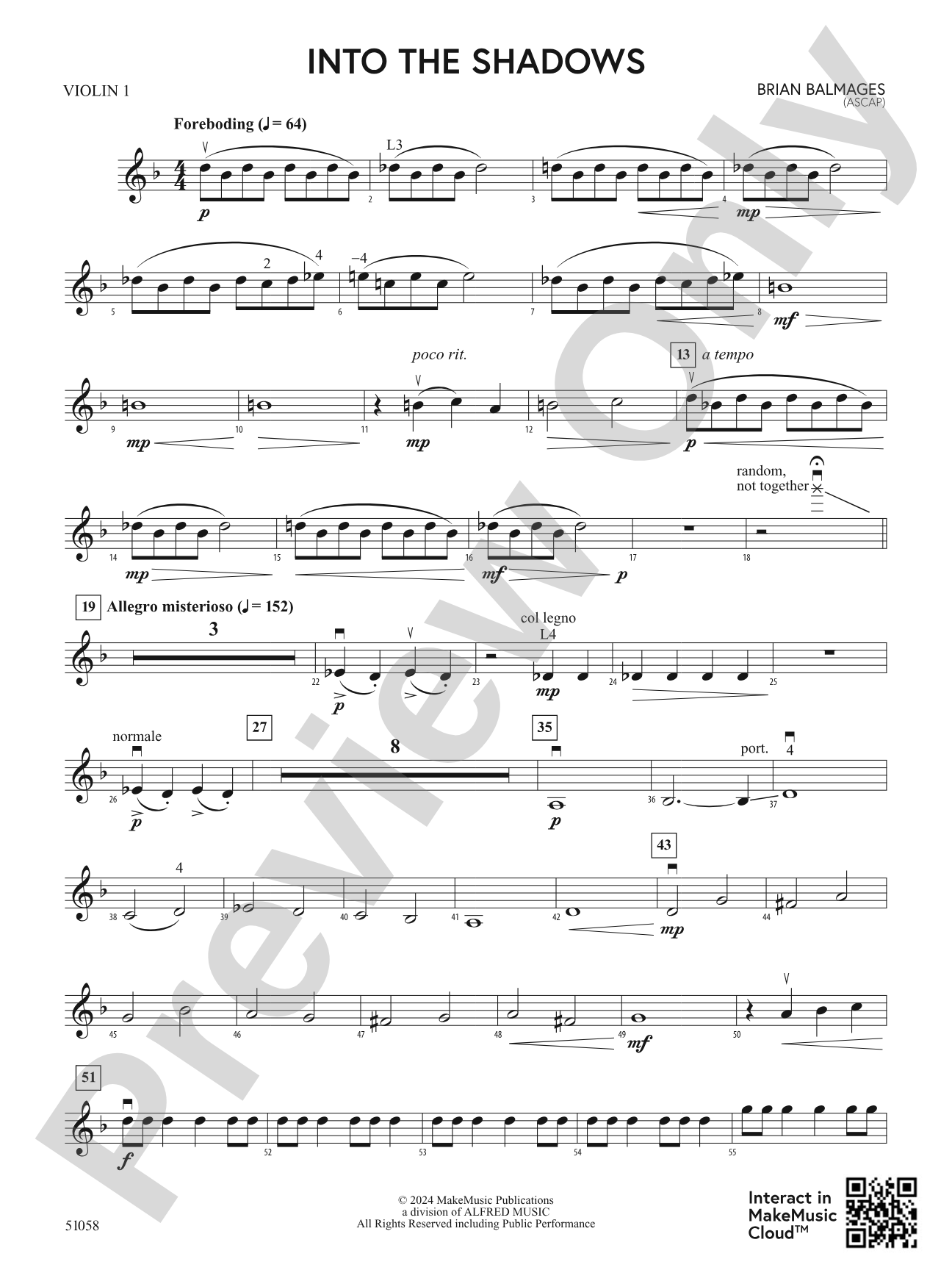

Into the Shadows: 1st Violin
By Brian Balmages
Grade: 2.5
Item: 00-PC-0019390_VN1
$7.99
Pickup currently not available
Description
Journey into a place where shapes constantly shift as the light moves, and nothing is quite as it seems. While very approachable for intermediate orchestras, Into the Shadows pushes harmonic boundaries and colors, ushering in a new realm of sonic possibilities. Creative, eerie, and exciting, this is Brian Balmages as you have never heard him! (4:00)


Don't just read it, hear it, play along with it, and watch your students grow with it. In MakeMusic Cloud, Into the Shadows: 1st Violin comes alive with professional accompaniment, adjustable tempo, and built-in practice tools that turn solo practice into real progress.
Open in the Player
Jump straight in and assign it today.
Start Your Free Trial
Open this title and explore the full library in minutes.
Sample Audio
1
Audio File
--:--
0:00
0:00
Sample Video
Additional Details
Series:
MakeMusic Intermediate Strings
Publisher:
MakeMusic Publications
SKU:
00-PC-0019390_VN1
More about this title
About the Composer: Brian Balmages

Brian Balmages commands respect across orchestral, band, and chamber music worlds as both composer and conductor. His works have graced stages from Carnegie Hall to the Sydney Opera House, performed by ensembles spanning professional orchestras to school programs. He holds the A. Austin Harding Award from the American School Band Directors Association, won the 2020 NBA William D. Revelli Composition Contest, and serves as an elected member of the American Bandmasters Association.
Balmages has received commissions from major institutions, including James Madison University (which honored him with its inaugural Distinguished Alumni Award) and the University of Miami for the presidential inauguration. His compositions were performed at the 2013 Presidential Inaugural Prayer Service attended by President Obama and Vice President Biden. As a conductor, he maintains active guest engagements with all-state ensembles, university orchestras, and professional groups globally, with notable appearances at the Midwest Clinic, Western International Band Clinic, and regional ASTA conferences. He currently serves as Director of MakeMusic Publications and Digital Education.
Why we love this
Balmages delivers something genuinely rare here: a piece that works technically for Grade 2.5 orchestras while refusing to play it safe musically. The harmonic language feels sophisticated and unsettling in the best way, giving your students permission to sound more mature than their experience level might suggest. It's the kind of score that makes intermediate orchestras sound like they've discovered something special.
What to expect
Shadows moving across a surface, familiar shapes becoming strange as perspective shifts. The music hovers between beautiful and unsettling, with harmonic movement that feels dreamlike and slightly disorienting. It's eerie without being melodramatic, creating an immersive soundscape where students can feel themselves pulling the listener into a specific, evocative place.
Who it's for
String orchestras at the Grade 2.5 level looking to program something that sounds significantly more advanced than its technical demands. Directors who want to challenge their students' ears with contemporary harmonies while keeping fingering patterns and shifting manageable. This works equally well for festival programming or concert contexts where you want to showcase artistic growth.
How to get the most out of it
- Shape the sustained textures with gradual dynamic shifts rather than sudden changes; the shifting light imagery works through subtle tonal evolution, not jarring contrasts.
- Balance the eerie quality by keeping vibrato controlled in the melodic lines so the harmonic colors remain clear and don't blur into murk.
- Use the 4-minute duration to build a coherent emotional arc from introduction through climax; avoid letting individual sections feel disconnected even as the harmonic language remains complex.
- Mark cue points carefully for entrances in divisi passages so that sectional independence doesn't undermine the unified sonic effect you're building.
How to use it
Program this as a centerpiece for a Halloween concert or fall festival, where its atmospheric quality commands full attention on the second half of your program. It pairs well alongside more traditional repertoire, serving as a tonal and stylistic pivot point that reminds audiences orchestral music can explore unfamiliar territory. The moderate length (4:00) makes it ideal for constructing a balanced concert program without overwhelming your rehearsal schedule.
Skills your students will build
- Playing sustained passages with tonal control and dynamic subtlety
- Responding to non-traditional harmonic language and finding pitch security in complex chords
- Balancing divisi texture while maintaining ensemble cohesion
- Building emotional narrative through tone color and phrasing rather than relying on traditional melodic drive