Beatrice A. Miller grew up in Detroit, Michigan, in a musical household shaped by her father's work as a Lutheran pastor, choir director, and accomplished musician. Family hymn singing after evening devotions became the foundation of her lifelong devotion to sacred music; her four brothers were reportedly so captivated by her natural musical responsiveness as an infant that they eagerly joined in the singing.
Miller earned her Master's degree in music composition from Northwestern University. She spent decades teaching piano, directing choirs, and serving as a church organist in Corvallis, Oregon, before retiring from classroom instruction in 1979 to focus entirely on composition. Her published works began appearing in 1987, and the Oregon Music Teacher's Association honored her as Composer of the Year in 1997.
Why we love this
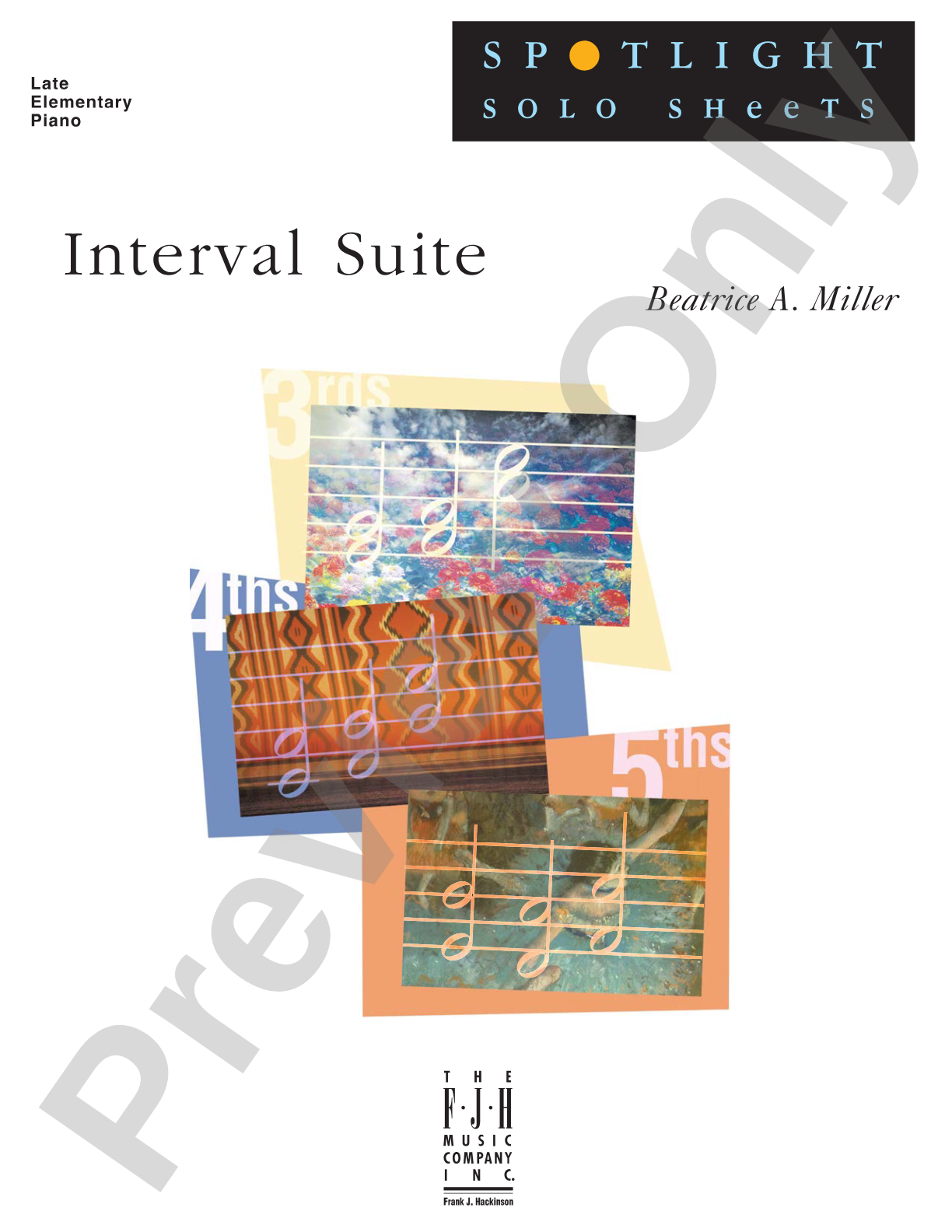
Miller's gift for crafting pieces organized around musical building blocks makes pedagogical sense without sacrificing genuine artistry. Each movement of this suite uses intervals as its governing idea, giving students both a structural anchor and a clear harmonic identity to explore. The progression from thirds through fourths to fifths creates natural momentum while staying rooted in what pianists of intermediate ability need to develop.
What to expect
Each movement offers a distinct emotional landscape while remaining firmly rooted in its harmonic territory. The suite moves from quiet introspection through warm, exotic color to infectious rhythmic energy, creating a satisfying arc from beginning to end.
Who it's for
Late elementary and early intermediate pianists ready to deepen their understanding of intervallic thinking through character-driven composition. Students who respond well to programmatic titles and structural clarity will find this suite especially rewarding.
How to get the most out of it
Honor the character suggested by each title. 'Dreamy Thirds' invites rubato and a gentle touch; 'Indian Sunset in Fourths' calls for a warmer, more open sonority; 'Dancing Fifths' needs rhythmic precision and forward motion.
Listen carefully to the interval relationships Miller emphasizes in each movement. Let those sonorities speak clearly rather than rushing through them.
Use the three-movement structure as a shape for the entire performance. Build from intimate and reflective to energetic, allowing each movement's contrasting tempo and texture to refresh the listener's ear.
How to use it
Present all three movements together in a student recital to showcase growth within a single piece, or program individual movements strategically across a concert to create variety in mood and texture. The suite also works beautifully as a teaching recital selection, allowing the audience to hear how a single compositional idea develops across different harmonic and emotional contexts.
Skills your students will build
Recognition and performance of major and minor thirds, perfect fourths, and perfect fifths in musical context
Playing with contrasting touch and sonority appropriate to character descriptions
Understanding how interval relationships create harmonic color and mood
Managing tempo and rhythmic precision in dance-like writing
Shaping a multi-movement performance as a coherent whole
You May Also Like
Scan to Complete Your Purchase
Use your phone's camera to scan the code below
You'll log in on your phone and the order will be added to your account