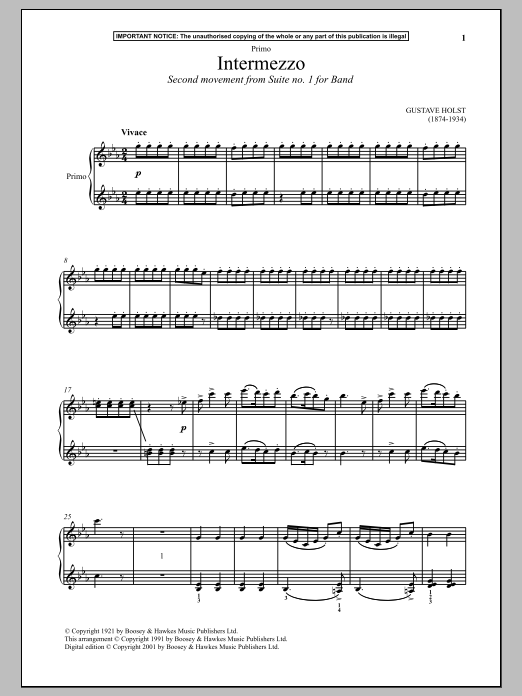
Gustav Holst (1874-1934) was an English composer whose music shaped band and orchestral repertoire for generations. Beyond his famous The Planets, Holst composed extensively for wind band, understanding the medium's unique capabilities and limitations with the ear of a true craftsman who conducted bands himself.
Why we love this
Holst's band writing strikes an elegant balance between accessibility and sophistication. This movement offers melodic warmth without sacrificing harmonic depth, giving your ensemble a piece that sounds refined and genuinely musical rather than merely competent.
What to expect
This intermezzo unfolds with quiet dignity and gentle lyricism. Lyrical passages drift across the ensemble with chamber-like intimacy, creating moments of reflective beauty that feel both timeless and human in scale.
Who it's for
Intermediate to advanced bands seeking substantial concert repertoire with historical weight. Directors programming classical instrumental music will find this movement provides an ideal bridge between folk-inspired works and more contemporary concert music.
How to get the most out of it
Shape the opening phrase with subtle rubato, allowing the melody to breathe naturally rather than locking strictly to the beat.
Balance the harmonic foundation carefully; inner voices matter greatly in Holst's writing, so ensure accompaniment parts articulate clearly without overwhelming the primary line.
Attend to the dynamic contours between sections. Transitions often call for restraint rather than obvious cuts, creating seamless forward motion.
Release notes with precision at phrase endings. The silence between ideas is part of the structure, not a gap to fill.
How to use it
Use this as a concert centerpiece or thoughtful intermission piece that invites genuine listening. It pairs well in a program exploring early twentieth-century band repertoire, or as a respite between more energetic selections.
Skills your students will build
Balancing melodic prominence against supportive harmonic layers
Sustaining steady air support across longer lyrical phrases
Responding to subtle dynamic shifts that define musical architecture
Executing clean releases and precise cutoffs in ensemble setting
You May Also Like
Scan to Complete Your Purchase
Use your phone's camera to scan the code below
You'll log in on your phone and the order will be added to your account