
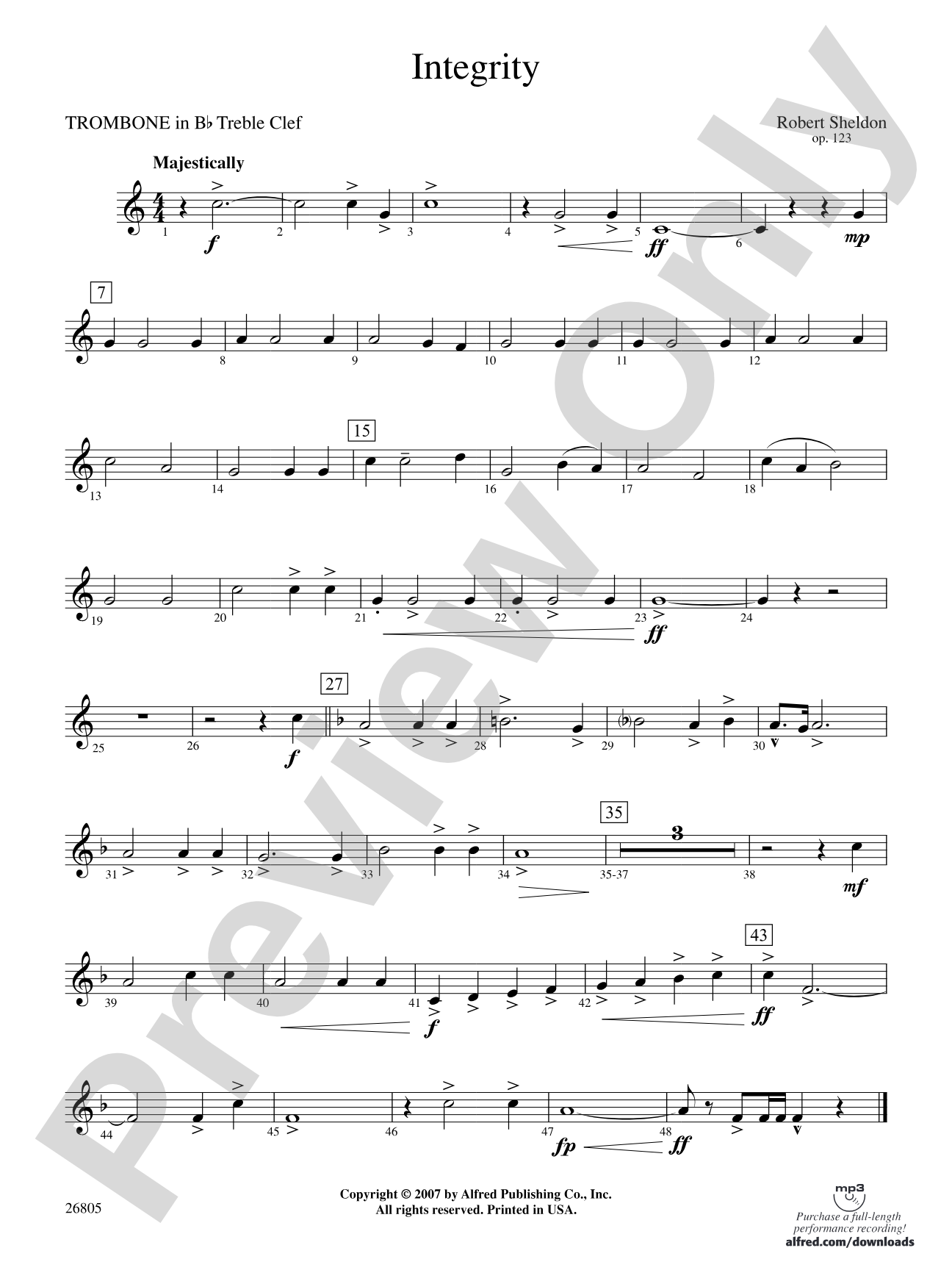

Integrity: (wp) 1st B-flat Trombone T.C.
By Robert Sheldon
Grade: 1.5 (Easy)
Item: 00-PC-0001243_wpTN1TC
$3.00
Pickup currently not available
Description
This stately march is an excellent choice for concert, contest, festival performance or graduation. Bold and tuneful, Integrity is a superb addition to any developing band program. The powerful rhythms and colorful scoring will encourage any band to play with greater maturity of sound and expression. This title is available in MakeMusic Cloud.


Don't just read it, hear it, play along with it, and watch your students grow with it. In MakeMusic Cloud, Integrity: (wp) 1st B-flat Trombone T.C. comes alive with professional accompaniment, adjustable tempo, and built-in practice tools that turn solo practice into real progress.
Open in the Player
Jump straight in and assign it today.
Start Your Free Trial
Open this title and explore the full library in minutes.
Sample Audio
1
Audio File
--:--
0:00
0:00
Sample Video
No sample videos found.
Additional Details
Series:
Challenger Band Series
Publisher:
Alfred Music
Page Count:
60
SKU:
00-PC-0001243_wpTN1TC
More about this title
About the Composer: Robert Sheldon

Robert Sheldon's compositions for wind band appear on contest lists and concert stages across the globe. His works have earned recognition from the American School Band Director's Association, Phi Beta Mu, and ASCAP, and his music resonates consistently with both student ensembles and professional audiences. Beyond composing, Sheldon co-authored Sound Innovations for Concert Band and maintains an active schedule as a guest conductor for honor bands and clinician at universities and state conferences.
Throughout his career, Sheldon has conducted his own works in some of North America's most prestigious venues, including Carnegie Hall, Orchestra Hall in Chicago, Boston Symphony Hall, the Sydney Opera House, and the Kennedy Center. He has worked with ensembles across the United States, Japan, Canada, Italy, Germany, Australia, and China. In 2020, VanderCook College of Music awarded him an honorary doctorate in recognition of his contributions to music education and composition.
Why we love this
Sheldon writes for developing bands with genuine understanding of what they can achieve. Integrity balances accessibility with musical substance: the march form sits comfortably at Grade 1.5, yet the colorful scoring and deliberate phrasing demand maturity of interpretation. Directors appreciate that this piece respects their students' capabilities while lifting their ensemble sound.
What to expect
Integrity carries the dignity of a formal procession without bombast. The march unfolds with clear melodic lines and purposeful harmonic movement; the scoring opens up moments of warmth and reflection alongside its bold sections. This is music that invites young players to stand taller and listen to themselves with greater care.
Who it's for
Concert bands at the Grade 1.5 level, including developing high school programs and mature middle school ensembles ready for straightforward march repertoire. Sheldon's writing assumes competent ensemble balance and basic musicianship without requiring advanced technical facility.
How to get the most out of it
- Shape the melodic phrases with clear but unhurried phrasing to bring out the stately character. Sheldon's marches reward deliberate, purposeful conducting.
- Balance the sections so the countermelodies and inner voices support rather than overwhelm the primary theme. Developing bands often default to uniform dynamics; this piece benefits from intentional weight distribution.
- Use the march structure to teach formal coherence. Mark the key sectional transitions in rehearsal so students understand the architecture they're building.
- Give attention to the "colorful scoring" mentioned in the description by listening for which instruments carry the melody in each section and drawing out those voices distinctly.
How to use it
Program Integrity at graduation ceremonies, school assemblies, or concert openings where a piece of substance and respectful character sets the right tone. Its moderate length and single-title format make it ideal for band festivals or contest programs where you want reliable, musically rewarding repertoire that doesn't overshadow other selections.
Skills your students will build
- Reading and executing a complete march form (introduction, principal theme, trio, modulation)
- Balancing melody and countermelody across multiple sections
- Sustaining lyrical phrasing within a march idiom
- Ensemble blend and section balance in stately tempos
- Recognizing and responding to clear structural landmarks in the score