
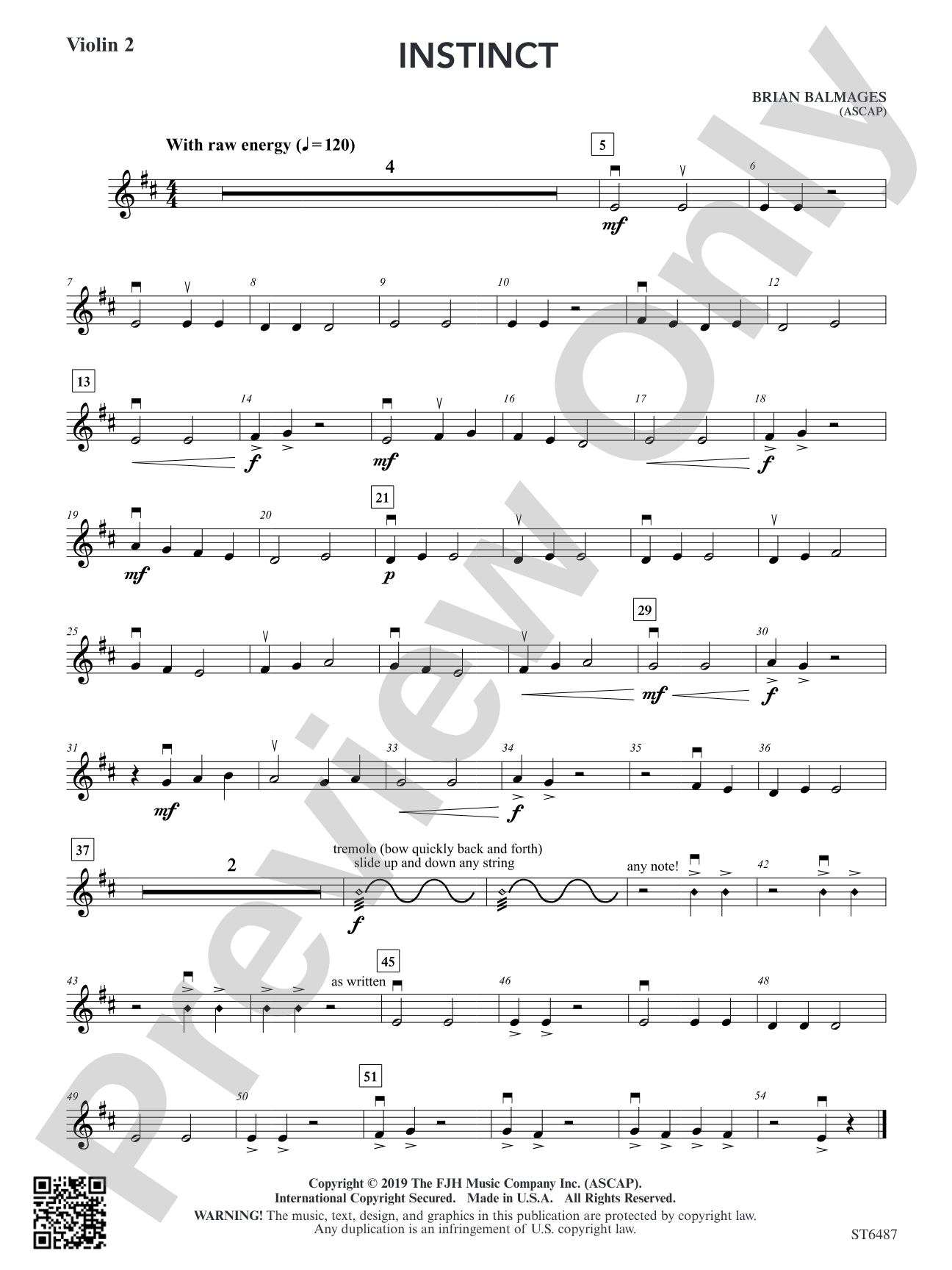

Instinct: Violin 2 (Viola T.C.)
By Brian Balmages
Level:.5
Item: 98-PC-DST6487_VN2
$7.00
Pickup currently not available
Description
This aggressive work for true beginners portrays those inherent, and sometimes raw behaviors that help a species survive. All string parts move almost entirely by stepwise motion and use just half and whole notes. Violin 1 uses a full D Major scale and all other instruments use D through B. An optional percussion part adds considerable interest to the piece (and an optional background track is available if you do not have percussionists). Powerful!


Don't just read it, hear it, play along with it, and watch your students grow with it. In MakeMusic Cloud, Instinct: Violin 2 (Viola T.C.) comes alive with professional accompaniment, adjustable tempo, and built-in practice tools that turn solo practice into real progress.
Open in the Player
Jump straight in and assign it today.
Start Your Free Trial
Open this title and explore the full library in minutes.
Sample Audio
1
Audio File
--:--
0:00
0:00
Sample Video
Additional Details
Series:
FJH Beginning Strings
Publisher:
The FJH Music Company, Inc.
SKU:
98-PC-DST6487_VN2
More about this title
About the Composer: Brian Balmages

Brian Balmages has established himself as a major voice in contemporary orchestral, band, and chamber music composition. His works have reached audiences across the globe, from professional symphony orchestras and university ensembles to elementary school groups performing in halls including Carnegie Hall, the Kennedy Center, and the Sydney Opera House. He is an elected member of the American Bandmasters Association and received the A. Austin Harding Award from the American School Band Directors Association; his composition Love and Light won the 2020 NBA William D. Revelli Composition Contest.
As a conductor, Balmages maintains active relationships with all-state and regional ensembles, university orchestras, and professional groups worldwide. His guest conducting has taken him to major conferences including the Midwest Clinic, Western International Band Clinic, and numerous state ASTA conferences, as well as Teatro dell'Aquila in Italy. He holds the Distinguished Alumni Award from James Madison University's School of Visual and Performing Arts and was commissioned by the University of Miami to compose music for the inauguration of its 6th president. Currently, he serves as Director of MakeMusic Publications and Digital Education for Alfred and MakeMusic.
Why we love this
This piece distills aggressive energy into a format true beginners can actually handle. Rather than simplifying through unison playing, Balmages gives each string section real independence while keeping the technical demands minimal, which means students feel the satisfaction of ensemble balance and voicing from day one. The optional percussion part transforms the piece from competent to thrilling, and the availability of a background track ensures you can perform this powerfully even in resource-limited situations.
What to expect
Raw and propulsive, like watching something move with pure instinct. The stepwise motion and simple note values create an almost primal directness; when performed with commitment, the piece channels contained force rather than delicacy. It feels alive.
Who it's for
This is an ideal contest and festival piece for beginning string orchestras (Grade 0.5) that need something with genuine musical presence and controlled technical scope. Conductors leading young orchestras will appreciate how it builds independence between parts without requiring wide intervallic jumps or complex rhythms.
How to get the most out of it
- Establish a confident pulse from the downbeat. The half and whole note writing demands clarity of attack; any uncertainty in tempo will undermine the piece's instinctive power.
- If you are not using the optional percussion part, commit fully to the background track for contrast and rhythmic drive. Let it anchor your string tone quality.
- Shape phrases within the stepwise motion by varying bow weight and contact point slightly. Even restricted melodic movement benefits from subtle dynamic shaping.
- Balance your violin sections carefully. Violin 2 and lower voices need to be heard as integral to the harmonic fabric, not buried beneath Violin 1.
How to use it
Program this as an opener or closer at a festival or concert where you want to signal energy and capability right away. It pairs well alongside lyrical pieces because the contrast is sharp; the audience will feel the shift in mood immediately. At contest, it presents a confident first impression of your ensemble's musicianship.
Skills your students will build
- Reading stepwise motion and managing quarter-note stepwise passages at tempo
- Half note and whole note value integrity and sustain control
- Tuning and balance in homophonic textures across four string parts
- Ensemble entry precision and rhythmic independence within a unified pulse
- Dynamic contrast and phrasing within a restricted melodic range