
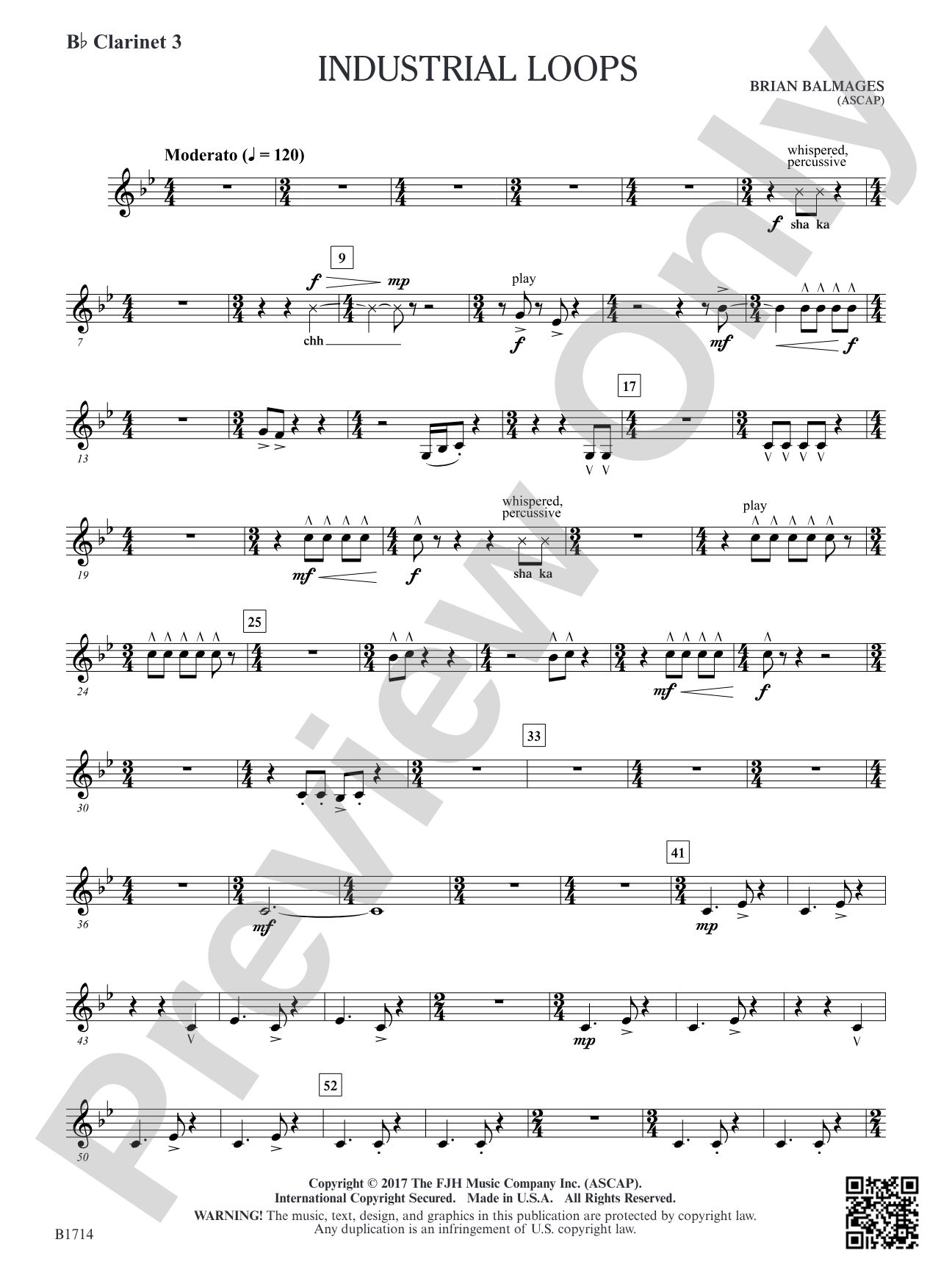

Industrial Loops: B-flat Clarinet 3
By Brian Balmages
Grade: 4
Item: 98-PC-DB1714_C3
$7.00
Pickup currently not available
Description
This innovative work explores the fusion of music with mechanical ideas. Based on the rhythmic drive of a factory underscored with a series of musical “loops” provided by the ensemble, the piece explores the combination of organic and inorganic sounds. Inventive percussive and vocal effects are layered upon one another as the groove begins to metamorphose into more complex sounds while a bluesy element is added to create a “blue-collar” vibe. A series of micro-climaxes ultimately explode in a furry of intensity and flourishes, bringing the work to a dramatic close.


Industrial Loops: B-flat Clarinet 3 isn't in MakeMusic Cloud just yet...but it could be. Let us know you'd like to see it, and you'll help shape what comes next. In the meantime, start a free trial and dive into thousands of interactive titles your students can play along with today.
Request This Title
Tell us you want it.
Start Your Free Trial
Explore everything that's ready to play right now.
Sample Audio
1
Audio File
--:--
0:00
0:00
Sample Video
Additional Details
Series:
FJH Symphonic Band
Publisher:
The FJH Music Company, Inc.
SKU:
98-PC-DB1714_C3
More about this title
About the Composer: Brian Balmages

Brian Balmages has established himself as a composer and conductor whose work spans orchestral, band, and chamber music with equal fluency. His compositions have been performed by ensembles ranging from professional orchestras to school groups in prestigious venues including Carnegie Hall, the Kennedy Center, and the Sydney Opera House. He is a recipient of the A. Austin Harding Award from the American School Band Directors Association and won the 2020 NBA William D. Revelli Composition Contest. Balmages holds membership in the American Bandmasters Association and received the inaugural James Madison University Distinguished Alumni Award from the School of Visual and Performing Arts.
As a conductor, Balmages maintains regular engagements with all-state and regional ensembles, university groups, and professional orchestras internationally. His guest conducting has taken him to the Midwest Clinic, Western International Band Clinic, and numerous state and national conferences. His music was featured in the 2013 Presidential Inaugural Prayer Service, and he has been commissioned to compose for significant institutional events. Currently, he serves as Director of MakeMusic Publications and Digital Education for Alfred and MakeMusic.
Why we love this
This piece harnesses the energy of a Grade 4 ensemble to deliver something genuinely theatrical. Rather than relying on sheer power, Balmages builds the work through layered loops and rhythmic momentum, letting students experience how compositional restraint and strategic intensification create impact. It's the kind of piece that students remember because they understand how each section functions within the larger architecture.
What to expect
Industrial Loops pulses with the mechanical drive of factory machinery translated into rhythm, then gradually humanized through bluesy coloring and organic layering. The piece walks a deliberate line between the raw, inorganic, and the soulful, building tension through accumulation and releasing it in moments of controlled intensity.
Who it's for
This work suits Grade 4 bands prepared to engage with contemporary compositional language and willing to embrace theatrical approaches to band sound. It works best for ensembles with competent rhythm sections and percussionists who can manage layered effects; it rewards careful rehearsal and attentive listening.
How to get the most out of it
- Establish the mechanical pulse in early rehearsals as the foundational layer. Once the core groove sits solidly, add the musical loops one section at a time so the ensemble can hear how each layer enriches the texture without losing clarity.
- Balance the bluesy elements against the industrial character by resisting the urge to make either side too aggressive. The contrast between organic and inorganic sounds works only when both are clearly defined.
- Shape each micro-climax with the same attention you would give a full climax. These moments build credibility toward the final explosion, so mark clear dynamic peaks and releases in your score.
- Attend to the percussive and vocal effects with precision. These textural elements are not ornaments but essential voices in the ensemble's dialogue.
How to use it
This piece works exceptionally well for contests or festivals where contemporary repertoire is valued, and it offers a compelling contrast on a program mixing traditional and modern band works. Its theatrical character and clear architecture make it engaging for audiences unfamiliar with new band music.
Skills your students will build
- Reading and maintaining rhythmic precision in multiple meters simultaneously
- Layering ensemble voices to create textural depth without loss of clarity
- Responding to conductorial nuance in building and releasing tension across a longer form
- Executing extended percussion techniques and vocal effects as integral musical material
- Sustaining concentration through repetitive material while tracking gradual structural evolution