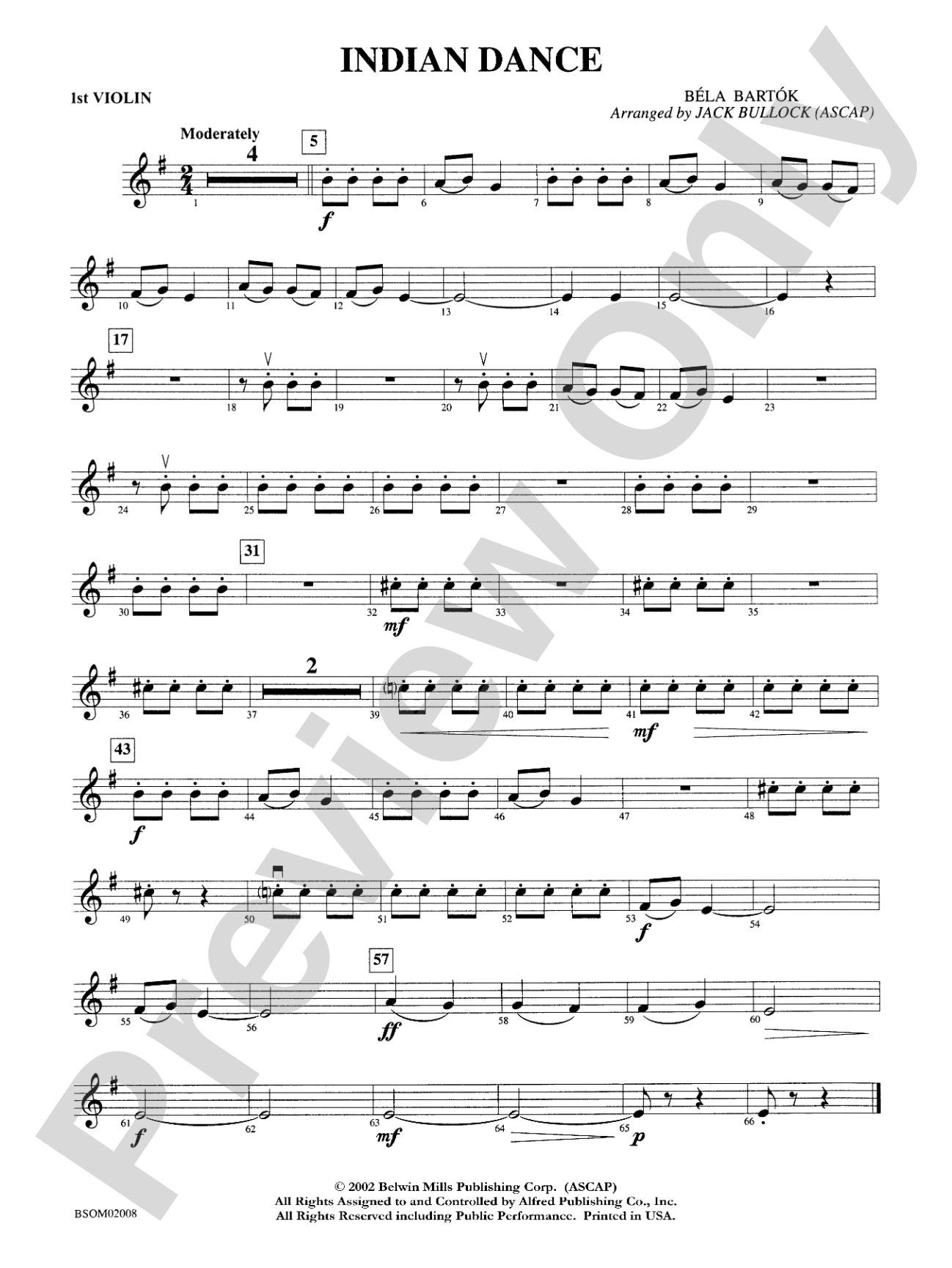
Indian Dance: 1st Violin Sheet Music Preview

Indian Dance: 1st Violin

By Béla Bartók / arr. Jack Bullock

Grade: 1

Item: 00-PC-0002273_VN1

Digital Download
$5.99
Description
Béla Bartók for beginning strings! All the parts are reinforced in the piano accompaniment guaranteeing a superb presentation. Fine opportunities exist to develop outstanding characteristic tone qualities at the earliest level of instruction with this Jack Bullock arrangement. Great for teaching and performance. (1:11) This title is available in MakeMusic Cloud.

Don't just read it, hear it, play along with it, and watch your students grow with it. In MakeMusic Cloud, Indian Dance: 1st Violin comes alive with professional accompaniment, adjustable tempo, and built-in practice tools that turn solo practice into real progress.

Sample Audio
No sample audio found.
Sample Video
Additional Details
Series: Belwin Beginning String Orchestra
Publisher: Alfred Music
Page Count: 32
SKU: 00-PC-0002273_VN1

More about this title

About the Composer: Béla Bartók

Béla Bartók transformed folk music into sophisticated concert works that shaped 20th-century classical composition. His tireless collection and study of Eastern European folk traditions gave him access to authentic melodic and rhythmic materials that he wove into his own musical language, creating works that sound both ancient and modern simultaneously.

Bartók believed deeply in music education and composed deliberately for young musicians. His pedagogical works demonstrate that accessibility and artistic integrity are not opposing forces; a piece written for beginners can still carry the stamp of a major composer's voice and vision.

Why we love this

Grade 1 orchestras rarely get music of real substance, and this Bartók arrangement shatters that expectation. Jack Bullock's scoring ensures that no section feels like it's carrying padding; every part matters because the piano continuously reinforces the string writing, which means even your first-year violins know exactly what they're aiming for. The characteristic tone work grows organically from the melodic material itself rather than from artificial exercises.

What to expect

Energetic and rooted, with the warmth of folk melody underlying rhythmic vitality. The orchestration captures the earthy, celebratory spirit of a traditional dance while maintaining the sophisticated harmonic language that makes Bartók unmistakably Bartók.

Who it's for

Beginning string orchestras that need repertoire with real musical substance. This works equally well for concert performances and festival competitions, and it opens doors for interdisciplinary projects with dance programs or cultural studies courses.

How to get the most out of it

  • Let the dance rhythms breathe naturally rather than metronomically. Bartók's folk-inspired material invites subtle rhythmic flexibility, especially in the melodic phrases.
  • Use the opening sections to establish rich, warm string tone before adding dynamic shape. The foundation you build here pays dividends in the more elaborate passages ahead.
  • Balance the strings against the piano accompaniment so that dancers (if you're using this for choreography) can hear the pulse clearly without the ensemble drowning it out.
  • Shape the characteristic melodic contours with bow control rather than sudden dynamic changes. Grade 1 players often confuse volume with expression.

How to use it

Position this as a centerpiece on a concert where you're introducing your youngest orchestra to repertoire beyond method books. The 1:11 duration fits naturally into mixed-level programs, and it pairs well with other 20th-century works that explore cultural music traditions.

Skills your students will build

  • Identifying and performing folk-derived melodic contours
  • Building characteristic tone in an ensemble setting
  • Responding to rhythmic subtlety within a steady pulse
  • Reading and balancing with piano accompaniment
  • Sustaining musical phrasing across changes in dynamic and texture

You May Also Like