
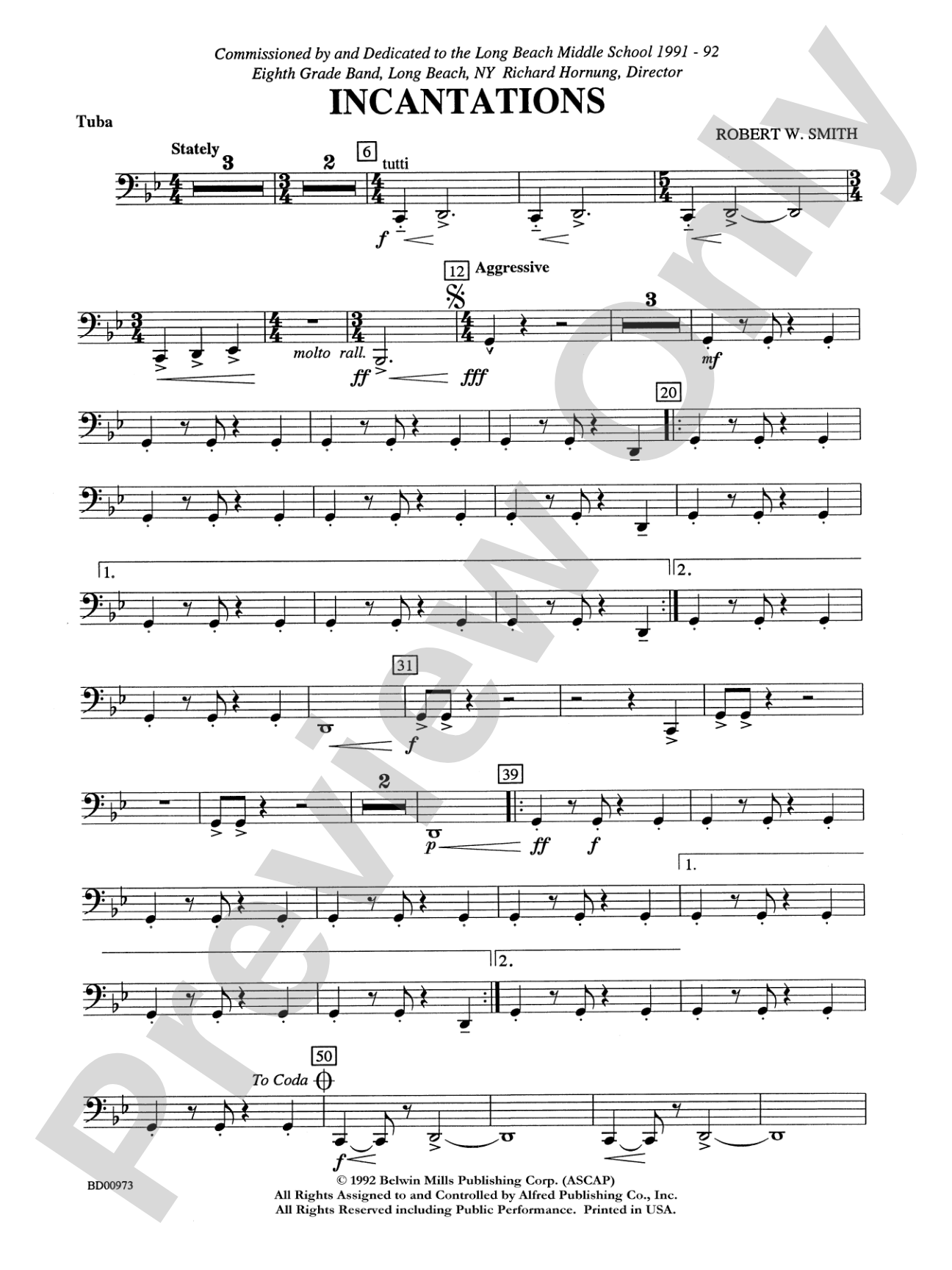

Incantations: Tuba
By Robert W. Smith
Grade: 3 (Medium Easy)
Item: 00-PC-0001987_TB1
$3.00
Pickup currently not available
Description
Rhythmic and exciting contemporary writing for concert band. The inner drive topped with great splashes of color will identify the bold strokes of composer Robert W. Smith. The images are sharp and intense. The drive is non stop. Highly recommended! (5:23)


Don't just read it, hear it, play along with it, and watch your students grow with it. In MakeMusic Cloud, Incantations: Tuba comes alive with professional accompaniment, adjustable tempo, and built-in practice tools that turn solo practice into real progress.
Open in the Player
Jump straight in and assign it today.
Start Your Free Trial
Open this title and explore the full library in minutes.
Sample Audio
1
Audio File
--:--
0:00
0:00
Sample Video
Additional Details
Series:
Belwin Concert Band
Publisher:
Alfred Music
Page Count:
90
SKU:
00-PC-0001987_TB1
More about this title
About the Composer: Robert W. Smith

Robert W. Smith stands among America's most frequently performed composers for concert band and orchestra, with over 400 published works distributed primarily through Alfred Music. He earned his Bachelor of Music Education from Troy State University in Alabama and a Master of Music from the University of Miami, establishing himself early as a voice for both developing and advanced ensembles.
Smith's original compositions, including his symphonies The Divine Comedy and The Odyssey, have been performed across North America, Europe, Australia, and Asia. Beyond the concert hall, his music has appeared on major television broadcasts, from the opening of the Macy's Thanksgiving Day Parade to Olympic Games coverage, presidential ceremonies in Japan, and Opening Day at Dodger Stadium. As a guest conductor and clinician, he has worked extensively throughout the United States, Canada, Japan, Australia, and Europe.
Why we love this
Smith knows exactly how to build momentum in a Grade 3 ensemble without sacrificing sophistication. Incantations delivers relentless forward motion paired with vivid orchestration that gives every section meaningful material, making it equally satisfying for players and audiences. The contemporary idiom and festival designation make it a smart choice for both contest preparation and concert programming where you want energy that lands.
What to expect
Incantations wraps relentless rhythmic drive in a cloak of bold, colorful orchestration. The piece propels forward with sharp, intense images that unfold without pause, creating a sense of momentum and urgency that feels both contemporary and visceral. It is music built on perpetual motion, layered with splashes of color that make the familiar feel fresh.
Who it's for
Band directors looking for contemporary repertoire that energizes a Grade 3 ensemble while remaining accessible to developing musicians. This work appeals to conductors who want vibrant, modern writing that doesn't demand virtuosic technical facility but does reward solid fundamentals and committed ensemble work.
How to get the most out of it
- Establish the pulse early and protect it fiercely. The piece's propulsive quality depends on absolute rhythmic clarity from the front ensemble; even small hesitations will derail the drive.
- Balance the instrumental colors with intention. Smith layers textures densely, so identify which voices carry the melodic narrative at each moment and ensure they cut through the accompaniment without the ensemble losing cohesion.
- Shape the dynamic swells as architectural moments, not just volume changes. Each crescendo builds toward specific harmonic or textural shifts; conducting them as single gestures keeps the ensemble unified and the forward momentum intact.
- Prepare the percussion section to anchor the rhythmic vitality. Their precision directly impacts how sharp and intense the images feel; rehearse them as a functional unit early and often.
How to use it
Program this as a festival submission or contest entry where contemporary, high-energy work strengthens your competitive portfolio. On a concert, it pairs effectively with lyrical or slower material to provide contrast and excitement, or it can anchor a program of modern band repertoire showcasing your ensemble's range and musicality.
Skills your students will build
- Maintaining consistent rhythmic pulse under complex layered textures
- Reading and executing contemporary harmonic language
- Balancing sustained tones and accompaniment figures
- Responding to rapid dynamic and textural shifts
- Building sectional independence within ensemble cohesion