
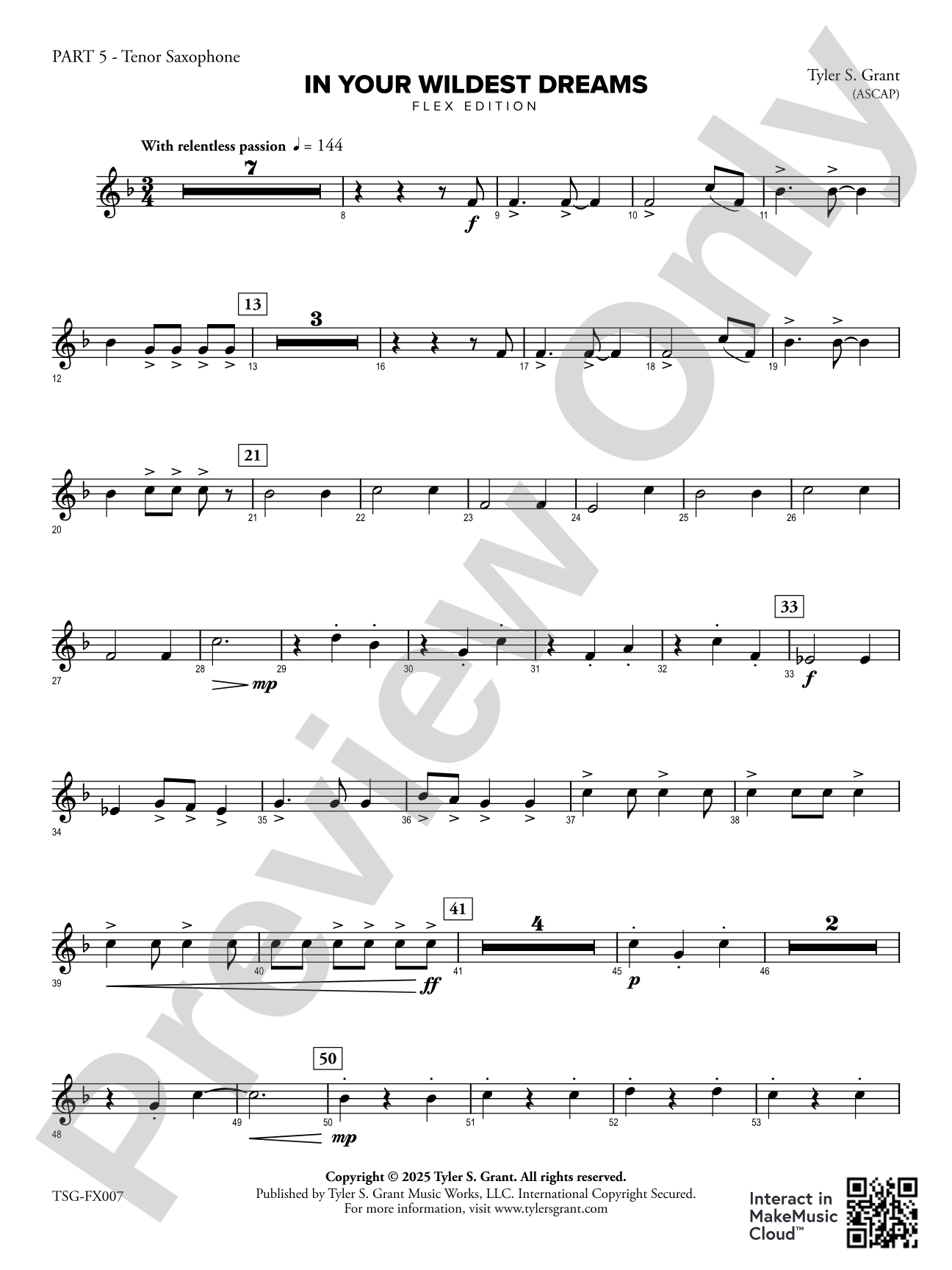

In Your Wildest Dreams: Part 5 - Tenor Saxophone (B-flat)
Flex Version
By Tyler S. Grant
Grade: 3
Item: 98-PC-TGFX007_PART5_TX
$4.50
Pickup currently not available
Description
Bring your students' dreams to life in this explosion of colorful energy! In Your Wildest Dreams by Tyler S. Grant sends the message that "any dream is possible." The themes will be memorable to both students and audiences alike, with plenty of opportunities for everyone to be in the spotlight. Suitable for any occasion and highly inspiring! (2:00)


In Your Wildest Dreams: Part 5 - Tenor Saxophone (B-flat) isn't in MakeMusic Cloud just yet...but it could be. Let us know you'd like to see it, and you'll help shape what comes next. In the meantime, start a free trial and dive into thousands of interactive titles your students can play along with today.
Request This Title
Tell us you want it.
Start Your Free Trial
Explore everything that's ready to play right now.
Sample Audio
1
Audio File
--:--
0:00
0:00
Sample Video
No sample videos found.
Additional Details
Series:
FLEX Editions
Publisher:
Tyler S. Grant Music Works, LLC.
SKU:
98-PC-TGFX007_PART5_TX
More about this title
About the Composer: Tyler S. Grant

Tyler S. Grant has built a reputation as a composer and arranger whose works appear regularly on honor ensemble programs across the country and internationally. His music has earned recognition including a 2014 Dallas Wind Symphony Fanfare Competition win, and his pieces receive annual selections for prestigious repertoire lists worldwide. His compositions are standard fare at major venues including The Midwest Clinic, Carnegie Hall, and Music for All's National Concert Band Festival.
Beyond the page, Grant maintains an active conducting and clinching schedule, having worked with over 100 school programs across 15+ states. He studied instrumental music education and conducting at the University of Alabama under Professor Randall Coleman, and credits composer Brian Balmages as instrumental to his development. Since 2010, he has produced new commissions and publications annually while contributing to Alfred Music's educational series and various music education publications.
Why we love this
Grant writes with the instinct of a clinician who understands exactly what mid-level bands need: accessible writing that doesn't talk down, built-in moments for section spotlights without becoming a showcase medley, and the kind of memorable melodic material that sticks with students long after the season ends. This is the rare Grade 3 that works equally well as an opener at a festival or as a feel-good concert finale, which makes programming decisions easier.
What to expect
Bright, optimistic, and genuinely joyful without veering into novelty. The melodic hooks are strong enough that audiences will hum along, and the harmonic palette stays colorful without becoming chaotic. There's real momentum here, driven by clear phrasing and a forward-moving harmonic rhythm that keeps the band engaged.
Who it's for
Grade 3 concert bands preparing for festivals, assembly performances, or end-of-year concerts will find this piece both rewarding and achievable. The flexible instrumentation means you can perform with exactly the players you have, without cuts or rewrites. It works equally well for programs building confidence and musicianship as for groups with solid fundamentals looking for repertoire with personality.
How to get the most out of it
- Balance the opening statement between your lead voices and inner parts; the energy comes from the full texture, not from trying to blast the opening theme.
- Keep tempo relationships consistent between sections so transitions feel inevitable rather than abrupt.
- Allow your students who get spotlight moments to really own them without over-conducting those passages; the piece is designed for them to shine independently.
- Record a full rehearsal run-through before your first performance to identify tuning trouble spots, particularly in the thicker harmonic sections.
How to use it
Open your concert with this and you've immediately signaled to the audience that something good is coming. Its two-minute duration makes it perfect for festival competition if you're short on time, or as a companion to a more substantial second work. Schools often program it as the finale of a concert to leave the audience with the uplifting message the title promises.
Skills your students will build
- Balancing sonority across full ensemble texture
- Executing clean section-to-section transitions
- Building confidence with exposed solo and small-group passages
- Sustaining accurate intonation in block harmonic sections
- Reading and executing flexible instrumentation voicings