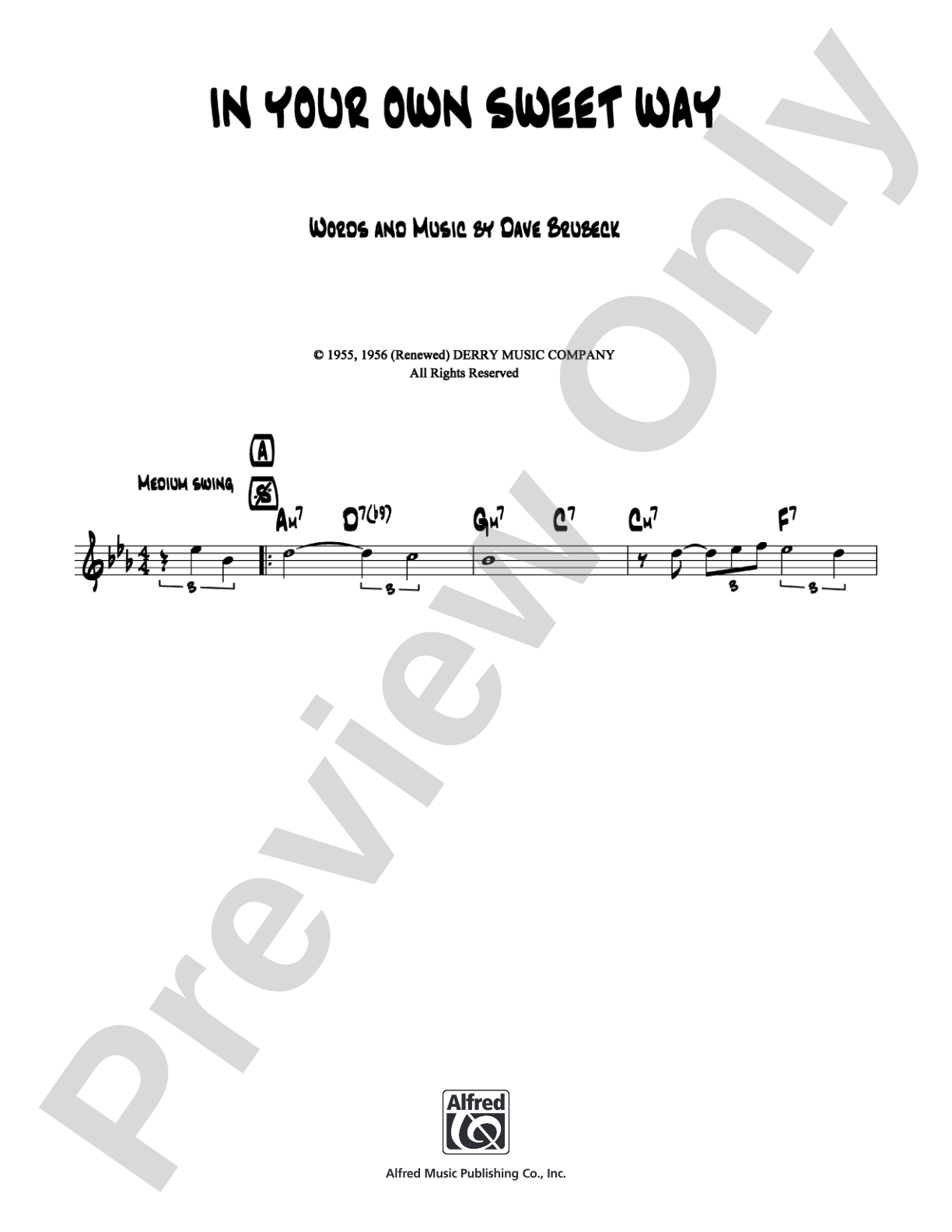
In Your Own Sweet Way: Lead Sheet Digital Sheet Music

In Your Own Sweet Way: Lead Sheet Digital Sheet Music

Dave Brubeck

Item: 00-PS-0007600

Digital Download
$1.99
Description

In Your Own Sweet Way: Lead Sheet Digital Sheet Music isn't in MakeMusic Cloud just yet...but it could be. Let us know you'd like to see it, and you'll help shape what comes next. In the meantime, start a free trial and dive into thousands of interactive titles your students can play along with today.

Sample Audio
No sample audio found.
Sample Video
Additional Details
SKU: 00-PS-0007600

More about this title

About the Artist: Dave Brubeck

Dave Brubeck

Dave Brubeck built his reputation as a jazz pianist through improvisation, but his compositional reach extended far beyond the jazz idiom. He wrote choral works, hymns, orchestral pieces, chamber music, ballets, string quartets, and large-scale works for chorus and orchestra, all while maintaining his identity as a bandleader and recording artist. His study with French composer Darius Milhaud at Mills College after World War II shaped his approach to blending jazz language with classical forms, a philosophy that informed everything from his early orchestral piece Elementals (1962) to his sacred works performed worldwide.

Brubeck's cultural impact matched his musical innovation. He broke racial barriers as a performing artist in the mid-20th century and received recognition including the Presidential Medal of the Arts from President Clinton, a Grammy Lifetime Achievement Award, and induction into the American Classical Music Hall of Fame in 2003. His album Time Out became the first jazz recording to sell over a million copies, introducing millions to the possibilities of jazz composition and improvisation.

Why we love this

Brubeck's lead sheets sit at the intersection of jazz sophistication and genuine melodic appeal, making them ideal for musicians developing improvisation skills without sacrificing musicianship. The harmonic language here is modern enough to challenge players accustomed to standards, yet the melodies remain singable and memorable, a rare combination that keeps students engaged during both study and performance.

What to expect

The melody moves with understated sophistication, unfolding naturally over harmonies that support without overwhelming. There's a quality of restraint here, a confidence that a beautiful idea need not shout to be heard. Playing or singing it feels like having a conversation with someone who listens as much as they speak.

Who it's for

Jazz improvising musicians at the intermediate level and above will find this lead sheet essential for learning the tune and building solo ideas. It also serves arrangers, composers, and bandleaders looking to understand Brubeck's approach to melodic and harmonic construction. Educators introducing small-group jazz or big-band rehearsals will appreciate having a clear lead sheet to distribute for sight-in and sectional work.

How to get the most out of it

  • Study the harmonic progression before improvising; Brubeck's chord changes often move with purpose and logic that rewards close listening.
  • Anchor the melody's phrasing in the lyrical quality of the original recording; this piece speaks through its elegance, not flash.
  • Let silence breathe between phrases; Brubeck's compositional thinking values space as much as sound.
  • Build improvisations that respond to the melody's contour rather than ignore it; the best solos on this tune honor its shape.

How to use it

Use this as the foundation for a jazz combo performance or as part of a unit on jazz composition and arrangement. It works well in a program exploring Brubeck's legacy, paired with recordings of the original and student interpretations. This tune also serves teaching purposes in small-group rehearsals, where students can practice reading chord symbols, responding to comping, and developing improvisation strategies in a real musical context.

Skills your students will build

  • Reading and interpreting lead sheet notation and chord symbols
  • Jazz phrasing and articulation at a conversational tempo
  • Improvising melodies that respond to and build on the written tune
  • Understanding harmonic movement and voice leading
  • Transcribing and internalizing a jazz standard through active performance

You May Also Like