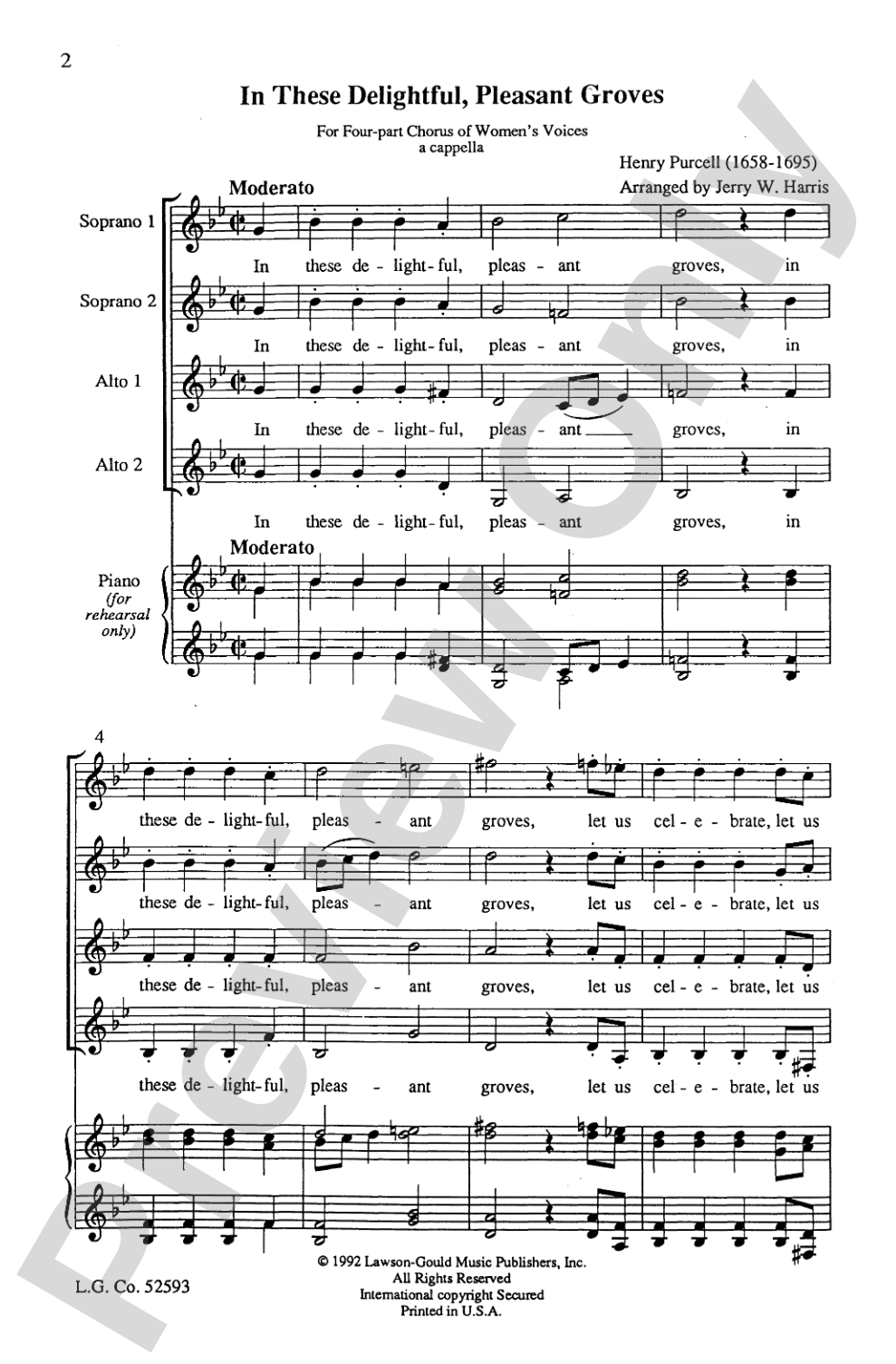
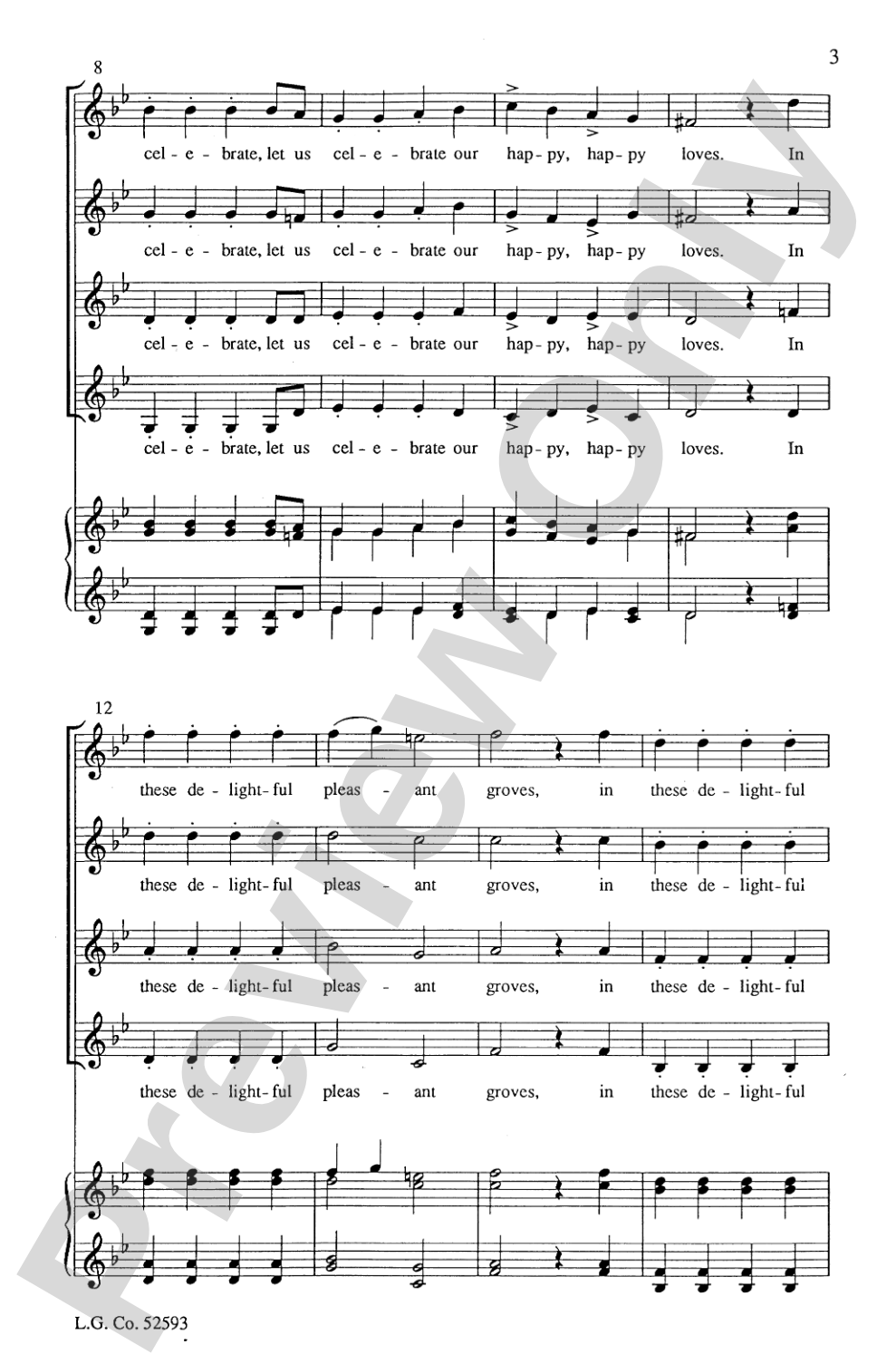
In These Delightful Pleasant Groves Sheet Music Preview

In These Delightful Pleasant Groves: SSAA Choral Octavo

By Henry Purcell / arr. Jerry Weseley Harris

Item: 00-PO-0005075

Digital Download
$2.25

Minimum order quantity: 20 copies

Description

In These Delightful Pleasant Groves: SSAA Choral Octavo isn't in MakeMusic Cloud just yet...but it could be. Let us know you'd like to see it, and you'll help shape what comes next. In the meantime, start a free trial and dive into thousands of interactive titles your students can play along with today.

Sample Audio
No sample audio found.
Sample Video
Additional Details
Series: Alfred Archive Edition: Lawson-Gould Music Publishers
Publisher: Alfred Music
Page Count: 8
SKU: 00-PO-0005075

More about this title

About the Composer: Henry Purcell

Henry Purcell (1659-1695) stands as England's greatest Baroque composer and a towering figure in the history of English music. His career spanned the Restoration court under Charles II and James II, where he served as organist, composer, and master of the King's Music. Purcell's genius lay in his ability to fuse Italian and French musical idioms with distinctly English sensibilities, creating works of remarkable expressiveness and harmonic sophistication.

Purcell composed across virtually every genre available to him: vocal music, instrumental works, chamber pieces, and dramatic scores. His vocal writing, in particular, reveals his deep understanding of the English language and its natural prosody. Even his secular vocal works display the structural integrity and emotional depth that distinguished him from his contemporaries. His influence on English music extended well beyond his lifetime and continues to shape choral repertoire today.

Why we love this

This arrangement captures the crystalline beauty of Purcell's writing while remaining eminently singable for intermediate treble choirs. Jerry Weseley Harris has preserved the harmonic integrity and melodic contours of the original while creating parts that lie naturally for high voices, making it an ideal choice for singers who want authentic Baroque repertoire without excessive technical demands. The piece works beautifully as a contest selection or festival offering, and its elegant simplicity appeals to audiences while challenging singers to achieve clarity and blend.

What to expect

This is music of refined grace and gentle charm. Purcell's language glides across elegant harmonic progressions, creating moments of quiet luminosity without ever sacrificing musical substance. The piece breathes with the ease of conversation set to music, inviting singers and listeners into its world of courtly pleasantness.

Who it's for

This octavo suits intermediate to advanced treble choirs seeking authentic Baroque repertoire with accessible but sophisticated writing. It works equally well for competitive festival singers and programs looking to expand their choral literature beyond standard contemporary fare.

How to get the most out of it

  • Shape phrases with a light, forward attack. Baroque vocal lines need buoyancy rather than the sustained intensity of later eras; think of the text propelling the melody forward across the bar line.
  • Balance the SSAA voicing by ensuring second sopranos don't overshadow altos. The inner voices carry important harmonic movement that shouldn't be masked by the top line.
  • Articulate consonants cleanly without separating them from vowels. English text in Baroque music benefits from precise but connected diction that supports the musical line.
  • Use the recorded accompaniment as a reference for tempo and phrasing, but train the choir to hear and lock the inner parts as independent melodic lines rather than mere harmony.

How to use it

Program this as a contrast to heavier contemporary work, or pair it with other Baroque sacred or secular pieces to create a historically informed concert segment. Its modest length and elegant character make it perfect for festival competitions or as a refined opener or closer for a formal concert.

Skills your students will build

  • Reading and performing Baroque-era harmonic progressions and cadence structures
  • Balancing independence of melodic lines within close four-part writing
  • Shaping phrase contours with period-appropriate diction and articulation
  • Understanding text expression in English Baroque vocal music

You May Also Like