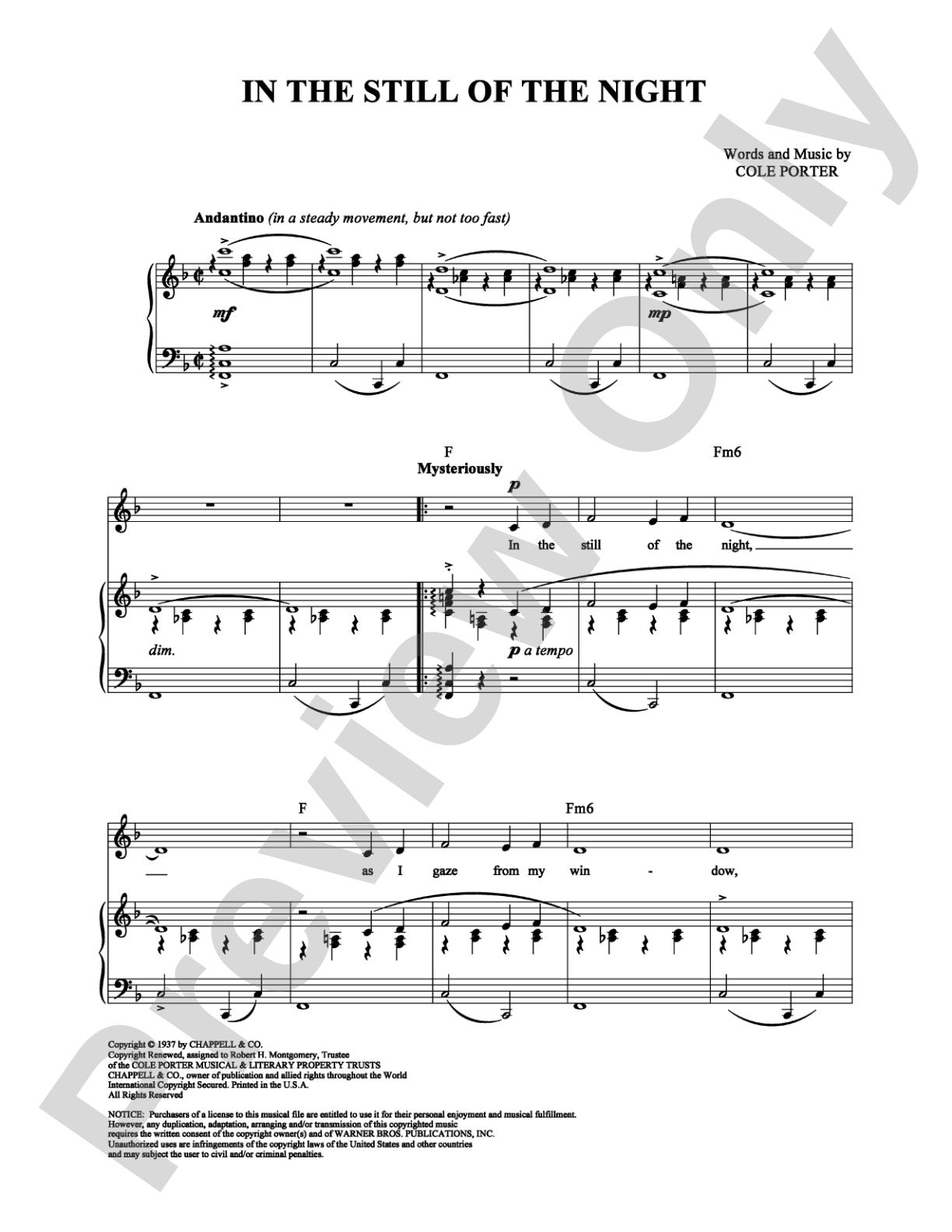
In The Still Of The Night: Piano/Vocal/Chords Digital Sheet Music

In The Still Of The Night: Piano/Vocal/Chords Digital Sheet Music

Cole Porter, Frank Sinatra

Item: 00-PS-0004526

Digital Download
$3.99
Description

In The Still Of The Night: Piano/Vocal/Chords Digital Sheet Music isn't in MakeMusic Cloud just yet...but it could be. Let us know you'd like to see it, and you'll help shape what comes next. In the meantime, start a free trial and dive into thousands of interactive titles your students can play along with today.

Sample Audio
No sample audio found.
Sample Video
Additional Details
SKU: 00-PS-0004526

More about this title

About the Artist: Frank Sinatra

Frank Sinatra (1915-1998) shaped American popular song through his phrasing, breath control, and interpretive depth. His recordings established the standard for how jazz standards should be sung and accompanied, influencing generations of vocalists and pianists who study his choices in rubato, dynamics, and lyrical storytelling.

For music educators, Sinatra's catalog offers masterclasses in vocal line and harmonic sophistication. His interpretations of Cole Porter, Richard Rodgers, and other Great American Songbook composers demonstrate how a singer navigates complex chord changes while maintaining emotional transparency. His work remains essential listening for anyone teaching jazz standards or popular song interpretation.

Why we love this

This standard arrives with the harmonic framework and vocal melody that defined mid-century popular song. The piano/vocal/chords format gives students and teachers immediate access to the changes, allowing singers to understand how voice and accompaniment interact across one of the Great American Songbook's most enduring ballads.

What to expect

Midnight clarity. The melody unfolds with tender restraint over gently shifting harmonies, creating a space where each phrase feels both inevitable and fragile. This is a ballad that asks singers to find intimacy within simplicity, and pianists to support that vulnerability without overwhelming it.

Who it's for

Singers developing jazz standard repertoire and voice students learning to navigate swing-era popular song. Pianists accompanying vocalists or studying the harmonic language of the American Songbook will find the chord notation essential for understanding substitutions and voicing choices.

How to get the most out of it

  • Shape the vocal line through sustained legato rather than rhythmic precision; the written melody is a foundation for expressive phrasing and strategic breath placement.
  • Listen to Sinatra's original recording to internalize the harmonic ambiguity and gentle rubato in the middle section; this informs how much flexibility the piano can support.
  • Accompany with a light touch in the lower register and restrained voicings in the right hand. The standard's intimacy depends on space between singer and pianist.
  • Treat the chords as guides, not prescriptions. Jazz pianists often reharmonize or substitute voicings; encourage students to listen to multiple recorded versions before settling on their own approach.

How to use it

Pair this with other Sinatra standards or Great American Songbook selections for a jazz vocal recital or cabaret program. It works equally well as a study score for jazz history classes or vocal pedagogy courses exploring mid-century interpretation and phrasing conventions.

Skills your students will build

  • Legato vocal line and breath management across long phrases
  • Reading lead-sheet chord notation and recognizing jazz voicing conventions
  • Interpreting harmonic movement through sung melodic shapes
  • Piano accompaniment for ballads with rubato and dynamic restraint
  • Coordination between vocal phrasing and harmonic progression

You May Also Like