
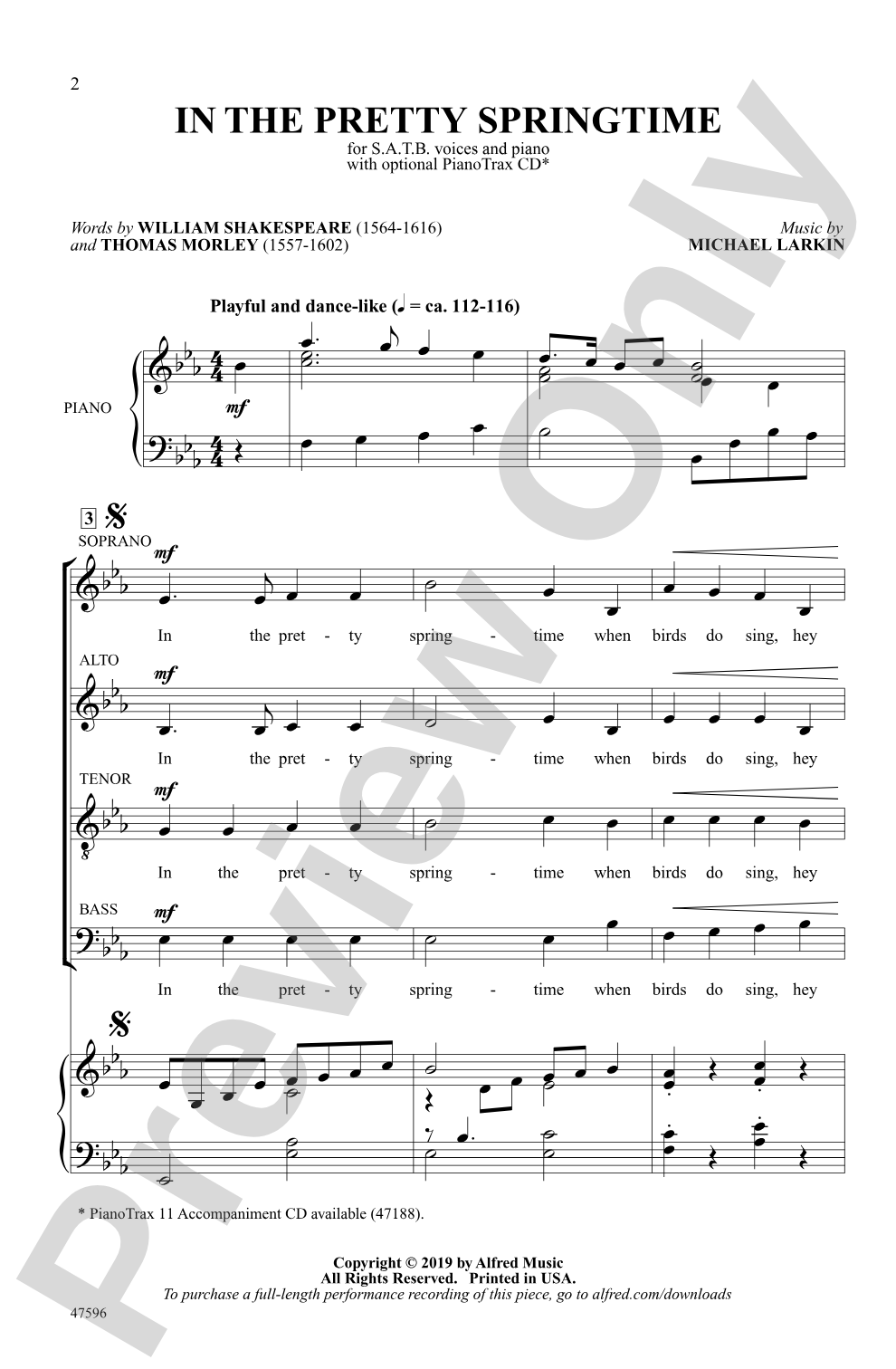
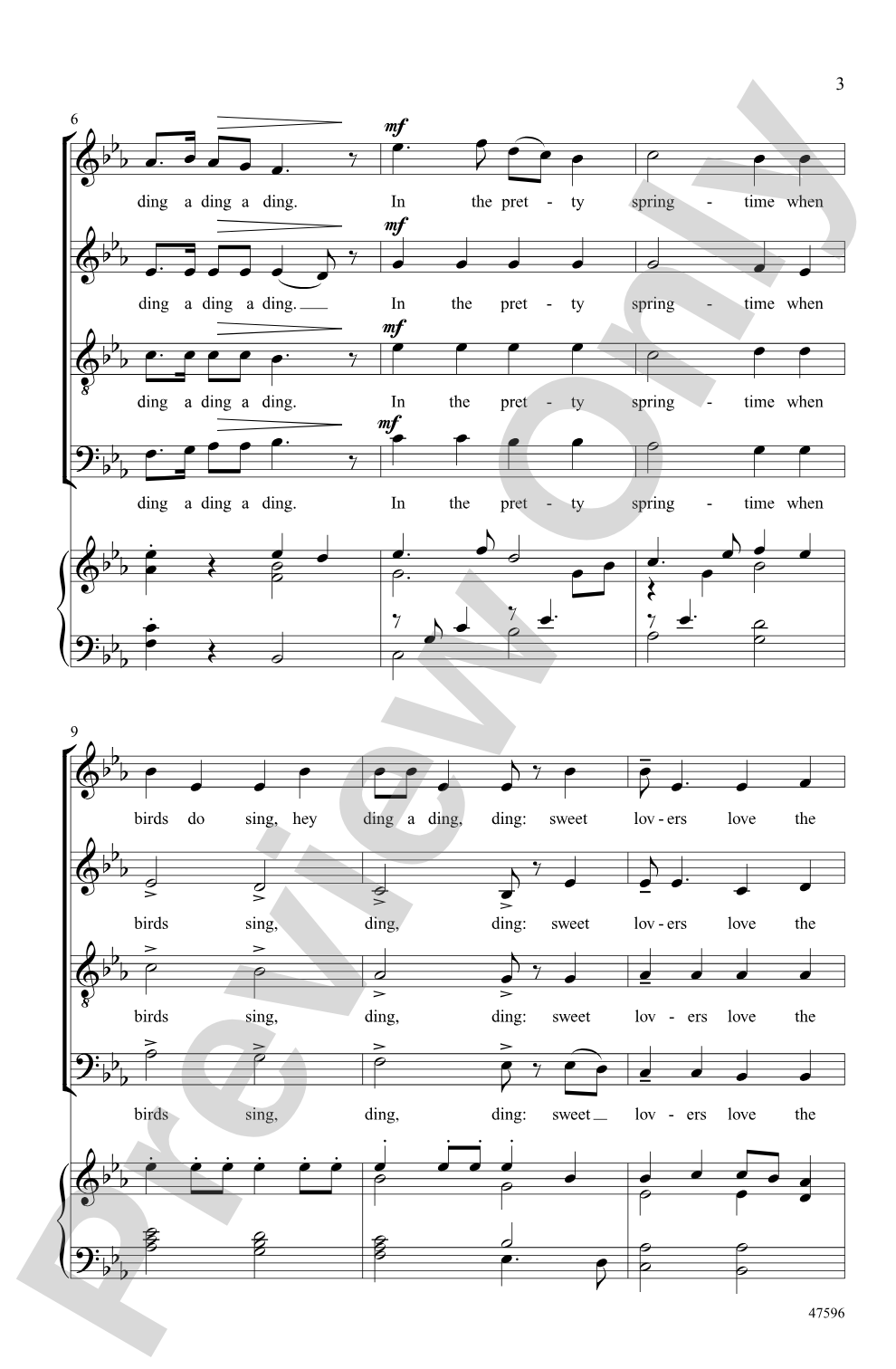
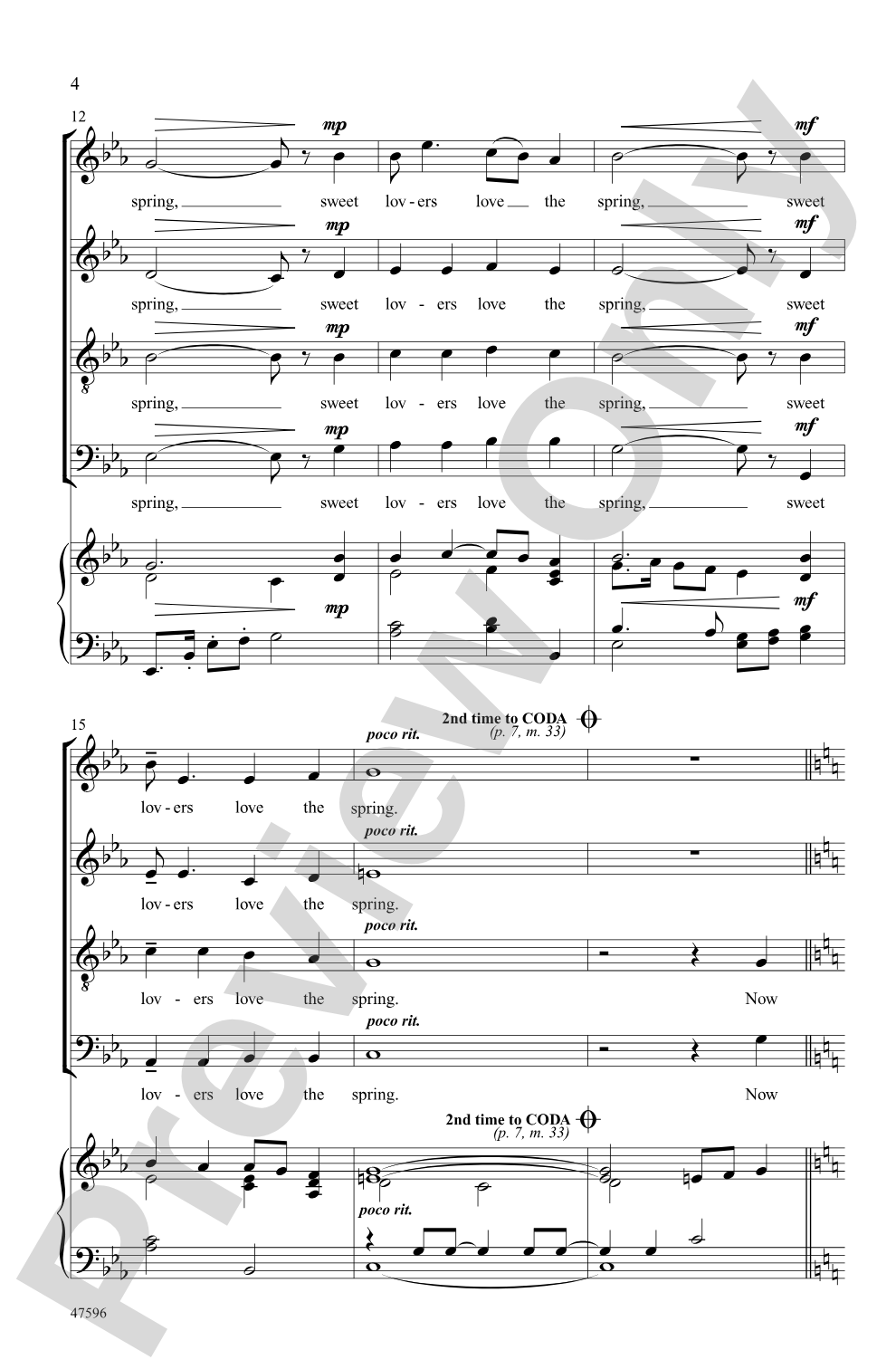

In the Pretty Springtime: SATB Choral Octavo
Words by William Shakespeare and Thomas Morley, music by Michael Larkin
Item: 00-PO-0005953
$2.05
Minimum order quantity: 20 copies
Pickup currently not available
Related Items
In the Pretty Springtime: SATB Choral Octavo |
$2.05
|
View |
Description
Featuring text by William Shakespeare and references to Thomas Morley's madrigal “Now Is the Month of Maying,” this playful contemporary choral celebrates young love with sparkling vocal counterpoint. A satisfying yet supportive piano part and some delightful vocal interplay provide many moments of challenge and interest. Fitting for concert or contest.


In the Pretty Springtime: SATB Choral Octavo isn't in MakeMusic Cloud just yet...but it could be. Let us know you'd like to see it, and you'll help shape what comes next. In the meantime, start a free trial and dive into thousands of interactive titles your students can play along with today.
Request This Title
Tell us you want it.
Start Your Free Trial
Explore everything that's ready to play right now.
Sample Audio
1
Audio File
--:--
0:00
0:00
Sample Video
Additional Details
Series:
Alfred Choral Designs
Publisher:
Alfred Music
Page Count:
12
SKU:
00-PO-0005953
More about this title
About the Composer: Michael Larkin

Michael Larkin shaped choral music in the Mid-Atlantic region for nearly three decades as chair of the Vocal/Choral Department at the Music School of Delaware, where he also maintained a distinguished teaching studio. Beyond his academic leadership, he founded and directs the New Ark Chorale, one of the region's most respected ensembles, conducts the Brandywine Pops Orchestra, and serves as Director of Music Ministry at St. Barnabas Episcopal Church in Wilmington. His prolific output includes over 300 works for choral, vocal, piano, and orchestral forces published by the nation's major music houses, and his expertise is sought regularly as a guest conductor, festival clinician, and adjudicator across the country.
Why we love this
Larkin channels the spirit of Renaissance madrigals through a contemporary harmonic lens, creating something that feels both theatrical and genuinely singable. The vocal writing sparkles with counterpoint without sacrificing the clarity your singers need to feel confident, and the Shakespeare text paired with echoes of Morley's "Now Is the Month of Maying" gives directors a piece with real literary substance and historical resonance.
What to expect
The piece dances with youthful energy and wit, balancing sprightly vocal exchanges with moments of tenderness. Its Shakespearean text about springtime and love, layered over harmonic language that nods to the madrigal tradition, creates an atmosphere of elegance and charm that feels both timeless and playfully irreverent.
Who it's for
This piece suits intermediate to advanced choral programs that have developed strong ensemble blend and can handle independent voice lines. Whether you're preparing for a spring concert or contest, singers will find the madrigal style engaging and the moderate demands manageable with focused rehearsal.
How to get the most out of it
- Bring out the text with clarity; the interplay between voice parts carries meaning, so shape phrases according to the poetry rather than purely musical phrasing.
- Balance the soprano line when it carries the primary melody, but ensure lower voices are heard during their contrapuntal moments so the texture reads clearly.
- Use the recorded accompaniment to lock ensemble coordination during rehearsal, then work toward independence so singers can breathe naturally and respond to the text together.
How to use it
Program this as a centerpiece for a thematic concert celebrating literature, Renaissance influences, or the season of renewal. It pairs well alongside other secular madrigals or contemporary character pieces, and works equally effectively in a festival setting where its sophistication and accessibility will impress both audience and adjudicators.
Skills your students will build
- Independent voice leading within SATB texture
- Madrigal style and historical awareness of secular vocal music
- Text-driven phrasing and dramatic interpretation
- Ensemble balance when multiple melodic lines compete for prominence
- Coordination with piano accompaniment while maintaining vocal independence